
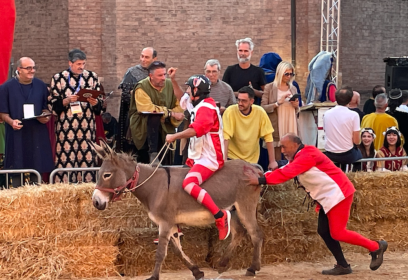
When I saw that there was a donkey palio in Alba, Italy, I knew I had to go. What could be more fun than being in Italy, eating pasta and gelato and watching Italian donkeys – which are just as stubborn as donkeys of any other nationality – race around the cathedral in the center of town?

But First, the Palio
The Italians have a special kind of race called a palio. It’s called a palio because the banner that is presented to the winner is also called a palio. These races are usually run in a circular area in the city centers, and they are usually horse races. The most famous one is in Sienna, but there are horse palios all over the country.
They’re usually accompanied by historical reenactments and district rivalry. The different districts of the city put on their best historical costumes, march in parades, play music, and throw flags. Then, of course, there is the horse race – or in this case the donkey race.
These palios are held at different times throughout the year to celebrate special occasions, such as saint’s days or to commemorate some historical event.

Alba’s Donkey Palio
While Sienna’s horse palio is the most famous, Alba’s donkey palio might just be the most fun. It’s accompanied by all the same serious historical festivities of a regular palio. On Saturday afternoon, the day before the race, there is a parade. Then that evening there is a show about the history of Alba. It’s in Italian, so if your Italian isn’t strong, you might have a hard time following it, but it’s enjoyable to watch even if you don’t know what’s going on.
Each district chooses one of their own to be their rider in this tongue-in-cheek palio. They are decked out in their best colorful historic costumes. But instead of climbing onto majestic steeds, they hop atop their donkeys to race around the cathedral.

But first each rider must be assigned their mount. Each donkey has a number painted on its hindquarters. These numbers are drawn at random as each district is announced. The riders have no saddle and no bridle, just a halter to steer their steeds.
Up until the start of the race, you would think that this celebration is a serious event: some solemn celebration of historical importance… Then the donkeys come out.
Donkeys don’t seem naturally inclined to race. They’re known for doing things their own way, and the palio donkeys are no different.
First the donkeys are lined up (as much as donkeys can be lined up) in front of a chalk line on the ground with a rope stretched across at chest height to keep back those who are raring to go. When the starting bell rings, some donkeys take off around the track, but others turn around and go the wrong way. Still others just aren’t into racing and decide to stand and look at the spectators or the judges – maybe looking for sympathy points.


What’s a Rider to Do?
There’s not much they can do, really. If a donkey doesn’t want to go, the rider might get off and try to pull them, or go behind them and push. But basically, if Donkey doesn’t want to go, Donkey isn’t going.
To cross the finish line, the rider must be on the donkey. One of the stragglers pulled their donkey up to the finish line then hopped on and yelled ‘Let’s go’ (or the Italian version of that) but the donkey just stood there. Only inches from the finish line, but it had no interest in crossing it. The rider urged it on by rocking back and forth, the donkey didn’t move. The rider got off and talked to the donkey. The donkey wasn’t interested and didn’t budge. The rider got back on dropped his head into his hands in a hopeless motion. Nope – not going anywhere. Then it seemed as though the donkey looked down and noticed the chalk line on the ground and just stepped over it. He didn’t win.


Why Oh Why Donkeys?
Watching the donkeys “race” is fun and it’s good for a laugh, but you have to wonder why the good people of Alba decided to race an animal so seemingly unsuited to the task.
Well, it all started in the 1200s, when Alba was in a long-standing feud with the neighboring city of Asti.
It was August 10, 1275, and It was the feast day of Alba’s patron saint, San Lorenzo. Asti decided that it would be an insult to Alba to attack them on their saint’s day – so that’s what they did. They attacked the Monastery of San Frontiniano located just south of the city and destroyed their vineyards and fruit trees. Then to add insult to injury, they held a palio in celebration, running their horses in front of the city gate.
The people of Alba were not amused. They said, “Those silly Astians (people from Asti). All they did was defeat a little group of monks and take a monastery. They didn’t even get into our city and now they are doing victory laps like a bunch of asses,” (or something like that).
Even in those days, people who were ignorant and foolish were called asses. So the city leaders decided to have their own palio to mock the Astians. And the perfect animal to represent their rivals was the donkey. And that’s how Alba’s donkey palio began.


I don’t know how long Alba’s donkey palio continued, or if it was a one off in 1275, but at some point, it stopped. Then in 1932 it was revived – then it stopped again during the Second World War. With peace time the donkey race restarted and has been going strong ever since. It’s now held the first Sunday in October.
You can find out more about Alba’s donkey palio (palio degli asini) here
And just a week later, the white truffle fair begins in Alba. There are truffle events every weekend for 9 weekends. If you like things that are a bit out of the ordinary, a donkey race and a truffle fair might be for you. Info on the truffle fair can be found on the same website as the palio above.
What do you think? Let me know in the comments section below. And if you want to read more of my curious histories, subscribe to my blog (at the top or bottom of this page).
Follow Me on Social Media:


- Did Michelangelo Carve This Face in Florence? The Palazzo Vecchio Mystery – 17 March 2026
- 5 Curious Easter Traditions: Rabbits, Bells, Exploding Carts, and More – 16 March 2026
- Ten Wow-Worthy Women Who Changed History – 5 March 2026




COMMENT HERE: Can't wait to hear what you think… (email not required)