
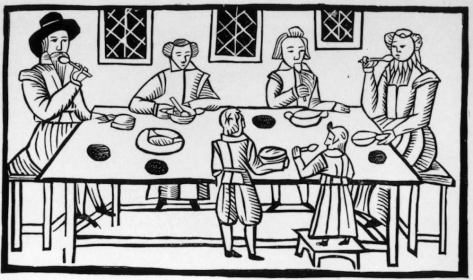
Today Christmas is a major time of festivity in England and America, but for 18 years during the 17th century, people were not allowed to celebrate it. The Puritans came in and booted out the festive holiday.
Charles I and Christmas
Charles I sat on the English throne from 1625 to 1649. During the early years of his reign, Christmas was a jolly time of year. It was a religious holiday as well as a secular one.
It was celebrated in churches with special services and carol singing, and it was celebrated in the public sector with gatherings of friends, eating, drinking, merry making, singing, dancing, going to the theatre, and sporting events. Shops were closed and everyone had a day off. Churches and public buildings were decorated with holly, ivy, and other evergreens. Christmas was a fun time that most people enjoyed.

Puritans and Christmas
But time was running out for that happy holiday. The Puritans would see to that. They wanted to purify the Anglican church from activities that they deemed too Catholic. And they didn’t like anything at all about Christmas. They thought the merry making contributed to sins of excess and profaneness. In short, they didn’t like people having fun.
But they were also against Christmas being celebrated in church. They claimed that the only religious celebrations should be ones mentioned in the Bible – and Christmas definitely wasn’t in there. They declared that Christmas was a pagan festival covered with a Christian veneer… and they weren’t wrong. In the fourth century, Christmas was set at the 25th of December to replace the pagan festival of Saturnalia, the festival of the winter solstice.

Charles and the Puritan Parliament
The Puritans became a major political force and took control of Parliament. They didn’t like the King because he had married a Catholic (oh my!) and they were afraid that he would reinstate Catholicism in England.
King Charles didn’t like Parliament either. Even though he was the king, he was supposed to discuss certain things with Parliament and get approval for spending money. But Charlie believed that kings were divinely appointed and didn’t need a parliament. So when they became a real pain in the neck to deal with, he simply dismissed them and ruled on his own. But that got him into big trouble.


Civil War
In March 1642, Parliament took control of the armed forces. In return, Charles raised his own army, and a civil war broke out: Parliamentarians versus the King’s supporters.
The Parliamentarians came out the winners, and Charlie lost his crown – and his head along with it. The Puritan Parliament ruled for 18 years, and Oliver Cromwell (also a Puritan) was in charge of the country as Lord Protector.

The Puritan Parliament and Christmas
The new Puritanical government was eager to force their religious beliefs on the country. First of all, Sundays were holy days. They were for worship and nothing else. Also, the last Wednesday of each month was to be a day of fasting for everyone. And holidays such as Christmas and Easter were to be completely ignored.
The public had to obey the rules and ignore Christmas in public, but in the privacy of their homes, they continued to celebrate – maybe not as extravagantly as in the past, but they didn’t give up Christmas that easily.

No More Christmas
In 1642 and 1643, non-Puritans pretended, in public, that the 25th of December was just another day, while, at home, they continued to celebrate.
Then in 1644, people looked at their calendars and noticed that Christmas fell on the last Wednesday of the month – the day of the monthly fast. Would they really have to fast on Christmas day – a day when they much preferred to feast?
The Parliament noticed the dates too, and when they met on the 19th December, someone brought it up, “Christmas falls on the day of fasting this year. Shall we remind everyone that they are expected to fast?”
“Yes, yes, good idea,” everyone chimed in. “Let’s write it up in an ordinance and have it read in all the churches next Sunday. We don’t want anyone feasting or having any fun.”
“Hear! Hear! That’s right,” someone piped up. “And we need to remind them to ask forgiveness for those who, in the past, have turned Christmas into a day of feasting and sensual delights.”
“Hear! Hear!”
So the Puritanical Parliament posted notices to remind everyone that the day formerly known as Christmas was to be a day of fasting and prayer.

18 Years Without Christmas
So for 18 years, the public celebration of Christmas was not to be. The 25th of December was just a normal day (unless it happened to be on a Sunday or a day of fasting.) Cromwell enforced the Puritanical Parliament’s strict orders and made sure that shops were open as usual on Christmas day, and that there were no special church services, no public decorations and no public show of gaiety.
This led to the myth that Oliver Cromwell banned mince pies which are a typical Christmas treat. Although there were no laws passed regarding mince pies or any other specific food, people were certainly discouraged from indulging in special foods at Christmas.

Puritans Were Unpopular
The parliament’s strict religious beliefs and ‘no Christmas – no fun’ policy made them unpopular. The non-Puritans didn’t like having to give up their Christmas traditions, and some protested in the streets.
Christmas Returns
In 1660 the monarchy was restored and so was Christmas. The new king Charles II repealed all the laws and ordinances put in place by Puritan Parliament. Christmas had been banned for 18 years.

Puritans in American Colonies
The Puritans in England weren’t the only ones banning Christmas festivities. Beginning in 1630 (a decade before the Puritans had taken over the English Parliament) boatloads of those pious people headed for the American colonies, and most of them settled in the Massachusetts Bay Colony. Over the following 13 years, approximately 21,000 Puritans immigrated to New England.
As you might imagine, the colonial Puritans didn’t like Christmas any more than their parliamentary brethren in England did. In 1659 the Massachusetts Bay Colony followed their example and fined anyone caught celebrating Christmas, whether by taking the day off, feasting, or any other way… The Massachusetts Bay Colony Christmas ban lasted 22 years, until 1681.
In both England and her American colony, it wasn’t until the 19th century that Christmas festivities got back up to pre-Puritan levels.
Personally, if I were rating all the different eras of Christmas celebrations, the Puritan era would be my least favorite. I love Christmas celebrations: the food, decorations, music, fellowship, atmosphere… I’m so glad I wasn’t a Puritan.
Happy Christmas!
You Might Also Like:
- British Christmas Pudding and Pie
- Legends of St. Nick and his Evil Sidekicks
- A Window, A War, and a Metaphor in Winchester Cathedral


.

- Weird and Wonderful Victorian Christmas Cards – 20 December 2025
- Hidden Histories Behind Three Classic Christmas Songs: Jingle Bells, Rudolph, and Figgy Pudding – 13 December 2025
- Thanksgiving History: The Woman Behind the Holiday – 21 November 2025



COMMENT HERE: What do you think? Leave a comment..