
 A few years ago, I took a course that required me to get up early and catch a bus to another town. Sometimes I would take the tram to the bus and I used to giggle to myself every time I heard the breathlessly sexy voices announce the next tram stop. Little did I know, that these announcements were part of the “Art in the City” (L’art dans la ville) project. Apparently these recordings are different depending on the time of day, day of week and season. They are intended to make our travel experience more agreeable, and I can personally attest to the effectiveness of the early morning ones.
When the city planners were designing the new tramway, which was inaugurated in 2007, they decided that the journey should be, not only about getting from one place to another, but about beauty and discovery along the way. As part of the project, thirteen public art pieces were installed along the 8.7 km (5.4 miles) of track, turning it into an open air art gallery.

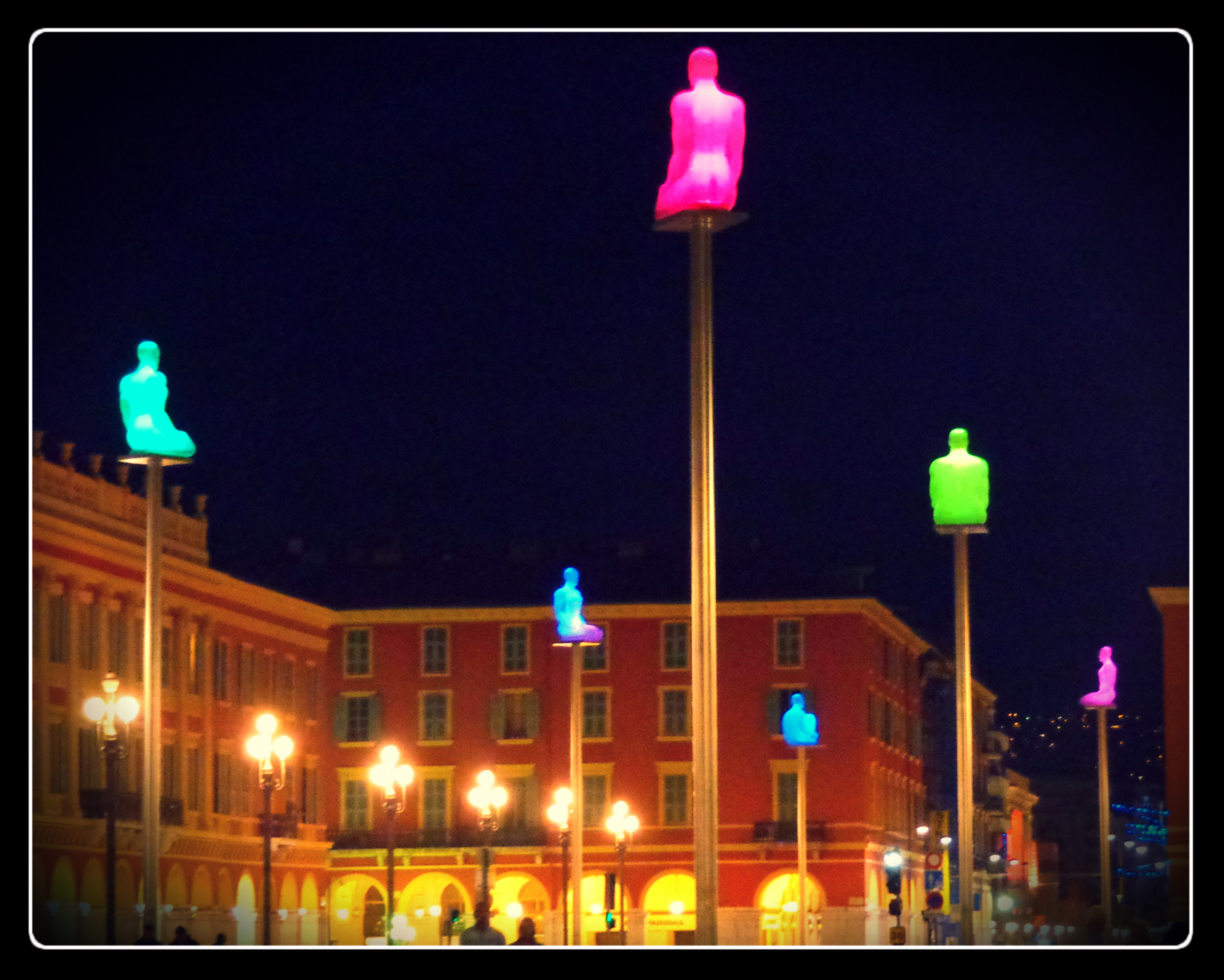
“Conversations in Nice” by Spanish artist, Jaume Plensa, found in Place Massena, is one of my favourite installations. The seven figures perched high above the plaza represent the continents. At night, they slowly change colours, symbolising a conversation taking place between them. Wouldn’t it be wonderful if all nations could exchange ideas in such a calm and beautiful way?

“The False Door” As you approach this beautiful arched opening clad in gold and marble, you might not even notice the engraved words on the wall which read, “porte fausse” meaning false door or gate.
Why is it a false gate? Well, when the old city was surrounded by a large defensive wall, there was a small, sort of hidden door here. It was designed to be discreet and unnoticed by the enemy. When they weren’t under attack, the inhabitants used this gate which was linked to the Old Town by a dark narrow corridor that passed through part of a building. In 1946, the owner of the building donated part of it to make the larger public opening that we see today.
This “false gate” was decorated as part of the Art in the City project. The artist, Sarkis, saw it as a transitional space between the Old Town and the modern city and lavished it with gold and marble. On the landing, you can see a white marble block holding a black tray. It says “les postes restantes” which means post being held. The idea was that visitors and locals could write letters or postcards (to the city or to the inhabitants) and leave them in the tray. As far as I know, this practice has never caught on because, unfortunately, the only thing I have ever seen in this tray is rubbish. (You can see in the photo that the tray is empty.)

Blue Morse code… The lights in front of the Nice Etoile shopping centre shine like blue stars in the night sky. The strings of lights make a series of dots and dashes that spell out the different names of the colour blue in Morse code. It is called “L’Amorse du bleu” by Yann Kersalé.

Ben has his say… All along the tramway you will find the work of Benjamin Vautier, better known simply as Ben. He is renowned for his handwritten black and white messages. The station names are written in his signature style along with various slogans such as, “j’attends l’impossible” (I am expecting the impossible), “repartir à zero” (start over from scratch), “le nouveau est vieux” (the new is old), and occasionally you might see one in English such as “look elsewhere”. These sayings give us something to ponder along our journey.

“T” is for tramway… These “totem poles”, which identify the tram stops, form a “T” when viewed from any angle. Sometimes, as you can see, they are rather abstract “T”s, but “T”s nonetheless. They are done in shades of blue for the sea and red ochre for the traditional colour of Niçois buildings. “Totems” were designed by Pierre di Sciullo.
These are just six of the thirteen works that you can find along the tramway, so there are more for you to discover. There used to be a very interesting guided tour which has, sadly, been discontinued, but you can pick up a brochure in the tourist office and do the tour on your own. It is best to see the art in the evening as many of the installations are lighted. Enjoy!
*Don’t Miss Anything – If you would like to receive an email every time I post an article (2-3 times per month), sign up to follow The Curious Rambler. You’ll find the button just above my photo. And, of course, you can always leave a comment below. Thank you for reading.

- Did Michelangelo Carve This Face in Florence? The Palazzo Vecchio Mystery – 17 March 2026
- 5 Curious Easter Traditions: Rabbits, Bells, Exploding Carts, and More – 16 March 2026
- Ten Wow-Worthy Women Who Changed History – 5 March 2026





COMMENT HERE: Can't wait to hear what you think… (email not required)