
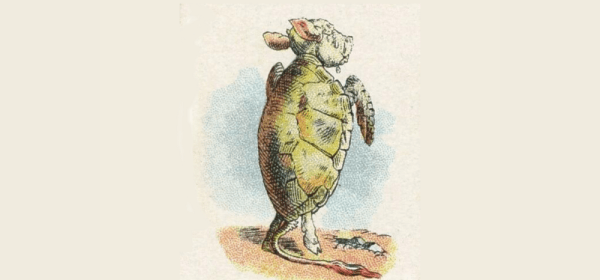

I recently took a course at Oxford University’s summer program on Lewis Carroll and Alice in Wonderland, and I learned so much about the author and his works. Today I want to share a bit about that woeful part turtle – part calf creature known as the Mock Turtle. It turns out that the Victorians really did eat mock turtle soup, but it wasn’t made from mock turtles…
The Mock Turtle in Alice in Wonderland is a curious character. I always wondered about his looks. He has a turtle shell and turtle front flippers, but then he has the head, back feet, and tail of a calf. So what is this strange mock turtle creature you might ask? Well, when Alice asked that question, the answer was, “It’s the thing mock turtle soup is made from.”

Of course, that answer makes perfect sense. Soups are generally named after their ingredients, for example vegetable soup is made from vegetables, chicken soup is made from chicken, etc. So mock turtle soup must be made from mock turtles… But what are mock turtles and what is mock turtle soup? Like Alice, we are still curious…
Real Turtle Soup
But before we talk about mock turtles and soup, let’s talk about real turtles and soup. Sea turtles became a highly sought after soup ingredient in the early 1700s when English explores brought them back to England from the West Indies.

Large colonies of green sea turtles – the best ones for soup – lived off the coast of the West Indies (and other tropical areas). The locals used them as a food source, so the English explorers took some back to England.
These sea turtles are huge creatures, with the average weight being between 68-190 kilos (150-419 pounds), and the largest ones sometimes reaching 300-400 kilos (660-880 pounds). As these giant sea creatures are air-breathing, can go for weeks without eating, and are non-aggressive, they were easy to transport alive on ships from the West Indies.

Once in England, they were made into tasty turtle soup. We might note here that green sea turtles are not green, as you might suppose. Their name is a reference to the layer of green fat that sits just under their shell. This fat is said to be very tasty and is green due to the turtles’ diet of sea grasses.
Turtle soup became a delicacy served at all the important banquets and in the best houses. People couldn’t get enough of it. It was so popular that the turtles were over hunted, and by the early 1800s, green sea turtle numbers had dwindled dramatically.

Mock Turtle Soup
As the number of turtles in the sea went down, the price of turtle soup went up. It became a luxury and so expensive that only the wealthy could afford to have it. However, everyone liked turtle soup, even those who couldn’t afford it. So the not-so-wealthy got creative and made their own version – without the expensive turtle.
They had to find something to replace the flavor that everyone craved. So they used off cuts of meat that had a “turtley” taste. There were a variety of ingredients that changed from recipe to recipe, but the main ingredient was always… a calf’s head! This explains why Lewis Carroll’s Mock Turtle had a calf’s head.
They called their new concoction mock turtle soup (as in fake turtle soup) and it became just about as popular as the real thing had been. It was (and in some places still is) sold in tins in supermarkets. However today, it seems that the calf’s head has mostly been replaced with ground beef – which probably sounds a bit more palatable to most people.

Real Turtle Soup at High Table, Mock Turtle Soup at Low Table
So while the richer folks ate the real thing, others ate mock turtle soup. Lewis Carroll would have been familiar with both versions of this soup and probably would have tasted both.
He would have also been familiar with a tradition that I got to experience at my course in Oxford. While there, we ate in the college dining hall. And similar to most Oxford University dining halls, there were long tables with benches running the length of the room where the students sat.
Then at the front there was one long table running across the width of the room at right angles to the others. It had chairs instead of benches and sat on a slightly raised platform, and this was referred to as ‘high table’. It was where the professors, fellows, and other important folks sat to dine. When Lewis Carroll was writing about the mock turtle, he might have been remembering his days as a student when the professors at the “high table” were served turtle soup, and the lowly students received mock turtle soup.

Lewis Carroll’s Mock Turtle
So now we can better understand why the Mock Turtle in Alice in Wonderland is such a strange looking part turtle – part calf creature.
In the book, the Gryphon takes Alice to meet the Mock Turtle and hear his story. The Mock Turtle (who was constantly crying) begins his story with, “Once I was a real turtle.”
That one sad little phrase almost sums up the history of the sea turtles and turtle soup: Once there were lots of real turtles in the sea. Then people discovered that they were tasty and most of them ended up in a tureen of “beautiful soup.”

As Alice left, the mock turtle was still crying and singing a song about turtle soup:
Beautiful Soup, so rich and green,
Waiting in a hot tureen!
Who for such dainties would not stoop?
Soup of the evening, beautiful Soup!
Soup of the evening, beautiful Soup!…
The Crying Mock Turtle
Why was the Mock Turtle constantly crying? Was he sad because he used to be a real turtle? That’s probably the reason in the Wonderland story, but real sea turtles do actually look like they are crying. Because they live in the salty sea and drink sea water, their bodies need a way to keep from overdosing on all that salt. So they have a special gland near their eye which produces a fluid to wash away the excess salt, and this gives them the appearance of crying. Lewis Carroll must have known this and turned it into an emotional response for a sad mixed-up creature who used to be a real turtle.
So there you have it, three mysteries solved: Now you know why the mock turtle looks so odd, why he’s crying, and why he’s singing about soup.
What do you think? Let me know in the comments section below. And if you want to read more of my curious histories, subscribe to my blog (at the top or bottom of this page).
Follow Me on Social Media:


- Did Michelangelo Carve This Face in Florence? The Palazzo Vecchio Mystery – 17 March 2026
- 5 Curious Easter Traditions: Rabbits, Bells, Exploding Carts, and More – 16 March 2026
- Ten Wow-Worthy Women Who Changed History – 5 March 2026





COMMENT HERE: Can't wait to hear what you think… (email not required)