
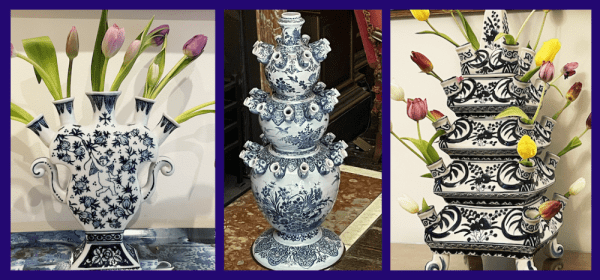

My New Tulip Vase
In the 1630s the Dutch went crazy for tulips, and now, nearly 400 years later, I’m mad for my new Delft tulip vase from Holland. Every Spring, when the tulips bloom, my heart yearns for a tulip vase, and this year, I finally bought one. It’s a big one: 24 inches tall (60 cm) with 5 stacking levels. Each level holds water and has 4 “spouts” or openings with an extra one at the top. That makes 21 individual “spouts,” so I immediately ran out and bought two big bunches of tulips to fill it.
What’s It Called?
These vases are usually called tulipières or tulip vases, but other flowers look equally gorgeous in them. They originated in the Delft pottery factories in Holland in the late 17th century.
The factories produced these vases in several designs and sizes: some are shaped like a hand with 5 fingers, others are rounded shapes with spouts at the top, and some are stacking pyramids like mine. I consider mine a large vase at 2 feet tall, but some of the stacking flower pyramids stood up to 5 feet tall (153 cm). These large ones decorated palaces and mansions and were often filled with flowers and placed in front of fireplaces in the summer when no fire was needed.

What Does Queen Mary Have to Do With It?
Several of these spectacular Delft flower pyramids survive in England in the large country houses of those who were associated with the court of William and Mary. That’s William III and Mary II who ruled England jointly from 1689 to 1694.
Mary Stuart, the daughter of King James II of England, was born in 1662. At the age of 15, she was married to her cousin in the Netherlands, William III of Orange. Her husband ruled in the Netherlands, then in 1689 she and William were crowned Joint Sovereign of Great Britain.

Queen Mary and Tulip Vases
Mary had a lot to do with the popularity of Delftware in England and especially the tall tulip pyramids. During the years when she lived in Holland, she developed two loves: First was her love of gardening. Of course, she probably didn’t do the gardening herself, she had people to do that, but she enjoyed looking at the plants and bringing the blossoms inside. And her second love was blue and white Delft pottery. She filled her palaces with it.
Tulip vases, and especially the tall flower pyramids, were the perfect combination of her two loves. The beauty of these towers is that the flowers in the spouts don’t completely cover the vase, so the pottery design and the flowers can be on show at the same time. And when there are no flowers, the vases are still beautiful on their own.

Queen Mary the Influencer
The nobles love to imitate the monarchs, so when they saw the Queen’s tall (and short) Delft vases in Hampton Court Palace, they had to have them too. Tulip Pyramids began to show up in the aristocratic British country houses throughout England. Anyone associated with William and Mary had to have one… or two… or more. They were lovely decorations for their home, but they were also a visual way to show their support for the Royal Couple.
Dyrham Park in Somerset is a good example of this. It was built by William Blathwayt who was a diplomat and politician under William III, and it contains many lovely Delft vases including several variations of the tulip vase.

But Are They Really for Tulips?
Why is this type of vase called a tulipiere or tulip vase? Were they really designed for tulips? No, they weren’t. Originally these vases weren’t used specifically for tulips. In Queen Mary’s day, they would have been filled with all sorts of blooms (but I’m sure tulips were among them). In the late 1600s at the time of William and Mary, the smaller ones were referred to as vases with spouts and the tall ones as flower pyramids.
It was only in the mid-nineteenth century that they became known as tulip vases. When the Victorian collectors and art historians “rediscovered” these unusual Delftware vases, they assumed they were for tulips. They knew about tulip mania which had spread through the Netherlands in the 1630s, and they thought these vases – also from the Netherlands – were intended to be filled with the precious, high-priced tulips. So they called them “tulip vases” or “tulipières” which are terms we still use today.

Tulip Mania
But the Dutch really were mad for tulips. When the bulbs arrived in Holland from Turkey in 1593, their exotic petals were immediately appealing to the Dutch – especially the striped or multi-colored ones. At the time, Dutch society was thriving and full of the newly rich who considered tulips as the ultimate luxury item.
The tulip trade went wild, and people were paying incredibly high prices for some bulbs. According to Amsterdam Tulip Museum, the most expensive tulip bulb ever sold went for 5,200 guilders which was more than three times the typical yearly earnings of an Amsterdam merchant at the time. Prices reached their peak at the end of 1636 and then a few months later… they crashed.

The rich folks who were playing the ‘tulip market’ may have lost their money, but the Dutch didn’t lose their love for tulips. The tulip has become Holland’s trademark flower, and today the Dutch can claim nearly 90 percent of the world’s total area of tulip farms.
However, tulips didn’t really have anything to do with the unusual vases that we now know as tulip vases. It was after Tulip Mania had subsided that the Delft pottery factories really hit their stride, and it was Queen Mary who commissioned the tall flower pyramids to display all her exotic garden flowers.
So what will I put in my new tulip vase? Tulips, of course, but lots of other flowers too, I’m sure.


What do you think? Let me know in the comments section below. And if you want to read more of my curious histories, subscribe to my blog (at the top or bottom of this page).
Follow Me on Social Media:
Read About Other Flowers:


- Ten Wow-Worthy Women Who Changed History – 5 March 2026
- Rats and Weevils Have Their Day in Court: Strange Medieval Animal Trials – 13 February 2026
- The Great Paris Mustache Strike of 1907: A Close Shave with History – 1 February 2026




COMMENT HERE: What do you think? Leave a comment..