
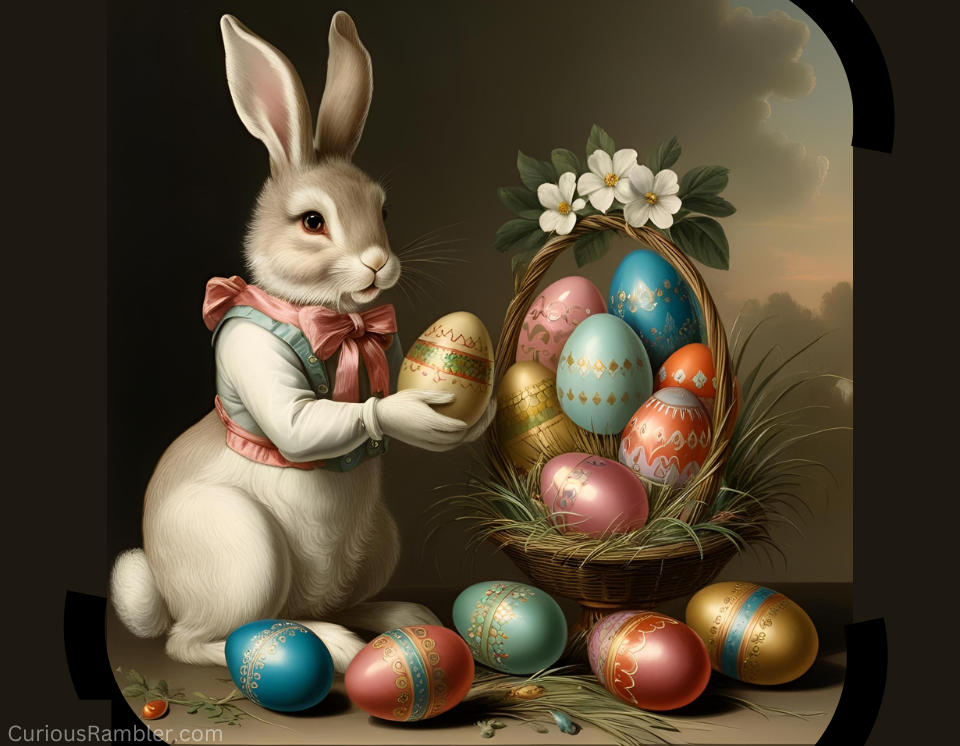

If, like me, you grew up with images of a bunny who hops around and delivers eggs to children every Easter, it seems perfectly normal. But when you stop to think about it, what does a rabbit really have to do with eggs?
Well, in the old tradition, the rabbit actually laid the eggs. But many people had a hard time understanding how that happened, so they began telling their children that the rabbit only delivered the eggs.

Egg-Laying Rabbits
Stories about rabbits that laid eggs at Easter time date back at least to the 1600s in Germany. Well, actually, they were egg-laying hares – the rabbits’ larger, longer-eared cousins. The origins of this strange story are unknown, but we do know that the Pennsylvania Dutch carried the Easter Hare tradition from Germany to America with them. In Pennsylvania, where there were more rabbits than hares, the Easter Hare became the Easter Rabbit. Then, in the 20th century, the term Easter Bunny gained popularity.

Rabbits and Goddesses
In 1874, when the mythologist Adolf Holtzmann was trying to find the origins of the old Easter Hare story. He wrote that the hare was probably the sacred animal of the goddess Ostara.
Ostara was a German goddess of Springtime. She was described – and possibly invented – by Jacob Grimm (folklorist and one of the Grimm Brothers of fairy tale fame). In his 1835 book of German Mythology, he speculated that Ostara might have been the German version of the Anglo-Saxon goddess of Springtime called Eostre from whom we get the name Easter.

From Bird to Rabbit
After Holtzmann hypothesized about an Ostara – Easter Rabbit connection, storytellers began making up tales about them. They tried to explain the relationship between the goddess, the rabbit, and Easter eggs. There are several versions of this story, and this is mine…
The goddess Ostara’s job was to warm the earth and bring it back to life after a long, cold winter season. Her favorite animal was the hare (or rabbit) and she sometimes traveled in a carriage pulled by several of them.
Ostara slept underground all winter, and one Springtime, when it was time for her to warm things up, she just didn’t feel like climbing out of bed. She snuggled up and went back to sleep. When she finally awoke and made her way up to the surface of the earth, she was two months late. Ostara was embarrassed when she saw the earth still cold and covered in snow.

She quickly got into her carriage and her rabbits pulled her across the land. As she passed, the snow melted and flowers sprang up. Trees and shrubs began to turn green and bloom. She was a tender-hearted goddess, so she pulled her carriage to a halt when she saw a little injured bird. He was lying on the ground and his wings had been frozen and broken.
Ostara felt guilty for being late and causing the poor little bird to suffer. So she cupped him in her hands, warmed him up, and turned him into a rabbit with lots of fur so he would always be warm.
The rabbit, however, retained one of its bird traits. It was still able to lay eggs. The rabbit was so grateful to the goddess for saving him that every year he laid colorful eggs for her spring festival of Easter… And that’s why the Easter Bunny can lay eggs.
There are other versions of this story, but they all seem to agree that the Easter Bunny is able to lay eggs because he was once a bird.
I guess in the area of myth and fable anything is possible.

But not every country is visited by the Easter Bunny: In Australia, where the rabbit is considered a pest, the cute, little Bilby is taking over egg-delivery duties. And in France, Easter eggs are delivered by church bells – Yes, church bells! To read how that works, click here.
Image Sources: Image 1, — Image 2, — Image 3, — Image 4, — Image 5, — Image 6, — Image 7


- Did Michelangelo Carve This Face in Florence? The Palazzo Vecchio Mystery – 17 March 2026
- 5 Curious Easter Traditions: Rabbits, Bells, Exploding Carts, and More – 16 March 2026
- Ten Wow-Worthy Women Who Changed History – 5 March 2026




COMMENT HERE: Can't wait to hear what you think… (email not required)