
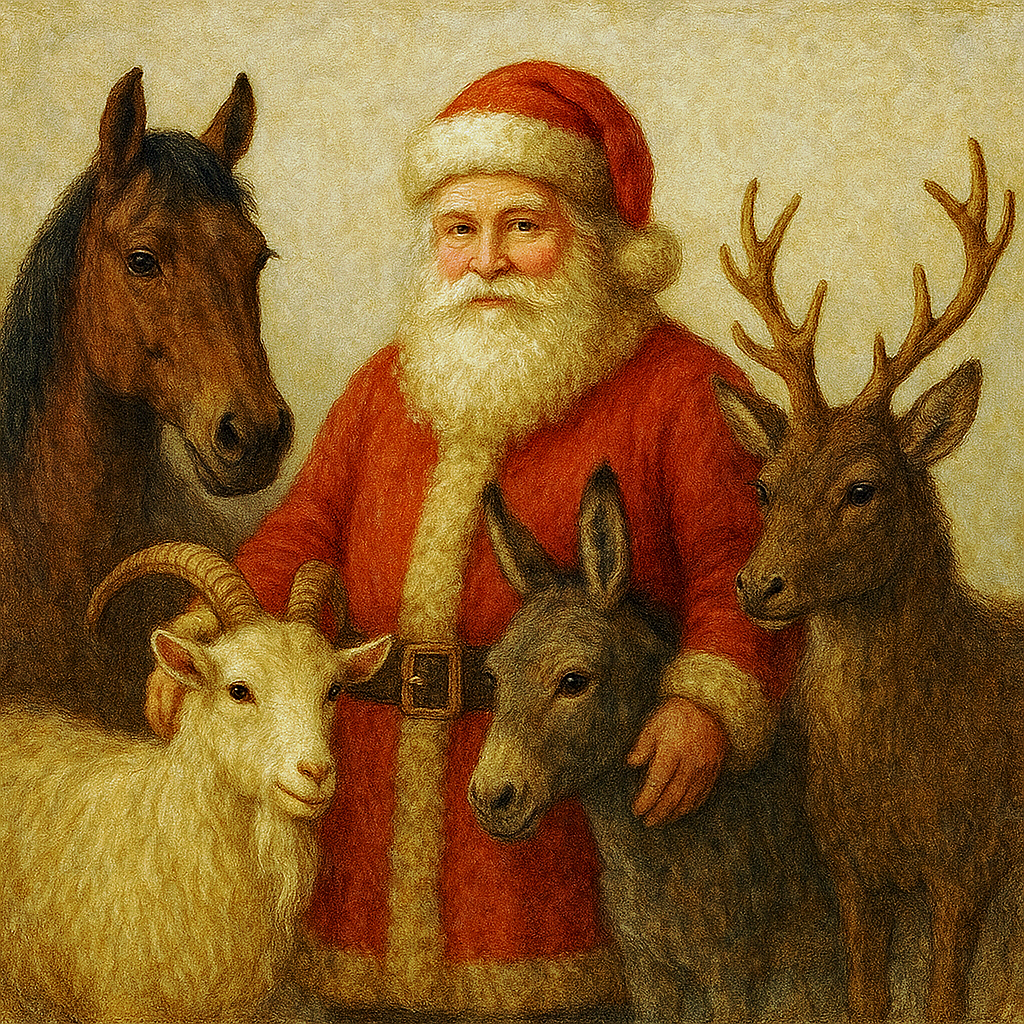

Everyone knows that Santa Claus flies all over the world in his sleigh pulled by reindeer, delivering gifts to good little girls and boys. Right? Well, maybe, but reindeer weren’t always the jolly gift-giver’s animal of choice. Before the reindeer, there were other more common animals associated with Christmas, Santa, and gift-giving.
Goats
In Sweden, as well as other Scandinavian countries, there is a Christmas goat. He’s called the Julbock, or the Yule goat, and has a long history. Traditions vary slightly, but it seems that originally the Yule Goat had a connection to the grain harvest. By the 17th century, the grain-harvest goat had become a scary figure that roamed around on Christmas night, knocking on doors and demanding food.

But by the 19th century, the Yule Goat had been reformed and even began delivering Christmas gifts. Often one of the men of the family would dress as a goat and distribute presents. As time went on, the role of gift giving passed from the goat to little goat-riding elves who left their gifts while children slept. In some areas, children would leave barley in a shoe for the Yule Goat.

In time Santa Claus or Father Christmas took over from the elves, but sometimes he still took the Yule Goat along with him.


Today the Yule Goat is represented mostly in straw Christmas decorations which harken back to his grain harvest connections. In cities and town squares much larger straw Yule Goats are made (and often go up in flames). The most famous one is traditionally placed in Gävle, Sweden.

Donkeys
In France, Belgium, Luxembourg, and Switzerland, St. Nicholas comes bearing gifts with a donkey. Although St. Nicholas and Santa Claus aren’t technically the same, St. Nick was the inspiration for Santa Claus.


Sometimes Santa walks alongside the donkey who carries the gifts.
In the early history of Santa Claus (or Père Noël) in France, old Saint Nick would descend from the sky riding his flying donkey called Gui. They would land on the rooftops, then slide down the chimneys to leave gifts. Children would line up their shoes by the fireplace and fill them with carrots or apples for Gui. The donkey would have his snack, then Santa would refill the shoes with small gifts and sweets. In some parts of northern France this is still the custom on the Festival of Saint Nicholas on the 6 December.


Sometimes the little donkey has to carry Santa and the gifts.
Horses
In the Netherlands, Sinterklaas (Saint Nicholas) traditionally rides on a white horse. He rides around the countryside visiting schools and homes.


Reindeer
Today, in many countries, Santa Clause rides through the skies on Christmas eve delivering gifts from a sleigh pulled by flying reindeer. But as we’ve seen, the reindeer are a relatively new and curious mode of transportation. The earlier animals were all familiar ones that might be found on any farm.

The first mention of Santa’s sleigh being pulled by these exotic horned beasts from the North appears in 1821 in a children’s poem called “Old Santeclaus with Much Delight.” The poem’s illustration shows a sleigh being pulled by a single reindeer.

Then, in 1823, Clement C. Moore wrote his famous poem, “Twas the Night Before Christmas.” He tells us that Santa’s sleigh is pulled by “eight tiny reindeer” and he even gives us their names: “Now, Dasher! now, Dancer! now Prancer and Vixen! On, Comet! on, Cupid! on, Donner and Blitzen!”

Then, of course, there is “the most famous reindeer of all.” Rudolph came along in 1939, more than 100 years after the original eight. He was created by Robert May, an employee of the Montgomery Ward department store. They wanted a little Christmas booklet to hand out to children in the store, and May was in charge of writing it. The result was the story of Rudolph the Red-Nosed Reindeer. Then in 1949 the song based on May’s story was recorded by Gene Autry. And, as they say, the rest is history. Today, Rudolph is generally considered the ninth reindeer pulling Santa’s sleigh.

Other Modes of Transportation
But, if some vintage Christmas cards are to be believed, Santa at times uses more modern or unconventional modes of transportation.


I hope all of you are enjoying the holiday season in whatever form it comes.

What do you think? Let me know in the comments section below. And if you want to read more of my curious histories, subscribe to my blog (at the top or bottom of this page).
Follow Me on Social Media:


- Did Michelangelo Carve This Face in Florence? The Palazzo Vecchio Mystery – 17 March 2026
- 5 Curious Easter Traditions: Rabbits, Bells, Exploding Carts, and More – 16 March 2026
- Ten Wow-Worthy Women Who Changed History – 5 March 2026




COMMENT HERE: Can't wait to hear what you think… (email not required)