
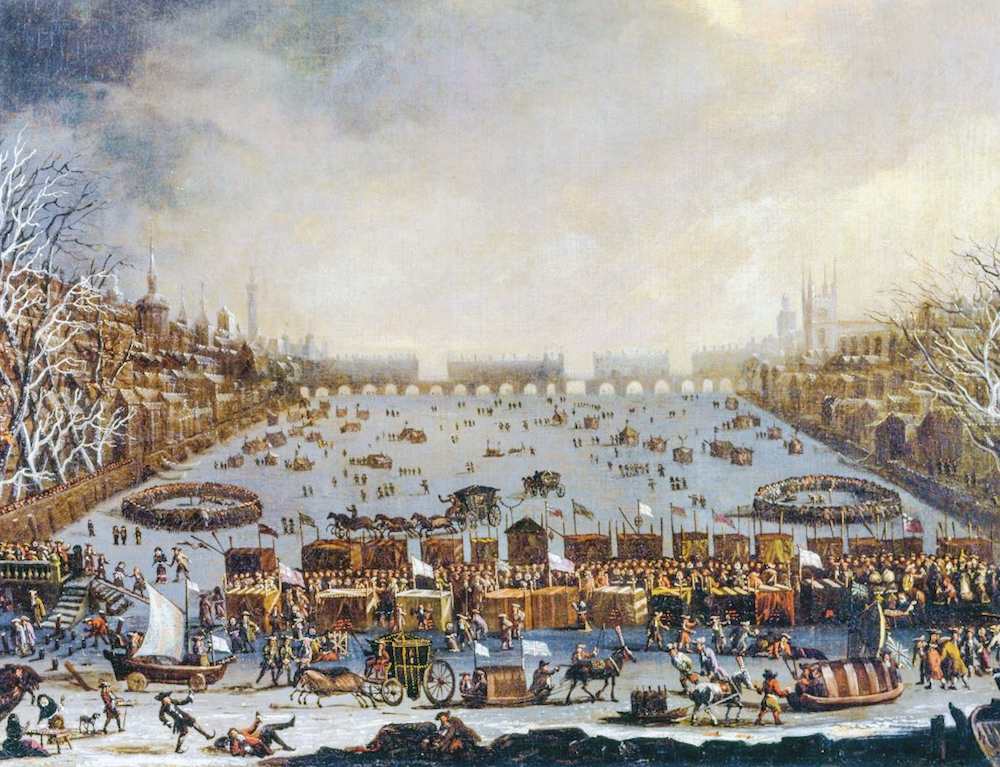
When it’s cold outside, my inclination is to stay indoors. I like to snuggle under a blanket close to the heat source with a steaming mug of tea or hot chocolate. So, I’m not sure I would have survived in London during the Little Ice Age.
From the 17th century to the mid 19th century, northern Europe experienced extremely cold temperatures in an era known as the Little Ice Age. And during that time in London, the Thames River, which winds through the heart of the city, froze over at least 23 times. Five of those years the ice was so thick that people actually set up fairs on it.

Frost Fairs
Instead of staying home under their duvets, those Londoners would go out onto the frozen river and have a big party. They called them Frost Fairs. Actually, it was the boatmen who organized these frosty gatherings. Normally they would have been earning their living by transporting passengers and goods along the river, but the thick ice put them out of work.
So they had to think of other ways to earn their wage: They encouraged merchants to set up shops on the ice to draw people in. Then they put their small boats on sleds and pulled people across the ice – for a small fee of course. Some of the larger barges that were frozen in place were turned into stages where people paid to watch impromptu performances.

They Had It All
Anyone who had something to sell hurried to claim their spot at the icy festival. There were games and sports such as bowling, fox hunting, horse racing, and bull baiting – everything seemed to be more fun when people and animals were slipping and sliding around on the ice.
There were simple carnival-type rides, and there was a “street” of tents or hastily-constructed sheds from which vendors sold food and drink. To keep warm in these “shops” and to cook their food they built fires. There was even an entire ox roasting over an open flame.

At the last Frost Fair, in 1814, an elephant was led across the frozen river. The ice was several feet thick in places and so it supported all this weight and activity without giving way – for the most part, that is. Sometimes there were accidents but not as many as might be expected in such a precarious situation.
Frolicking on the frozen Thames was a novelty, and even kings and queens turned out for the Frost Fair fun. Popular attractions at these fairs were the printing presses. They were set up to print souvenirs: leaflets saying “this was printed on the River Thames” along with the date. There were only five major fairs between 1683 and 1814 and people wanted a little keepsake to remember the occasion.

A Thing of the Past
With our warming climate, we’re not expecting any more Frost Fairs in the near future. But climate isn’t the only reason for that. The old medieval London Bridge had twenty closely-spaced piers and during those cold winters it would trap huge blocks of ice which were floating in the water. This would dam the river, making it easier for the water on the other side of the bridge to freeze.
The old London Bridge was replaced in 1835, and the new one has wider arches to let the water flow more freely. Then the embankment was built, making the river narrower and faster flowing. All this makes the Thames less likely to freeze.
But I can’t help but wonder if there isn’t another reason why the Thames no longer freezes over. Have a look at the handbill below printed in 1814 at the last Frost Fair. It reads, “NOTICE – Whereas you J FROST have by Force and Violence taken possession of the RIVER THAMES, I hereby give you warning to Quit immediately. – A Thaw – Printed By S Warner on the ICE FEB 5, 1814”

Was it just a coincidence that 1814 was the last time the Thames froze enough to have a Frost Fair? Who knows, maybe this strongly-worded notice had something to do with J Frost moving on and the climate warming up…
What do you think? Let me know in the comments section below. And if you want to read more of my curious histories, subscribe to my blog (at the top or bottom of this page).


Follow Me on Social Media:

- Curious History Review: April 2026 – 2 April 2026
- The Secret Victorian Language of Flowers: When Bouquets Carried Hidden Messages – 2 April 2026
- Did Michelangelo Carve This Face in Florence? The Palazzo Vecchio Mystery – 17 March 2026



COMMENT HERE: Can't wait to hear what you think… (email not required)