
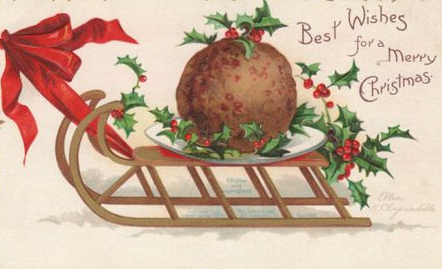

Christmas pudding and mince pies are found in the United States and other countries, but they just don’t have the same holiday importance that they do in Britain. Let’s have a look at these two essentially British desserts.
Christmas Pudding
Thirteen years ago, we were preparing to experience our first Christmas in England. December rolled around and I started to hear people talk about “Christmas Pudding.” Their eyes would sparkle and they would smack their lips, and I couldn’t wait to try this obviously delicious treat. Of course, to my American mind, pudding was a semi-liquid, custardy-type food and I wondered what the British did to make it so special.
Then, one day, my chance came. I was in a restaurant and saw Christmas Pudding on the menu. I was very excited to try it and was looking forward to the end of the meal when it would arrive. When the waiter brought dessert, he set a piece of fruitcake in front of me. I said, “No, this isn’t what I ordered, I ordered Christmas Pudding.”
“This is Christmas Pudding,” he replied.
Confused, I said, “But this is fruitcake…” And so it was. That’s when I discovered that the word “pudding” in British English is a general term for dessert – and fruitcake is the traditional Christmas dessert. And I had passed up chocolate for that fruitcake…

Fun Facts About Christmas Pudding
- It’s also known as plum pudding and sometimes as figgy pudding.
- Although this fruitcake is often called plum pudding, it doesn’t actually contain any plums. This is because in the Victorian times, the word “plum” referred to raisins.
- In its earliest form, Christmas pudding contained meat along with fruit and spices.
- It was already established as a Christmas dessert when the English Civil War did away with the monarchy in the mid 1600s. The Puritan, Oliver Cromwell, wasted no time in banishing Christmas pudding, along with other holiday traditions, claiming they were too pagan. But when Cromwell and his strict puritanical ideas fell from power, the monarchy was restored, and so was Christmas pudding.
- German-born, King George I, who reigned from 1714 to 1727, is fondly known as the “pudding king.” A legend tells that he requested a plum pudding as part of his first royal Christmas dinner.
- Traditionally, the holiday pudding making began on the Sunday before Advent (4-5 weeks before Christmas) which became known as “Stir-up Sunday.” This was because the prayer recited in church on that day began with, “Stir up, we beseech thee, O Lord, the wills of thy faithful people…” This reminded everyone that it was time to start stirring up that Christmas pudding.
- An old custom required each family member to give the pudding a stir while making a wish.
- Sometimes a dried bean or a coin was cooked into the cake and would bring good luck to the person who found it in their slice – assuming they didn’t bite into it and break a tooth.
- Christmas puddings are generally made with dried fruit, nuts, spices, suet, eggs, treacle, flour, and brandy or other alcohol. They’re not baked, but they are boiled or steamed. They are often doused with extra brandy which is set alight, then the flaming pudding is carried to the table.
- Because of its alcohol content, a Christmas pudding can last a year… or more.
- In the US, fruitcake has a rather dodgy reputation. There is even a joke which says there is really only one fruitcake in the US. It just gets sent from family to family each year and no one ever actually eats it.
- “Stir-up Sunday” 2016 was November 20 but if you still want to have a go at making your own Christmas pudding, this site surely has one you’ll like. They have easy options as well as more difficult ones: http://www.bbcgoodfood.com/recipes/collection/christmas-pudding

Mince Pies
Fun Facts About Mince Pies:
- Originally they were called mincemeat and contained minced meat (no surprise there), suet, fruit, and spices. By the Victorian times, the pie had become sweeter, and meat was optional.
- The mince used to be made into one large pie, but evolved into the smaller, individual pies that we know today.
- A medieval legend says that for every mince pie you eat during the twelve days of Christmas (Christmas through January 5th) you will have one month of good luck in the new year.
- Sometimes British children leave out mince pies for Father Christmas on Christmas eve.
- Just like Christmas pudding, mince pies got the Puritans in Britain all riled up. They were banned at Christmas time – even though they could be eaten the rest of the year.
- English settlers introduced their Christmas mince pies to America, but just like in England, the Puritans in America wouldn’t have it. So, the mince pies became a Thanksgiving treat.
- In 1804, Samuel Johnson wrote, “We have never been witnesses of animosities excited by the use of mince-pies and plumb-porridge; nor seen with what abhorrence those who could eat them at all other times of the year would shrink from them in December.”
- And for those ambitious cooks among you, here is a recipe which claims to be “unbelievably easy.”: http://www.bbcgoodfood.com/recipes/2174/unbelievably-easy-mince-pies

May your holidays be filled with yummy desserts!!!
What do you think? Let me know in the comments section below. And if you want to read more of my curious histories, subscribe to my blog (at the top or bottom of this page).
Follow Me on Social Media:
You Might Also Like:


- Weird and Wonderful Victorian Christmas Cards – 20 December 2025
- Hidden Histories Behind Three Classic Christmas Songs: Jingle Bells, Rudolph, and Figgy Pudding – 13 December 2025
- Thanksgiving History: The Woman Behind the Holiday – 21 November 2025





COMMENT HERE: What do you think? Leave a comment..