
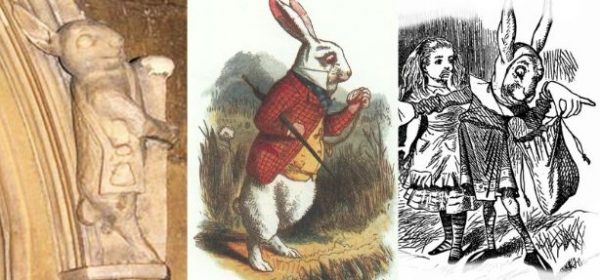
An unusual carved rabbit can be found on the wall of St. Mary’s church in Beverley, England. He bears a striking resemblance to the White Rabbit in Alice in Wonderland and may have been Lewis Carroll’s inspiration. But this rabbit also has a story of his own.

St. Mary’s church in Beverley was founded in 1120 and this rabbit carving dates from around 1330. He’s sometimes referred to as the “pilgrim” rabbit or the “messenger” rabbit. And some say he was the inspiration for the White Rabbit in Alice in Wonderland and the Messenger Rabbit in Through the Looking Glass.
Lewis Carroll, the author of these two books, had connections to the area, as his grandparents lived close to Beverley. So it’s quite possible that he visited this church and the image of this bunny-with-a-bag sparked his imagination.

White Rabbit
In Alice in Wonderland, the White Rabbit is the first character Alice meets. He walks upright, wears a waistcoat, and carries a pocket watch. As he hurries along, he mutters, “Oh dear! Oh dear! I shall be too late!” But most of us remember the Disney rhyming version, “I’m late, I’m late, for a very important date.” Alice is intrigued by the bizarre bunny and follows him down the rabbit hole where her adventures begin.
The White Rabbit’s human-like stance is very similar to the rabbit sculpture in Beverley, but his tardiness was apparently inspired by Alice Liddell’s father who never managed to arrive anywhere on time.

Messenger Rabbit
The rabbit in Through the Looking Glass is a messenger to the king. This rabbit is called Haigha, which he claims rhymes with “mayor.” He dresses in Medieval fashion and carries a bag – just like the Beverley bunny does.
When Alice sees Haigha coming down the road, she remarks that he has a “very curious attitude” – because he keeps “skipping up and down, and wriggling like an eel… with his great hands spread out like fans on each side.”
But the King explains that “he’s an Anglo-Saxon Messenger – and those are Anglo-Saxon attitudes.” Later, when the King is hungry, The rabbit opens his bag and pulls out a sandwich and some hay for his lord’s lunch.
The Bag
And what about that bag slung over the Beverley Bunny’s shoulder? This bag is the reason he’s often identified as a pilgrim rabbit. It’s called a scrip and all the fashionable Medieval pilgrims carried one as they travelled across the country visiting churches and praying at shrines. It held their food, money, and other essentials and was an important part of the pilgrim’s traveling attire.

The Beverley Bunny
Even though the Beverley Bunny might have inspired the rabbits in Lewis Carroll’s books, he also has a story of his own to tell. In the Middle Ages, when many people couldn’t read, lessons were taught in paintings and sculptures on church walls. The priests also used fables and folk tales in their sermons to get their point across. This rabbit sculpture is a reminder of a Medieval cautionary fable by Odo of Cheriton.
It’s the story of the simple people of Wilby (or Wilebege). The village lay at the very limits of their lord’s territory, and by the time they received their tax notice, it was late. There was no way they could get the money back to their lord on time. They were all in a tizzy. What could they do?
Then one of them came up with an idea. He said, “The rabbit is the fastest creature, so why don’t we put the notice and the payment in a bag, put it on a rabbit, and send him to our lord’s manor. Surely he will get there quicker than any of us could.” It was agreed that it was quite a clever idea, so that’s just what they did.
After putting the bag around the rabbit, they instructed him to run as fast as he could to their lord’s manor. Then they let him go. The rabbit shot out of their hands and ran off into the forest… and neither the rabbit nor their money were ever seen again. The moral of the story: Think carefully before putting your trust and money in the hands (or paws) of a stranger.
The Beverley Bunny’s story seems just about as bizarre as the stories that take place in Wonderland. So he seems a fitting model for Lewis Carroll’s rabbits.

What do you think? Let me know in the comments section below. And if you want to read more of my curious histories, subscribe to my blog (at the top or bottom of this page).
Follow Me on Social Media:


Read more stories like this in my book, Bowlers, Brollies, and Brits: Curious Histories of England.

- Did Michelangelo Carve This Face in Florence? The Palazzo Vecchio Mystery – 17 March 2026
- 5 Curious Easter Traditions: Rabbits, Bells, Exploding Carts, and More – 16 March 2026
- Ten Wow-Worthy Women Who Changed History – 5 March 2026





COMMENT HERE: Can't wait to hear what you think… (email not required)