
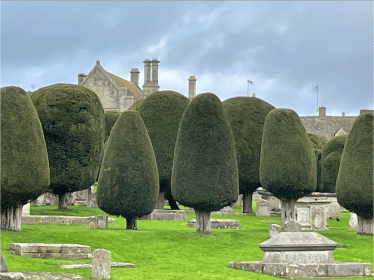

In England whenever you see a church, you can be sure that there are yew trees close at hand. But in the Cotswolds, which is a charming area in the south-central area of the country, there are two yew-sporting churchyards that are quite special. If you visit them, you might experience an otherworldly feeling. In one, you might expect to see a hobbit on his way to church, and in the other, it wouldn’t be surprising to see Alice run by chasing the white rabbit – possibly followed by a devil…
Why Yew Trees?
But first, let’s talk about why yew trees are a seemingly necessary component in every English churchyard. There are a few theories as to why this is.

First, the yew tree has certain characteristics that make it symbolic to the Christian faith: They live a really long time – with some reaching 1,000s of years of age. To our ancestors, this must have seemed almost like eternal life. In addition, yew trees have an amazing ability to regenerate themselves after damage, which could have represented resurrection to the early churchgoers.
Another more mundane theory is that yew trees were planted in churchyards to keep out the cattle. During the days when livestock grazed freely, cows trampling around among the tombstones must have been a problem. But since the berries that drop off yews are poisonous, the cows wouldn’t graze there and knock over uncle Bill’s headstone.

Hobbits in Stow-on-the-Wold
Now on to the first set of our otherworldly yew trees. If you are looking for hobbits in England, your first stop should probably be St. Edward’s Church in Stow-on-the-Wold. Wander around to the back of the church, and you’ll find a door flanked by two yew trees.
All I can say is that the person who planted them must have thought they were small shrubs that would remain small. But as yew trees do, they grew and grew. Their roots seem to pile up on the outside of the church and it now gives the appearance that the church door is actually part of a large tree and the perfect portal to the land of hobbits.
Some locals claim that this magical-looking door inspired Tolkien when he was creating and writing about his enchanted Middle Earth. There doesn’t seem to be any proof of that, but the writer is known to have visited the area, so perhaps it’s possible. In any case it’s still a sight that inspires the imagination.

The Devil in Painswick
Another Cotswold churchyard that can make you daydream is St. Mary’s in Painswick. This church claims to have 99 yew trees, and they’re all trimmed into wonderful shapes that reminded me of Alice in Wonderland. There are mushroom shapes, archways, and lollipops. It makes a truly magical landscape.
But are there really 99 of those trees? I must admit that I didn’t count them, and it would be difficult since some of them seem to grow together. But there is a legend (and I always love a good legend) that says there are exactly 99 trees in this churchyard. Apparently that number was set by the Devil himself, and if another tree should ever be planted the Devil wouldn’t let it grow, or he would kill a different tree to keep the number at exactly 99. We don’t know why the Devil likes the number 99, where this legend originated, or how long it has existed. It’s a mystery.
However, this little church faced a dilemma when in 2000 they were offered a new yew tree. To commemorate the end of the second millennium, every church in England was offered a cutting from one of the several British yew trees believed to be more than 2,000 years old.

It was a lovely gesture, and the church officials didn’t want to be rude, so they accepted the millennial yew tree. With a bit of trepidation, they planted it, bringing the total of the yew trees in the churchyard up to 100. They were modern folks and didn’t really believe in the old legend, but they must have quietly wondered if the devil would retaliate.
It seemed that all was well as the new tree grew and flourished. Then in 2007 a storm came through and blew over one of the other trees. Oh my! Was the devil setting the number of trees back to 99?
But, as we mentioned earlier, yew trees are very hardy and have an amazing capacity for regeneration. So the gardener set the tree aright, trimmed it back, and after a while, it took hold and began to thrive. So, are there now 100 trees? Well, there are a lot of them, and they are terribly difficult to count. In some places multiple trees are trimmed into one shape – could this be a tactic to confuse the Devil? I don’t know. Let’s just say there are 99 so we don’t attract any unwanted attention from “you know who.”
St. Edward’s Church, Church Street, Stow-on-the-Wold, GL54 1AB
St. Mary’s Church, New Street, Painswick, GL6 6UT
What do you think? Let me know in the comments section below. And if you want to read more of my curious histories, subscribe to my blog (at the top or bottom of this page).
Follow Me on Social Media:


- A Tragic Medieval Bedtime Story: The Chatelaine of Vergy – 18 September 2026
- Bath’s Jane Austen Festival: Books, Balls, and Bonnets – 5 September 2026
- Curious History Review: September 2026 – 3 September 2026




COMMENT HERE: Can't wait to hear what you think… (email not required)