Today, everyone knows what Humpty Dumpty looks like, right? He’s an egg with a face, and he has arms and legs. Oh yes, and he sits on a wall. But did you know that he wasn’t always that way? It seems that there was a song about a boy and a riddle about an egg, and Lewis Carroll scrambled the two together, and out came the hard-boiled and beloved egg-person we know today.
But before we talk about the rhyme itself, let’s look at the term “humpty-dumpty.” A 1785 dictionary of slang gives the definition as: “A little humpty dumpty man or woman; a short clumsy person of either sex: also ale boiled with brandy.”
I think we can rule out the ale for our purposes, but let’s move on to the rhyme with the idea of a short, clumsy person in our mind.
A Song and a Boy
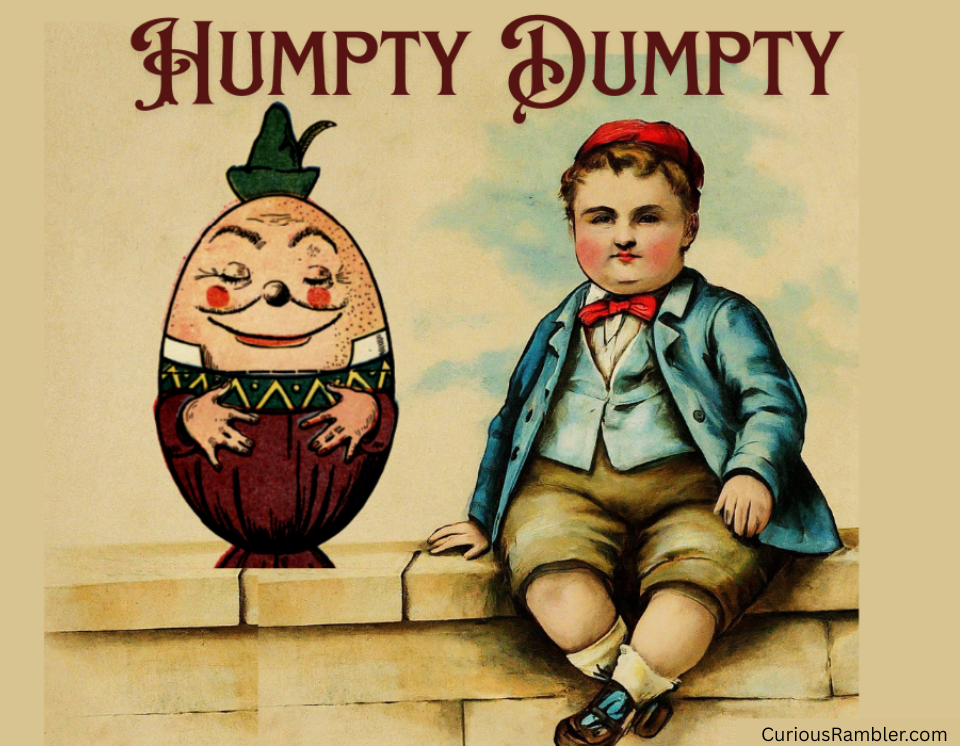
These two images of Humpty Dumpty are from an 1877 book, Mother Goose’s Nursery Rhymes.
Humpty Dumpty used to be a song about a short, clumsy boy falling off a wall, and he couldn’t get back up.
The first known mention of Humpty Dumpty as a rhyme surfaced in 1810. It’s found in a book titled: Gammer Gurton’s garland, or, THE NURSERY PARNASSUS – A Choice Collection of Pretty Songs and Verses for the Amusement of all Little Good Children who can neither read nor run. (Quite a title! It’s probably longer than some of the verses inside.) Anyway, the words go like this:
Humpty Dumpty sat on a wall, Humpty Dumpty had a great fall, Threescore men and threescore more, Cannot place Humpty-dumpty as he was before.
So, in the above, we see that 120 men (three-score and three-score) could not place Humpty Dumpty as he was before. It sounds like they are talking about setting him (a short, clumsy person) back up on the wall.
We All Agree – There was a Wall and a Fall
In all known versions of this rhyme, the first two lines are the same. So everyone agrees that Humpty Dumpty sat on a wall, and we’re all quite certain that he had a great fall. But what happens after that? It’s the last two lines where things get a bit scrambled.
So far, it seems that the rhyme is about a short, clumsy boy who falls off the wall, and a lot of men could not put him back up there – and there is no mention of anything being broken or of him needing to be put back together.
Humpty Dumpty as a boy holding a nest of eggs. From the National Nursery Book, 1865-72
A Riddle and an Egg
Then in 1813, we see the last two lines as we know them today. And they are in a quote from a reporter. There was a debate about the state of affairs in the East India Company, and one of the speakers was comparing the political situation to Humpty Dumpty. A reporter said he was referring to “an old riddle sometimes offered to children for their amusement,” and quoted the last two lines as…
All the King’s horses and all the King’s men, Could never put Humpty Dumpty together again.
So now we see the rhyme being referred to as a riddle for children. And in these types of riddles, the hearer has to figure out what the riddle is talking about. In this case, the answer is “an egg.” And an egg, once broken, cannot be put back together.
1902 Riddle with the answer (an egg) at the bottom 1902 Mother Goose Note that this image is after 1871 – after Lewis Carroll gave the egg his legs.
So we might think that the Humpty Dumpty boy sitting on the wall has now been transformed into an egg. But not so…
Two Versions
Another reporter, hearing the very same speech, said the speaker was talking about the nursery rhyme and quoted it as:
All the king’s horses and all the king’s men Could not place Humpty Dumpty on his legs again.
Two reporters heard the same speech, and one quoted the riddle about an egg, the other referred to the rhyme about a person (with legs). Because, of course, eggs didn’t have legs – not in 1813 anyway.
Lewis Carroll and a Personified Egg
So, there were two versions of Humpty Dumpty rolling along side by side: A rhyme about a clumsy boy who can’t be put back on his feet or back on the wall, and a “what am I” type riddle with the answer being “an egg” which, once broken, can’t be put back together.
Illustration from Through the Looking Glass 1871
Then In 1871, along came Lewis Carroll. When he set Humpty Dumpty up on the wall in Through the Looking Glass, he surely must have known both the riddle and the rhyme. But instead of choosing an egg or a boy, he made an omelet. He combined them and came up with an egg-shaped character with arms, legs, and a face – part person, part egg.
Lewis Carroll gave us a brand-new, original image of Humpty Dumpty. But ask anyone today what Humpty Dumpty looks like, and they will probably describe this Through the Looking Glass version of the personified egg.
So, it seems that we have Lewis Carroll to thank for our current image of Humpty Dumpty. He took the clumsy boy and the egg and whisked them together to give us the Humpty Dumpty egg-person that we know and love today.
Denslow’s Humpty Dumpty 1903
Humpty the Egg Person Didn’t Crack
However, it’s worth noting that Lewis Carroll’s Humpty Dumpty did not fall off the wall and did not crack. And when Alice recites the rhyme, her last lines are:
All the king’s horses and all the king’s men Couldn’t put Humpty Dumpty in his place again.
Maybe Lewis Carroll thought that falling, cracking and not being able to be put back together was a bit too violent for a character that looked human-ish. He didn’t want to traumatize children, after all.
What do you think? Do you know any other versions? Were you ever traumatized by Humpty Dumpty cracking? Let me know in the comments section below. And if you want to read more of my curious histories, subscribe to my blog (at the top or bottom of this page).
Margo has authored seven books and writes mostly about England, France and Italy. She has a BA in Liberal Studies with International Emphasis and enjoys travel, languages, history, writing, and experiencing other cultures.
Hi Jim,
You’re welcome. I’m so glad that you enjoy reading my curious ramblings, and hopefully you learned a bit more about the history of Humpty Dumpty.
All the best, -Margo
How very interesting , Margo. I found your analysis of the two rhymes (or a rhyme and a riddle) absolutely fascinating. You find the best things to investigate.
Best wishes, Paula
Thank you, Paula. That was a bit of leftover research inspired by my Lewis Carroll course last summer. The Alice in Wonderland books may seem like nonsense, but there’s a lot to learn in them… and they make us smile. 🙂
Best wishes, -Margo




COMMENT HERE: Can't wait to hear what you think… (email not required)