
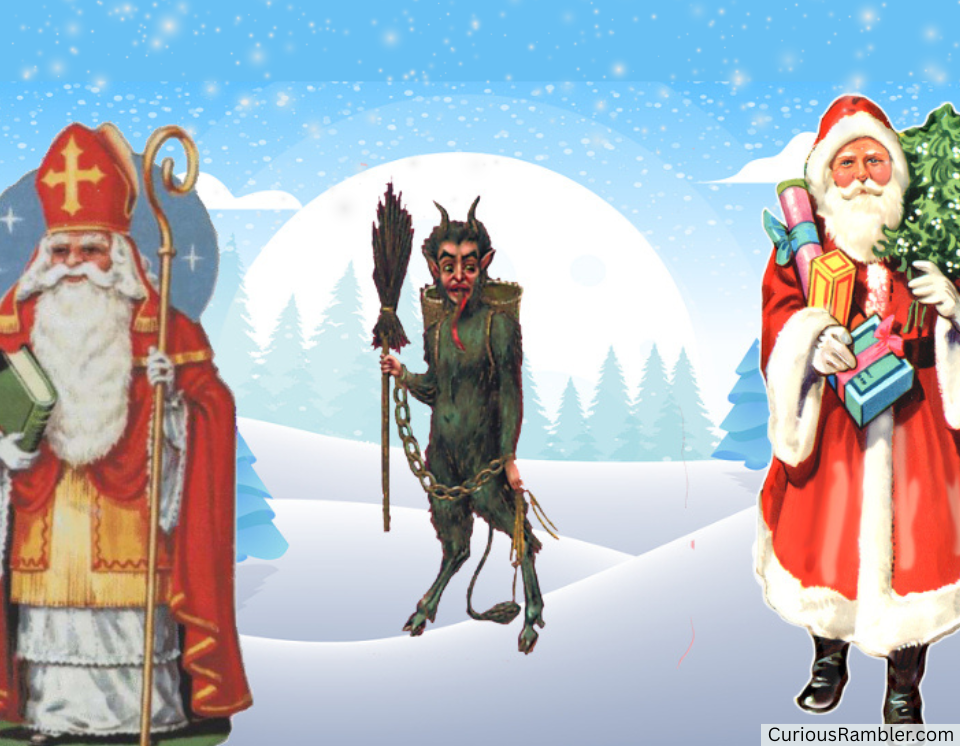
Legend tells us that St. Nicholas was a kind man who loved children and rescued them from harm. But in parts of Europe, he was known to travel with an evil sidekick who punished misbehaving children.
It just wouldn’t be Christmas without that jolly, round-bellied, bearded man in the red suit. He’s called Santa Claus in America, Father Christmas in England, and Père Noël in France (which also means Father Christmas). Although his name and his looks have evolved over the centuries, today, people all over the world recognize the gift-giving man in the red suit.

History of St. Nick
That jolly character that we call Santa Claus can trace his lineage back to the fourth century, when a bishop called Nicholas came onto the scene. He was from the area that is now Turkey and was known for his generosity. He was said to have performed many miracles and eventually became Saint Nicholas, the protector saint of children… and sailors… and fishermen… and barrel makers, merchants, broadcasters, the falsely accused, repentant thieves, brewers, pharmacists, archers, pawnbrokers, and single folk…
Phew! St. Nick must have helped a lot of folks. Even though many groups of people have claimed that he performed miracles for them, today St. Nick is mainly known for making children’s wishes come true. Two well-known medieval legends tell us how he helped three sisters and three brothers.

Saving Girls from Slavery
One medieval tale featuring St. Nick tells of a poor man with three young daughters nearing marrying age. The poor girls had no dowry so no one would marry them, and the father had fallen on hard times and couldn’t afford to keep feeding them. So he felt he had no choice but to sell them into slavery.
One night when Nick was walking by their house, he stopped underneath their window when he heard the girls crying. They were lamenting their situation and wishing there was a way for them to be saved from their terrible fate. Nick was moved by compassion and decided to help the girls.
So, the next evening as he passed by their house, he threw a sack of gold coins through the window. Some say it landed in a sock which was hanging by the fireplace to dry, but it doesn’t matter where it landed, it was enough for the eldest daughter’s dowry. Then the kind, old saint did the same thing twice more for the other two girls.

Saving Boys from the Butcher
Another legend tells us of three young boys who were lost in the woods. A butcher found them and decided that, since he hadn’t had much luck on his hunt that day, those three tender little morsels would do. He chopped them up and put them in the salt barrel to cure. He planned to sell them later as pork.
When St. Nicholas wandered into the butcher’s shop, the evil man tried to sell him a piece of his “best meat.” But Nick couldn’t be fooled. He emptied the salt barrel, pieced the boys back together like a puzzle, then resurrected them and took them back home to their parents. This is probably one of the most common of Nick’s stories and depictions of it are sometimes found in church windows or sculptures. These legends cemented Nick’s reputation as a protector of children and a kind-hearted gift-giver.

Father Whipper
You might suppose that the evil butcher in the second story was duly punished by St. Nick – perhaps imprisoned or banished from the land, but you’d be wrong. According to a legend in northern France, after St. Nick resurrected the boys, the butcher started traveling with St. Nick. He became known as Père Fouettard in French which translates as Father Whipper.
While St. Nick gave gifts to the nice children, Father Whipper dealt with the naughty ones. When he came across a child who had misbehaved, Father Whipper might beat him, abduct him, or even eat him. Thankfully, he’s no longer allowed to do those things. His only job these days is to scare children into being good.

Other Evil Helpers
Northern France isn’t the only place where St. Nick has an evil counterpart, similar characters exist in other parts of Europe too: In the Netherlands, St. Nick is accompanied by Black Peter who might grab up a bad child and go bake him into a cookie. In parts of Austria, Slovenia, and Croatia, St. Nick’s companion is a devilish demon called Krampus.

Krampus is a scary-looking character with horns who seems to be part goat but walks upright. While St. Nick is handing out gifts, Krampus is causing havoc. He grabs up misbehaving children and beats them with his bundle of sticks.
And he doesn’t limit himself to punishing children – he can spank adults too. So, I think it might be best to avoid these areas during Christmas time.
In Winchester Cathedral in England, you can see the above stories of the girls and the boys saved by St. Nicholas told on a baptismal font.
What do you think? Let me know in the comments section below. And if you want to read more of my curious histories, subscribe to my blog (at the top or bottom of this page).
Follow Me on Social Media:


- Rats and Weevils Have Their Day in Court: Strange Medieval Animal Trials – 13 February 2026
- The Great Paris Mustache Strike of 1907: A Close Shave with History – 1 February 2026
- A Hilarious History of Farting – 13 January 2026



COMMENT HERE: What do you think? Leave a comment..