

What is this amazing food that has protected the city under siege, nourished the population during peacetime and inspired men to go to extraordinary lengths to protect it? In fact, it’s an unassuming pancake made of chickpea flour and olive oil.

Used as Ammunition
According to one story, the recipe for socca was discovered when the Turks attacked the city in 1543 (the same battle that Catherine Ségurane fought in). When they ran out of ammunition, the Niçois mixed hot oil with chickpea soup and poured it down on the heads of the invaders. Apparently, it stopped the Turks and when the defenders licked their fingers they thought – “Hey, this stuff is pretty good! We could probably even sell it!”
Have Socca, Will Travel
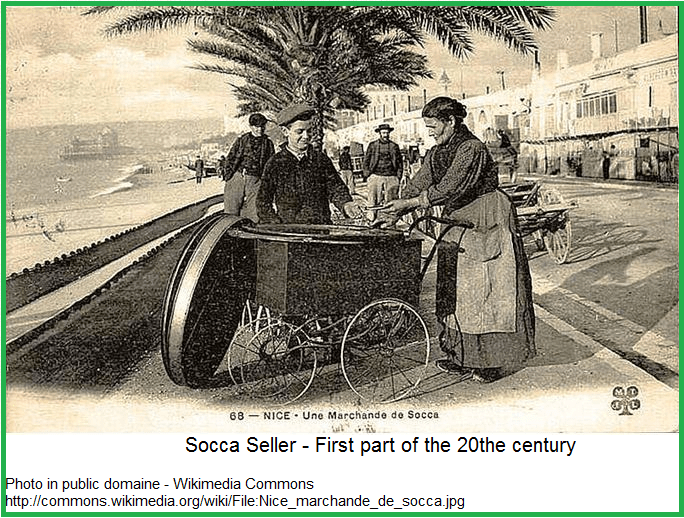
It was in the early 1900s (when socca was no longer needed for military purposes) that it really started to gain popularity as a quick snack sold from portable cookers. These could be taken to the port in the early morning for the fishermen, then later in the day, rolled over to where other labourers were working. It was a nourishing and inexpensive Niçois fast food.
Queen of Socca
One enterprising Niçoise named Térésa, set up her kiosk in the Cours Saleya market and became somewhat of a legend. It seems that she was a gregarious woman who talked to everyone and was always ready to give her opinion about anything and everything, whether it was solicited or not.
Of course, the original Térésa is no longer in the market, but her place has been taken by another “Térésa”. If you visit the Cours Saleya today, you will see a stall called “Chez Térésa” where they serve up socca that is cooked a few streets away. It arrives by scooter every 5 minutes or so.
Three families have owned this business since the original Térésa was there in 1928. And each time it seems that there has been a “woman of character” who slips easily into the role. The one who is there now appears to be more subdued than the one who was there in the 1970s. Christian Gallo, relates a story about the 1970s Térésa in his book, ‘Les Dessous de la Côte’.

Térésa Protects her Socca From the Parisian
In the 1960s -1970s, the Cours Saleya market was covered and cars were not allowed in the perimeter during market hours. One day an unlucky Parisian in a little Fiat 500 tried to drive through. Finding his way blocked by the merchandise and sellers, he started to honk and rev the engine. This sent exhaust fumes in the direction of Térésa’s socca – big mistake. She called out to two stout men nearby and said, “Get that thing away from my socca”. They picked up the small car and set it down in a tiny street where the driver couldn’t even open the doors to get out. He escaped through the roof and probably (if he was smart) waited until the market was closed before going back for his car. I imagine that he showed more respect for socca after that.
Today, this humble pancake still plays an important part in the Niçois life. It can be a mid morning snack, a light meal, or an aperitif. It is best piping hot, dusted with black pepper and accompanied by a glass of rosé. You can eat it on the go from a paper cone (Chez Téresa), or you can sit and eat it on a plate with a fork.

Where to Get a Good Socca?
For my own little taste test, I tried 3 restaurants (oh, the lengths that I go to for my research).
Chez Pipo – 13 Rue Bavastro – The general consensus is that this is one of the best, if not the best place for socca. I liked it, but it was a bit dry for my taste.
Chez Térésa – Cours Saleya market near the church – Here the socca is thicker, moister, and more controversial with some loving it and others hating it. Again, I liked it but found it was a bit too thick.
Lou Pilha Leva – 10 Rue Collet – For me, this socca was the best. It was between the other two, not too dry, not too thick, but just right (I sound like Goldilocks trying the porridge of the 3 bears.)
And of course, there are other restaurants, mostly in the old town but some outside as well. My advice is to do your own taste test. But if you are the adventurous type and want to try this at home, you can find a recipe here – David Lebovitz socca recipe
What do you think? Let me know in the comments section below. And if you want to read more of my curious histories, subscribe to my blog (at the top or bottom of this page).


You can find out more about Nice in my book – Curious Histories of Nice, France
Follow Me on Social Media:

- Curious History Review: April 2026 – 2 April 2026
- The Secret Victorian Language of Flowers: When Bouquets Carried Hidden Messages – 2 April 2026
- Did Michelangelo Carve This Face in Florence? The Palazzo Vecchio Mystery – 17 March 2026





COMMENT HERE: Can't wait to hear what you think… (email not required)