
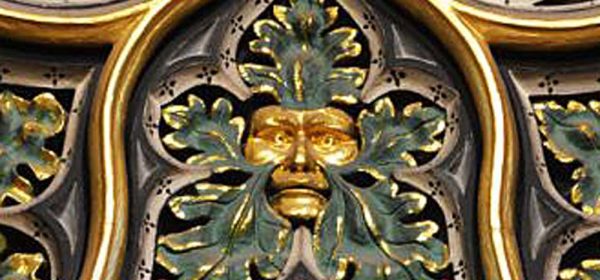

Medieval churches all over Europe are decorated with carved, leaf-covered faces called Green Men. But, after all these years, who they are and why they are there remains a mystery.
If you enter one of those magnificent churches built during the Middle Ages and feel like you’re being watched – you probably are. And not just by the gargoyles, grotesques, and other obvious carvings who are eyeing you. Look up toward the ceiling and you might see a man’s face peeking out from an entanglement of leaves – as if he is hiding and wants to observe you undetected.
What Are Green Men
These curious characters that inhabit our sacred spaces are called Green Men and they come in all shapes and sizes. Sometimes they just stare stoically at us, but often they taunt us by making faces or sticking out their tongues. At other times they’re busy spewing foliage out of their mouths, ears, and even their eyes. What these strange faces might have meant to our medieval ancestors remains unknown.

They’re called “Green Men” with the “green” part of their name referring to the vegetation surrounding (and sometimes sprouting from) their heads. Very rarely, you might find a green woman or a green animal, but for the most part, they are masks of men who have beards and hair of made of leaves. They might be carved of stone or wood and they usually gaze down from church ceilings or pose at the top of columns.
The Green Man’s history is long and obscure. Examples of foliage-covered faces were found in ancient Roman times, and they began to crop up in European churches in the first few centuries AD. But they reached their zenith during the Middle Ages, when there was a surge in church and cathedral building.

What Do They Mean?
Unfortunately, the Medieval architects left us no records of who these Green Men were or what they might represent. Nor do we find any clues in church records. With no firm trail of evidence to tell us who or what they are, people have attached their own ideas to them.
Pagan God
To some people, the Green Man appears to be a Pagan symbol. Perhaps he had links to the Greek god, Dionysus, (also called Bacchus by the Romans) who was god of wine, fertility, and religious ecstasy. Bacchus was often represented wearing a wreath of vines and leaves.
Tree Worship
Another hypothesis is that the Green Man was an integration of tree worship into the church. We know that some Pagans worshipped trees and that in the early days of Christianity, Pagans were brought into the fold by incorporating some of their familiar customs and symbols. Could the Green Man be a tree or vegetation deity? (For more on Pagan tree worship, see: History of the Christmas Tree.)

Personification of Nature
Others think that the Green Man might just be a personification of nature. Some Green Men are surrounded by spring leaves and others by autumn foliage. So maybe he is simply the face of nature and the changing seasons which represent birth, death, and rebirth.
Inoffensive
Whatever these Green Men represented, they didn’t cause a fuss with the Medieval churchgoers. No one ever bothered to explain them, and it seems that no one objected to them.
They were just a part of church decoration, and no one gave much thought to them. Then in the late nineteenth and early twentieth century, an interest in folklore and ancient customs took root. People wanted to preserve the old ideas and stories before they were lost to the modern world.

Lady Raglan Names the Green Man
In the early 1900s, Julia Somerset considered herself an amateur folklorist. She was the wife of Lord Raglan who himself was an amateur anthropologist and archaeologists.
One day Lady Raglan was visiting a church in Wales and the minister, who also fancied himself a student of folklore, pointed out a carving in the church. It was a mans face with oak leaves growing out of the mouth and ears. The minister suggested that it might represent the spirit of inspiration.
But Lady Raglan had other ideas. She began to think of pagan religions and other folkloric characters that she had been reading about. She concluded that the church carvings, along with several mythic characters such as Robin Hood, Jack in the Green, and the May King, must be representations of the same early pagan deity – which she dubbed the Green Man.

In 1939 Lady Raglan published her article, The Green Man in Church Architecture, in Folklore magazine. This article popularized the phrase “Green Man” for the church carvings that had previously been known as “foliate heads.”
In later years, when the study of folklore and architecture was taken up by more serious scholars, Lady Raglan’s theories were questioned. It seems that there was no real evidence to connect Robin Hood and the other characters to the Green Men found in churches. Neither was there any proof that they had Pagan origins. But still, it was a good theory and there are those today who believe it.
Secular Architecture
During the nineteenth-century Gothic Revival, the Green Man leapt from churches over to secular architecture. Then later, when the Arts and Crafts movement came along, the Green Man’s leaves and nature theme meant that he fit right in with that design style too.
Today, the Green Man image is more popular than ever. To modern folk who are concerned about the environment, he’s the spirit of nature and embodies the idea that man and the natural world are intertwined. The Green Man is an ancient symbol that’s still relevant today.
I found this small Green Man plaque that I really like. If you would like to have a little Green Man spirit for your home, you can get this one from Amazon (in fact, they have a set of four – one to represent each season).

- I’m an Amazon Associate, so if you click through from my site and make a purchase, I’ll earn a small commission. But don’t worry, there’s NO extra charge to you.
Read more stories like this in my book Bowlers, Brollies, and Brits: Curious Histories of England

Follow Me on Social Media:
You Might Also Like:


- Did Michelangelo Carve This Face in Florence? The Palazzo Vecchio Mystery – 17 March 2026
- 5 Curious Easter Traditions: Rabbits, Bells, Exploding Carts, and More – 16 March 2026
- Ten Wow-Worthy Women Who Changed History – 5 March 2026




COMMENT HERE: Can't wait to hear what you think… (email not required)