
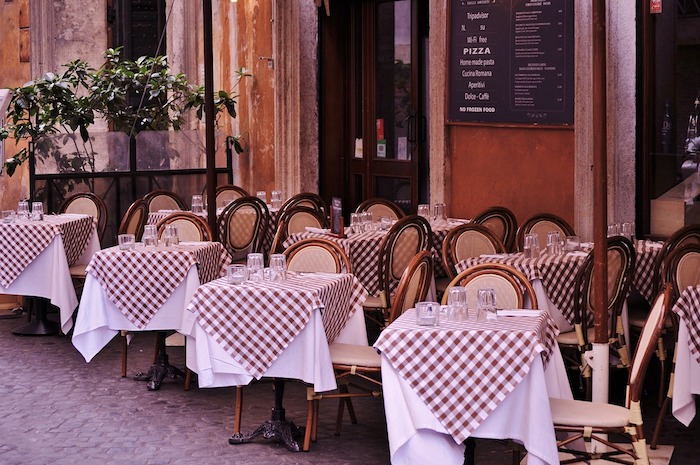

I’m not much of a cook, myself. My husband always says (only half-jokingly) that my favorite thing to make for dinner is reservations. If you too are a fan of restaurants, you might be interested to know how the word restaurant first came to be applied to a place that serves food.
Of course, there have always been places to eat outside one’s own home, but they weren’t always called restaurants. Legend has it that the first eating establishment to be called a restaurant was opened in Paris around 1765 by Monsieur Boulanger. In eighteenth century Paris, there were a variety of places to eat, but they were strictly regulated by the guilds (associations of merchants) and each type of business had its own rules.
The type of food or drink that could be sold depended on the type of establishment: In an auberge a meal was served at a certain time of day, and the clients all sat around one big table and ate whatever the cook had decided to serve that day. The food was placed in the center and everyone served themselves; The traiteurs (caterers) sold stews, ragouts, and full pieces of meat which could be taken away or sometimes consumed on the premises.
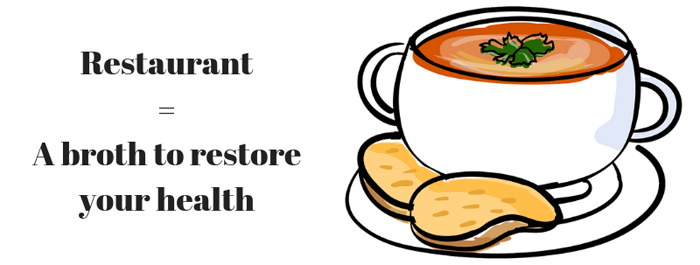
Restaurant = A Healthy Soup
Then along came Monsieur Boulanger (whose name actually means baker). He specialized in restorative broths: thin soups that were thought to help people regain their health. These broths were called restaurants because of their restorative powers. In French the word for restore is restaurer.
Restaurant = A Place to Eat
Eventually, the word “restaurant” which had referred to something akin to chicken noodle soup (good for what ails you) came to mean the place where these restorative soups were sold: Monsieur Boulanger’s restaurant.
Boulanger, however, wasn’t content to just sell his broths. He started to cook up and sell whatever he wanted. One day he went a bit too far when he served sheep’s feet in a thick white sauce that seemed an awful lot like a stew. But, he wasn’t allowed to sell stews – they were in the domain of traiteurs (caterers).
The traiteurs took Monsieur Bonalnger to court where he explained that he made his sauce separately on the side and only poured it over the sheep’s feet after they had been cooked. In a stew, as everyone knows, all the ingredients are cooked together over a long period of time. Therefore, technically, his dish wasn’t a stew. Who knows, maybe Monsieur B bribed the judge with a tasty plate of sheep’s feet, but as the story goes, he won the case. Monsieur Boulanger got to continue selling his sheep’s feet stew (I mean – just sheep’s feet with a nice thick sauce.)
After that, there was no stopping Monsieur B. He made several innovations to his new restaurant. Unlike the auberges that served only at certain times, at Boulanger’s restaurant you could eat whenever you wanted. And you could choose whatever you wanted to eat. He made up a menu and posted it at the door where people could see their choices and his low prices. He filled his space with small, individual tables instead of large communal ones. He even dressed up and stood on the street in front of his restaurant to coax people inside. His pretty wife helped him run the restaurant which also brought in customers.

Monsieur Boulanger opened his restaurant in 1765, twenty-four years before the French Revolution. But it was after the Revolution, that restaurants really began to spring up all over Paris. One contributing factor was that many aristocrats either went to the guillotine or left the country during the Revolution, and their cooks were out of work. These former chefs to the rich went to work in restaurants and raised the overall quality of dining out in Paris.
History tells us that Mr Boulanger’s first restaurant was located on the corner of Rue du Louvre (then known as Rue Pouille) and Rue Bailleul. Today that position is occupied by the Café du Museé which carries on the tradition by offering restorative light meals to weary tourists.

You can read more stories like this in my book, Berets, Baguettes, and Beyond: Curious Histories of France.
What do you think? Let me know in the comments section below. And if you want to read more of my curious histories, subscribe to my blog (at the top or bottom of this page).
Follow Me on Social Media:


- Curious History Review: April 2026 – 2 April 2026
- The Secret Victorian Language of Flowers: When Bouquets Carried Hidden Messages – 2 April 2026
- Did Michelangelo Carve This Face in Florence? The Palazzo Vecchio Mystery – 17 March 2026




COMMENT HERE: Can't wait to hear what you think… (email not required)