
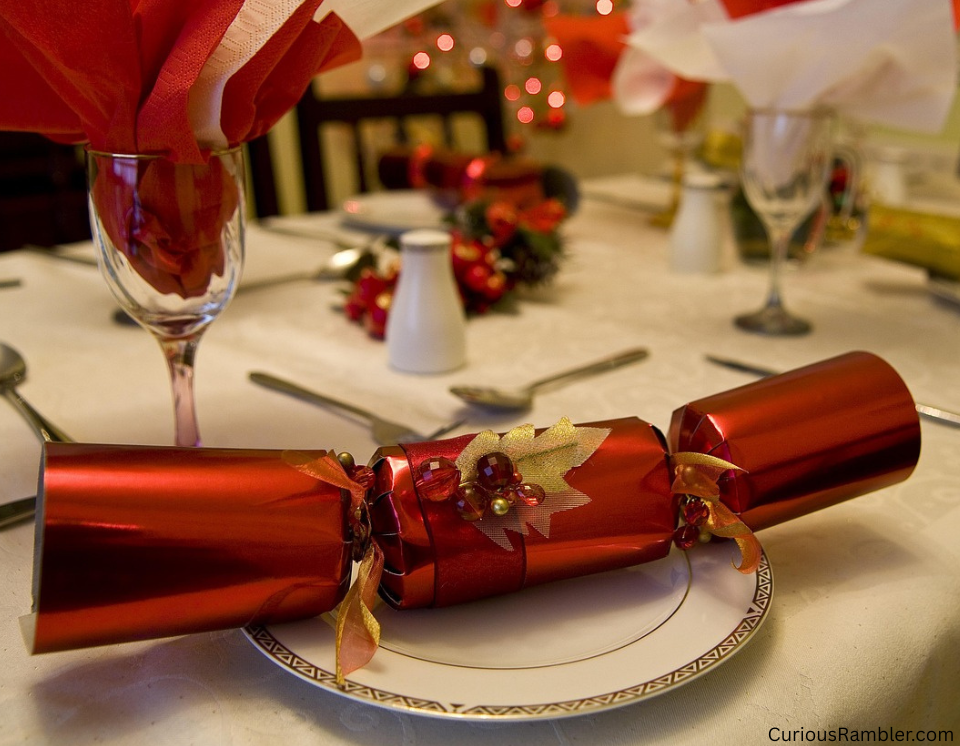
In 1847 British sweet-maker Tom Smith was inspired by French candies and crackling logs. He put them together and came up with the Christmas crackers that we know and love today. And Tom’s crackers have been making Christmas pop ever since.
The only crackers I knew about before moving to the UK were the dry, salty, edible kind – and nothing about them seemed very Christmassy. But, as I soon learned, the British Christmas cracker isn’t meant to be eaten at all…

What is a Christmas Cracker?
Basically, a Christmas cracker is a cardboard tube wrapped in festive paper with a surprise inside. Usually each person at the table has their own cracker and gets help from a neighbor to open it. That’s because it takes two people to open a cracker: Each person pulls one end of the paper until the tube breaks with a snap and the prizes spill out. You usually get a small trinket, a paper crown, and a little slip of paper with a really corny joke printed on it. It’s fun… and a bit quirky!
History: From Candy to Cracker
It all began in the mid 1800s with a chap called Tom Smith. Tom had a shop in London where he made and sold cakes, candies, and a variety of yummy, sweet treats.
One day, on a visit to France, Tom wandered into a French sweets shop. He was checking out the competition and looking around for anything he might add to his London shop. Some little candies wrapped in decorative paper that was twisted at each end caught his eye.

Tom thought his customers would like these lovely little treats. So he went home and began wrapping up small sweets in pretty twisted paper. But Tom added an extra special touch. He put a little piece of paper with a message of love inside each one. Since the French word for candy is “bonbon,” that’s what he called his little treats. The bonbons were romantic, and he sold a few, but basically the public just wasn’t interested.
However, Tom still liked the idea and didn’t want to give up on it. One night he was at home sitting by the fire wondering why his sweet idea had gone sour. Just then, one of the logs in the fireplace popped. Tom jumped – then he smiled. That crackling log had given him an idea. What if he could make his little packages pop when they were opened? That would surely interest people.

He started experimenting with cardboard tubes and silver fulminate-lined paper. He worked hard to find just the right pop. It had to be somewhere between an uninspiring snap and a dangerous explosion that might singe the fingers.
He made the cardboard tubes bigger, and he added little prizes and paper crowns instead of sweets. Then he replaced the sappy love poems with really corny jokes – the kind that makes everyone moan.
Tom’s noisy, newly-designed “bonbons” became known as “crackers” because of the cracking sound they made when pulled open. Sales soon exploded and Tom Smith’s crackers became an important part of any celebration.
Today we mainly associate crackers with Christmas, but up until the 1920s, crackers were made for all kinds of occasions: holidays, social events, birthdays, weddings, just about anything.

In 1880 Tom’s company passed to his sons, then in the 1930s it was sold and became part of the International Greetings Group. Although the company is still called Tom Smith’s, it’s no longer owned by Tom’s family. It is however still known as a maker of quality crackers, and it supplies Christmas crackers to the Royal Family.
Although I don’t think the Christmas crackers I get are quite the same as the ones the Royal Family orders, I still enjoy them. And it just wouldn’t be a holiday celebration without the colorful wrappers, the corny jokes, and that familiar pop.
What do you think? Let me know in the comments section below. And if you want to read more of my curious histories, subscribe to my blog (at the top or bottom of this page).
Follow Me on Social Media:
You Might Also Like:


Amazon Products You Might Like:
- I’m an Amazon Associate, so if you click through from my site and make a purchase, I’ll earn a small commission. But don’t worry, there’s NO extra charge to you.


- A Tragic Medieval Bedtime Story: The Chatelaine of Vergy – 18 September 2026
- Bath’s Jane Austen Festival: Books, Balls, and Bonnets – 5 September 2026
- Curious History Review: September 2026 – 3 September 2026


COMMENT HERE: Can't wait to hear what you think… (email not required)