
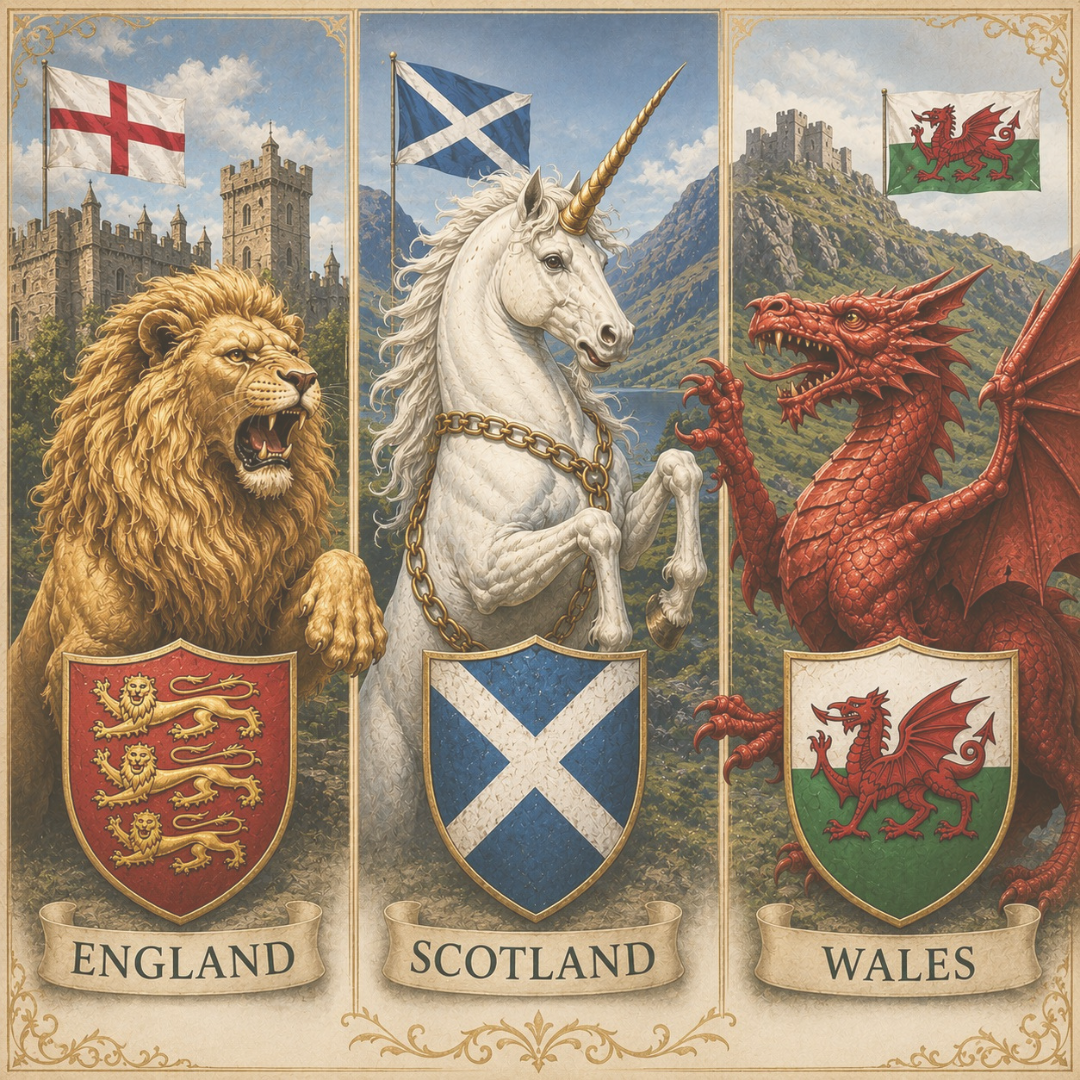
Why does England have a lion when no lions have roamed Britain for thousands of years? Why does Scotland proudly embrace a unicorn? And why does Wales fly the image of a fire-breathing red dragon?
These national animals speak of history, mythology, and national identity.

Why Does England Have Lions?
Out of the three countries that make up Great Britain, England’s national animal is the only one that actually exists. England is represented by a lion.
This may seem a bit odd, considering lions are not exactly native to the English countryside. You’re unlikely to spot one strolling through the Cotswolds.
However, the lion became associated with English royalty during the Middle Ages. It symbolized courage, strength, nobility, and military power. Medieval bestiary books listed the lion as ruling over all other beasts.
So, the Kings of England felt a kinship to the king of beasts and added it to their heraldry – most famously in the royal coat of arms, which features three golden lions.
The lion is often linked to kings such as Richard I, better known as Richard the Lionheart. His nickname helped cement the lion’s place in the English identity.
In short: England’s kings chose the king of beasts.

Why is the Unicorn Scotland’s National Animal?
While England’s national animal isn’t native to their land, Scotland’s animal isn’t native to any land. Their national animal is the unicorn.
Yes, Scotland chose a mythical horse-like creature with a long spiralled horn.
But why? To find out, we need to go back to medieval symbolism. In the Middle Ages, unicorns were believed to be as real as lions and other beasts who lived in faraway places. Their existence was “proven” when traders from the arctic came along with narwhal horns. When they saw that people thought they were unicorn horns (with magical powers) that commanded a very high price, they didn’t bother to tell them they were really from a tusked whale.
Unicorns represented purity, strength, pride, and freedom. In addition, they were believed to be fiercely independent creatures and impossible to tame. That untamed spirit appealed to Scotland’s monarchs, who adopted the unicorn in royal heraldry as early as the 12th century.
The unicorn was also considered by some to be the strongest of all animals. The Scottish kings depicted it with chains around it to demonstrate that they had the power to capture even the strongest and wildest of beasts.
Perhaps no national animal better captures the idea of fierce independence than the unicorn.

Why Does the UK Coat of Arms Have a Lion and a Unicorn?
In folklore, the lion and the unicorn are enemies, and for much of the Middle Ages, England and Scotland were too. They were independent kingdoms that frequently fought over territory and independence. England’s kings often tried to bring Scotland under their control, while the Scots fiercely resisted.
When James VI of Scotland inherited the English throne in 1603, the lion and unicorn suddenly found themselves supporting the same royal shield.
Previously, the Scottish coat of arms had two unicorns, one on each side of the shield. But when King James became King of England as well as Scotland, he replaced one of the unicorns with a lion to represent England. Today the lion and unicorn still stand beside the royal coat of arms appearing on everything from government buildings to British passports.

Why Does Wales Have a Red Dragon?
Wales doesn’t officially have a national animal in the same way that England and Scotland do, but its national animal symbol is undoubtedly the red dragon – another mythical creature. The red dragon appears on the Welsh flag and is tied to ancient Celtic legends.
The traditional Welsh legend tells of a fierce underground battle between a red dragon and a white one. The dragon fight caused the land to tremble until Merlin revealed the cause. The dragons were freed, and the red dragon defeated the white one, symbolizing the victory of the Welsh people over invading forces. This story was popularized in the 12th century book, Prophesies of Merlin, written by Geoffrey of Monmouth.
Today, the victorious red dragon remains the national symbol of Wales and appears proudly on the Welsh flag.
If England chose power and Scotland chose freedom, Wales chose fire-breathing victory.
Britain’s National Animals
| Country | National Symbol | Real? | Meaning |
| England | Lion | Yes (not native) | Courage, royalty |
| Scotland | Unicorn | Mythical | Freedom, purity, strength |
| Wales | Red Dragon | Mythical | Victory, strength |
What National Animals Really Tell Us
National animal symbols aren’t really about wildlife – they’re about identity and the stories these countries want to tell about themselves.
England chose the king of beasts. Scotland chose the creature no one could tame. Wales chose the dragon that refused to be defeated. Together, they tell the story of a nation built as much on legend as on history.
Do you know any other unusual National Animals? Which is your favorite? I’d love to hear in the comments.
If you enjoy strange and lesser-known stories from history, make sure you’re subscribed – and feel free to share this with a friend who might enjoy it too.


Follow Me on Social Media:

- Curious History Review: October 2026 – 1 October 2026
- How Johanna van Gogh-Bonger Made the World See Vincent Van Gogh – 28 September 2026
- A Tragic Medieval Bedtime Story: The Chatelaine of Vergy – 18 September 2026


COMMENT HERE: Can't wait to hear what you think… (email not required)