
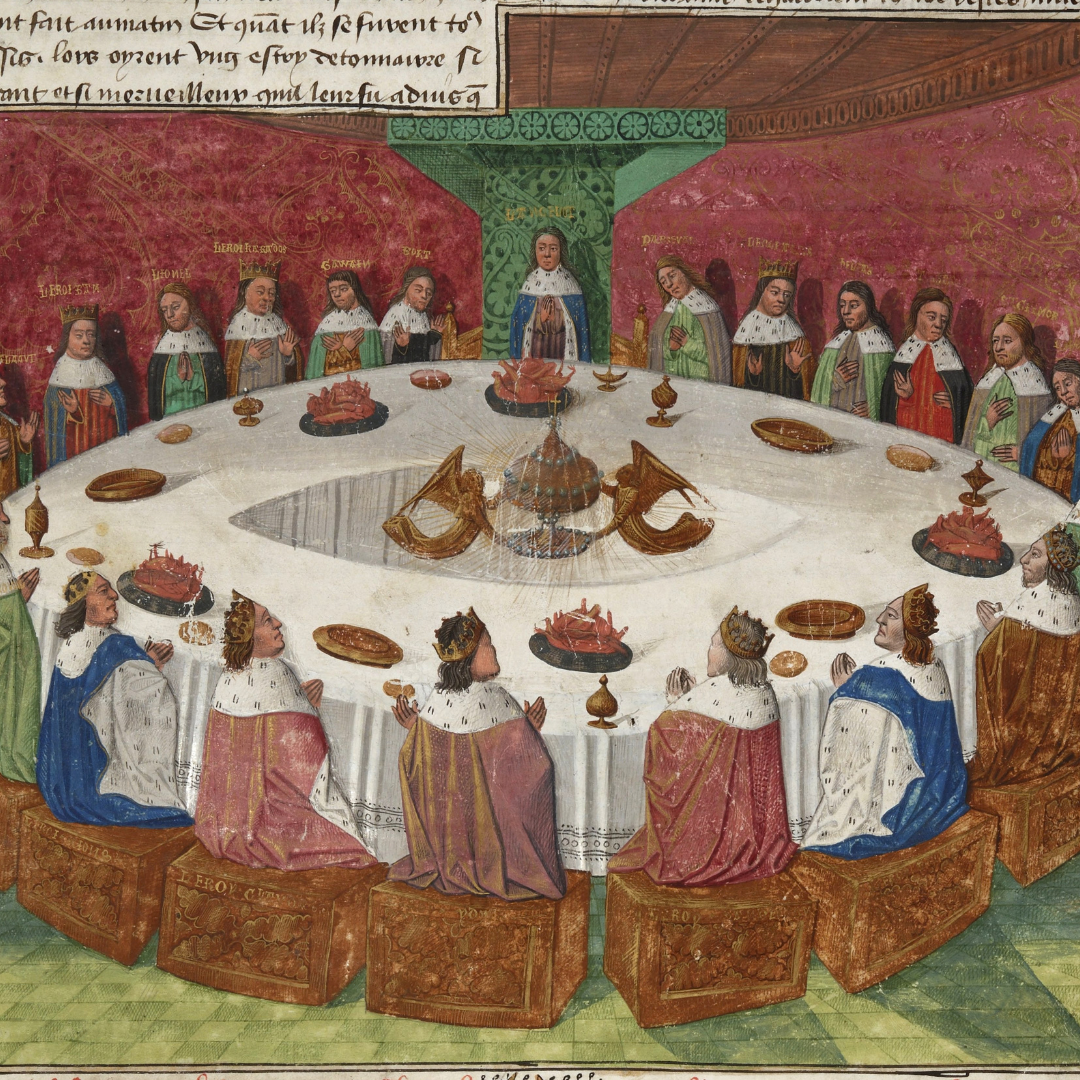

Hanging in the Great Hall in Winchester, there’s a huge, old round tabletop. It brings to mind King Arthur’s Round Table, and for many years, people thought it might have actually been his.
Unfortunately, it’s not. But let’s go ahead and talk about Arthur’s (and Guinevere’s) famous Round Table anyway, then we’ll get to the Winchester one.
Arthur and Guinevere’s Table
King Arthur and his Round Table are legendary. According to medieval tales, Arthur would discuss important matters with his chivalrous knights while sitting around a large circular table.
Today, we consider that table as a symbol of equality: there was no head, so everyone sitting around it had an equally important position. We think what a clever man Arthur must have been to come up with that idea. But maybe it wasn’t Arthur’s idea at all and maybe it wasn’t to show their equality either…
One legend seems to indicate that Arthur acquired the Round Table thanks to his wife, Guinevere. Merlin supposedly created the table for Uther Pendragon (Arthur’s father), but after Uther’s death the table passed to another local king called Leodegran, who just happened to be Guinevere’s father. When Arthur and Guinevere married, the table was given to Arthur as part of his new wife’s dowry.

Too Big
The legends don’t tell us what Arthur and Guinevere did when an enormous table arrived as part of her dowry. But I like to imagine it went something like this…
The newlyweds probably didn’t know what to do with that big unwieldy table. It was too big for the breakfast room and they already had a perfectly good dining table, so they shoved it up in the attic and went about their royal business.
Arthur was so good at his royal business that his reputation spread throughout Europe. Princes and rulers came from everywhere to sit in his court and learn from him. He became a mentor and inspiration to men of valor everywhere.

However, in those days, social rank was a mighty big deal, and at gatherings everyone expected to be seated according to their status. When men showed up at Arthur’s table with the same title or rank, they would fight over which one got the seat closest to the head of the table. This gave Arthur a lot of headaches.
One day Arthur came home complaining yet again about his knights.
“They’re never happy. If two men have the same rank, they fight over who should sit closest to the head of the table. Today they actually drew their swords. I tried assigning the seats at random, but then half of them sulked through the meeting… Honestly, they’re worse than children!”

Guinevere has the Answer
Guinevere looked up from her embroidery and smiled at her husband. “Darling, we already have the perfect solution to your problem. It’s up in the attic. Remember that big round table from my father? If you use that, there’ll be no head of the table for them to fight over. Then maybe you can get something done.”
Arthur hit his forehead with the palm of his hand. “Why didn’t I think of that? Sweetheart, you’re a genius.”
That night Arthur slept better than he had in a good long while. The next day he ordered the big table moved into the meeting room. And when his knights came in, they couldn’t figure out which seat was the most important, so they just sat down and got to work.
So maybe we have to rethink Arthur’s cleverness and give the credit to Guinevere. And maybe the Round Table wasn’t brought out because of high ideals of equality, but just to stop the constant squabbling about who got to sit where.
Of course, no medieval storyteller actually recorded that conversation… But the quarreling knights — and the Round Table’s ability to settle arguments over who sat where — really do appear in early Arthurian literature.
The Winchester Round Table
If you want to get an idea of what Arthur’s (and Guinevere’s) table might have been like, have a look at the Winchester Round Table. The painted wooden tabletop hangs in the Great Hall which is all that remains of Winchester Castle.
It’s 18 feet in diameter, weighs more than a ton, and was once supported by twelve sturdy legs. It’s around 700 years old and has been hanging in this hall for at least the last 500 years – maybe more.

At one time, people believed it was actually King Arthur’s Round Table. But alas, Arthur never put his elbows up on this table. In 1976 it was taken down for radiocarbon dating, and the tests showed that the timber was cut between 1250 and 1280. So it’s a medieval construction made at least 600 years after King Arthur was supposed to have lived. But it’s still pretty impressive and historic.
One of the earliest written records we have of the Winchester Round Table hanging in this hall is in 1464, when John Hardyng wrote (in the spelling of his day):
“The Rounde Table at Wynchestere beganne, and ther it ende, and ther it hangeth yet.”
This was penned during the time that the table was considered to be King Arthur’s and Winchester was associated with Camelot – possibly because of the table.

Real Kings and Round Tables
Medieval people were obsessed with King Arthur, and tales of his exploits were all the rage. Kings fancied themselves as continuing in the mighty ruler’s footsteps, and their faithful knights dreamed of sitting at the Round Table recounting their chivalrous deeds.
One way that kings could recreate Arthurian times was to sponsor a Round Table Tournament. I imagine they were similar to our medieval festivals of today. There was jousting, feasting, dancing, etc. Everyone pretended to be Arthurian: chivalrous, courteous, and righteous.
Edward I and the Round Table
One royal Arthurian fan was King Edward I. He was thrilled when the monks of Glastonbury Abbey found Arthur and Guinevere’s grave. And he participated in the ceremony to place their bones in the new tomb in the abbey.
He also hosted Round Table Tournaments. He held one in 1290 near Winchester to celebrate the betrothals of his children. Historians think the Winchester Round Table was probably made for that occasion. Then after the festival, they had to find a place to store that big table, so they hung it in the Great Hall in Winchester Castle. And there it remains to this day.

Henry VIII and the Round Table
About 200 years after Edward I had the Round Table made for his tournament, Henry VIII came on the scene. He was another king who felt closely connected to Arthur. He visited Winchester Castle and saw the table in 1516. He decided it would be a good thing to show off to the Holy Roman Emperor, Charles V, when he came for a state visit six years later.
So Henry had the table painted in the design we see today. In the process, he made sure that the connection between Arthur’s reign and his own was clear. In the center of the table is Henry’s emblem, the Tudor rose, and at the top is a likeness of King Arthur.
But since no one knew what Arthur looked like, Henry decided his own features would do just fine. So what we see today is King Arthur with a young Henry VIII’s face.
Even though the huge Round Table hanging in Winchester’s Great Hall didn’t belong to King Arthur (or Guinevere) it’s not an imposter. It’s a good representation of what Medieval people thought Arthur’s table looked like.
For centuries people looked up at it and believed it was actually Arthur’s table. And maybe an object believed in for that long can actually take on a bit of the mystique and magic associated with those fabulous Arthurian tales.


Read more stories like this in my book, Bowlers, Brollies, and Brits: Curious Histories of England.
Follow Me on Social Media:

- A Tragic Medieval Bedtime Story: The Chatelaine of Vergy – 18 September 2026
- Bath’s Jane Austen Festival: Books, Balls, and Bonnets – 5 September 2026
- Curious History Review: September 2026 – 3 September 2026



COMMENT HERE: Can't wait to hear what you think… (email not required)