
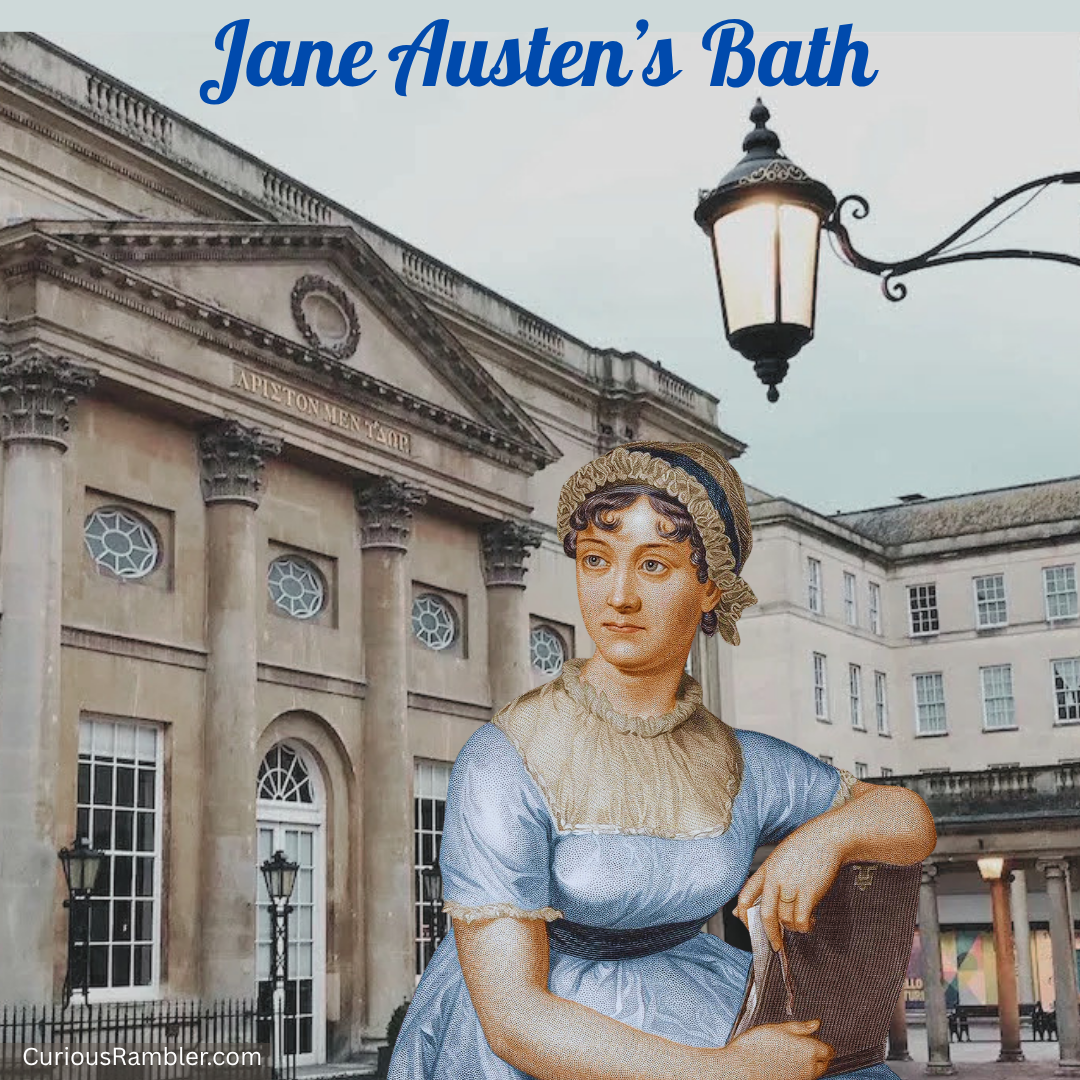
Follow Jane and Her Characters Through the City – With a Few Frankenstein and Bridgerton Encounters Along the Way.

Walk in Jane Austen’s footsteps, visiting the places she lived and socialized, the streets she wrote about, and the world of balls, bathing, shopping and gossip that surrounded her.
Two of Jane’s novels, Northanger Abbey and Persuasion are partially set in Bath, and many of the streets and buildings she mentions are still here.
This walk would be great to do in September during the ten-day Jane Austen Festival – or at any time.
And Jane isn’t the only literary connection we’ll encounter. Mary Shelley lived here and wrote much of Frankenstein while in Bath. And if some of these Georgian streets look familiar, it might be because much of Bridgerton was filmed here.
About This Walk
The sites are spread across Bath, so I’ve divided the walk into three main areas. You can do all three in succession, or choose individual sections depending on your time and energy. Then there’s a Worth a Detour section. These are sites that have Austen connections but don’t fit neatly into the main route.
And at the bottom of this page there is a map with all the sites marked.
You can also use the index below to jump to specific places.
Clickable Walking Tour Index
IN THE CENTER (approx. 30 min.)
- Bath Abbey • Roman Baths • Frankenstein sign • Pump Room
- Georgian Baths • Bath Street • Cross Bath • Hetling Pump Room • Hot Bath & Thermae Spa
- Shopping With Jane • Union Street • Union Passage • Milsom Street
- Jane Slept Here • Trim Street • Queen Square
UP THE HILL (approximately. 30 min.)
- Gay Street • Jane Austen Centre • House of Frankenstein • No. 25 Lodging
- The Circus • Assembly Rooms • Royal Crescent & No.1
- Gravel Walk
THE BRIDGE & BEYOND (approximately. 20 min.)
A Note About the Austen Connections
Under the title of each place, I’ve tried to make clear what the site is about:
- JANE AUSTEN – Places we know Jane lived, stayed or visited.
- IN THE NOVELS & JANE’S LETTERS – Places Jane wrote about.
- GEORGIAN BATH – Places that help us understand the city Jane lived in.
- FRANKENSTEIN or BRIDGERTON – Places related to one of these.
Let’s get started…
IN THE CENTER
The Abbey Courtyard

1. Bath Abbey
GEORGIAN BATH
We’ll begin right in the heart of Bath, in front of Bath Abbey. The Abbey has stood here since the Middle Ages, so it was already an ancient Bath landmark when Jane Austen knew the city.
Jane was the daughter of an Anglican clergyman and religion was an important part of her life, but there’s no known record of her attending services here. Nor does the Abbey make an appearance in either of her Bath novels.
Still, it would have been an unmistakable part of the city Jane knew – and a very convenient place for us to begin.
2. Roman Baths
GEORGIAN BATH
Just beside the Abbey is the entrance to to Roman Baths. Today, the archaeological remains of the old Roman baths are a huge tourist attraction, but in Jane’s time, they were still mostly hidden underground and covered over by Georgian buildings. They weren’t excavated until the late 19th century.
So, while Jane certainly knew Bath as a spa town built around its ancient hot springs, she never saw the Roman Baths as we can see them today.

3. Mary Shelley and Frankenstein Sign
FRANKENSTEIN
Between the Roman Baths entrance and the Pump Room, look for a sign marking the site where Mary Shelley wrote much of her famous novel.
A little over a decade after Jane Austen left Bath, Mary Shelley, another young female novelist, arrived. Mary lived here in 1816–1817 with Percy Bysshe Shelley and her stepsister. It was during this time that she continued work on her book, Frankenstein, which she had first begun at Lake Geneva in the famous ghost-story competition.
In a quirky modern twist, the place where Mary Shelley worked on her story about a creature being brought to life by electricity now sits directly above… an underground substation that delivers thousands of volts of electricity to central Bath. You really couldn’t make it up.
4. Pump Room
JANE AUSTEN • IN THE NOVELS: NORTHANGER ABBEY • GEORGIAN BATH
Standing in the Abbey Churchyard, the Pump Room was one of the most fashionable spots in Georgian Bath. It was the place to drink the hot spring water and to see and be seen.
Taking the Waters
Visitors flocked to Bath to drink its naturally hot mineral water. Doctors of the day prescribed drinking it for gout, rheumatism, skin complaints, infertility, and even melancholy.

See and Be Seen
The Pump Room wasn’t just for drinking the water.
It was also at the heart of Bath’s morning social scene. People came to listen to music, promenade around the room, find out who else was in Bath, be introduced to them, notice what they were wearing, and hear the latest gossip about them.
Jane knew this social world firsthand, and she portrays it humorously in Northanger Abbey, where Catherine Morland spends many an hour in the Pump Room:
“Every morning now brought its regular duties – shops were to be visited; some new part of the town to be looked at; and the pump-room to be attended, where they paraded up and down for an hour, looking at everybody and speaking to no one.”
Northanger Abbey, Chapter 3
Why were they looking at everybody but speaking to no one? Because they hadn’t yet been formally introduced to anyone. In polite Georgian society, you couldn’t just wander over and start chatting to an interesting stranger. (Heaven forbid!)
Today, the Pump Room is a lovely place to have a meal or an afternoon tea, and the original marble vase fountain still runs with mineral waters that you can taste by asking a server.

Georgian Baths Area: Taking the Waters
We’ve seen where fashionable visitors drank Bath’s famous mineral water. Now let’s see where they went to bathe in it.
👉🏼 Directions: With the Abbey behind you, leave the Abbey courtyard and walk straight ahead onto Stall Street. Turn left and stop at the entrance to Bath Street (the first street on your right). You’ll recognize it by the elegant colonnades on both sides.
5. Bath Street
GEORGIAN BATH • BRIDGERTON
Take a moment to look down Bath Street. It is pure Georgian elegance. In Jane’s day this was a busy street lined with shops selling fabric and all sorts of fashionable goods.
Its preserved Georgian architecture also appears in Bridgerton, where it stands in for Regency London.
6. No. 1 Bath Street
JANE AUSTEN
Look to the right-hand side of Bath Street (the Primark side) and find the Arlington House sign. This is approximately where No. 1 Bath Street stood, and it’s where a shopping trip landed Jane Austen’s aunt, Jane Leigh-Perrot, in serious trouble.
In August 1799, Aunt Jane visited this shop and bought some black lace. After she left, a card of white lace was discovered among her purchases… And she was accused of stealing it.
Aunt Jane claimed she was innocent, and the lace had been planted in her parcel to extort money from her. She was arrested and spent seven months in jail awaiting trial… Well, she wasn’t exactly in jail, because her husband paid for them both to lodge with the jailer and his family. Wealthy people could do that instead of actually sitting in a jail cell. Anyway, it was quite the scandal.
The good news is that Aunt Jane was acquitted. (Whew!) Now that we have that juicy bit of Austen family gossip out of the way, let’s get back to the baths.
Back to the Baths
Before continuing down Bath Street, turn around and look at the carving above the three doors behind you. You’ll see: KING’S AND QUEEN’S BATHS. In Jane’s time both these baths were in use but have since closed.
The covered walkways along Bath Street were designed to connect the old King’s and Queen’s Baths with the newer ones at the end of the street and protect people as they moved between them.

7. Cross Bath
GEORGIAN BATH
Continue down Bath Street to the small building at the end.
This is the Cross Bath, one of Bath’s historic thermal baths. Fed by its own natural hot spring, it’s still used for bathing today as part of Thermae Bath Spa.
Have a look through the window at the front, where you can see part of the bathing area and read a little about its history.

8. Hetling Pump Room
JANE AUSTEN • JANE’S LETTERS • GEORGIAN BATH
Look to the left and find the building with the large, faded words HETLING PUMP ROOM high on its wall.
In May and June 1799, Jane came to Bath with her mother and her older brother Edward, who had come for his health and was being treated at the Hetling Pump Room.
“He drinks at the Hetling Pump, is to bathe tomorrow, and try electricity on Tuesday… but I fancy we are all unanimous in expecting no advantage from it.”
Jane Austen to Cassandra, 2 June 1799
It sounds like Jane wasn’t exactly a believer in the healing waters of Bath.
The Hetling Pump Room is now the small but interesting Bath Medical Museum. They do have a bit of Austen history and sometimes have special exhibitions. Please check the Bath Medical Museum website for their hours and to see what’s on.

9. Hot Bath and Thermae Spa
GEORGIAN BATH
Opposite the Hetling Pump Room sign, look for a glass doorway with HOT BATH above it.
The Hot Bath was another of the thermal baths used by the Georgians. It has now been incorporated into the modern Thermae Bath Spa which you can see with the large glass wall.
It’s interesting that more than two centuries after Jane’s time, people are still coming to this same little corner of Bath to soak in the city’s naturally hot mineral water.
👉🏼 Directions: Retrace your steps back up Bath Street. Turn left onto Stall Street and continue until you reach Westgate Street.
Shopping with Jane: Shopping Streets
When you cross Westgate Street, straight ahead is wide Union Street, and just to its right is the narrower Union Passage. Both are shopping streets and both appear in Jane Austen’s novels.
So, follow the route of your favorite heroine: Either Anne Elliot on Union Street, or Catherine Morland and Isabella Thorpe on Union Passage. Proceed to the next street which is Upper Borough Walls.

10. Union Street With Anne
IN THE NOVELS: PERSUASION
Union Street plays a small but important part near the end of Persuasion. After Anne Elliot receives Captain Wentworth’s famous letter, she leaves the White Hart Inn, and in Union Street, she encounters Wentworth himself.
Anne had been walking with Charles Musgrove, but he very conveniently leaves her with Wentworth. The couple continue toward the Gravel Walk, where they finally have the conversation readers have been waiting for. (We’ll get there later.)
11. Union Passage With Catherine
IN THE NOVELS: NORTHANGER ABBEY
Just to the right, running parallel to Union Street, is narrow Union Passage.
In Northanger Abbey, Catherine Morland and Isabella Thorpe encounter two young men in the Pump Room who interest Isabella. When the men leave, Catherine and Isabella follow them. Their pursuit takes them through Union Passage.
12. Milsom Street
IN THE NOVELS: NORTHANGER ABBEY & PERSUASION • GEORGIAN BATH
If you’ve taken Union Street, you will see wide Milsom Street straight ahead. If you are on Union Passage, just go one street to your left and look right to see Milsom Street.
The street directly ahead is Burton Street for a short distance before becoming Milsom Street. Just look for now.
In Jane Austen’s time, this was one of Bath’s most fashionable shopping streets – the place to browse, promenade, and socialize.
It features prominently in Northanger Abbey. Henry Tilney and his sister Eleanor have lodgings here, while Catherine Morland and Isabella Thorpe shop and promenade along the street.
In Persuasion, Anne Elliot is walking on Milsom Street in the company of her cousin, Mr. Elliot, her sister, and Mrs. Clay when they get caught in the rain. They go into a confectioner’s shop, and Anne is surprised when Captain Wentworth comes in.
You may want to come back later for a little shopping of your own, but for now, stay on Upper Borough Walls and some places Jane stayed.
Jane Slept Here
Let’s go find a few places where Jane actually stayed.
👉🏼 Directions: Walking left on Upper Borough Walls, just beyond Caffè Nero, look for a narrow street on the right – sloping downhill and curving to the left. This is Trim Street.

13. Trim Street
JANE AUSTEN • JANE’S LETTERS • BRIDGERTON
Trim Street was Jane Austen’s final – and probably least desirable – Bath address. And, unfortunately, we don’t know exactly which house number it was.
After Jane’s father died, finances became much tighter for Jane, Cassandra, and their mother. They had to move several times to find cheaper accommodations.
When the Austens were originally house hunting in Bath in 1801, they had considered Trim Street an undesirable possibility. Jane wrote that her mother:
“will do everything in her power to avoid Trim Street.”
So, ending up here five years later is rather sad, and illustrates how far the family’s circumstances had declined following the death of Jane’s father. The Austen women left Trim Street and left Bath for good in July 1806.
BRIDGERTON: On a happier note, Trim Street also appears in Bridgerton. Have a look at No. 12 and see if you recognize it as Gunter’s Tea Shop where Daphne and Simon eat ices. This street was also used for filming street scenes.
👉🏼 Directions: Continue along Trim Street to Barton Street. Cross Barton Street and turn right.

14. Queen Square & No. 13
JANE AUSTEN • JANE’S LETTERS
At the end of Barton Street you’ll see leafy Queen Square with its tall obelisk in the center. This obelisk was already standing here when Jane knew Bath.
To get to our main Austen connection, walk along this side of Queen Square, passing the entrance to the Francis Hotel, until you reach No. 13.
This is where Jane stayed when she visited in May-June 1799 (before they moved to Bath). She was here with her mother and her older brother Edward and his family. This was when Edward underwent his treatments at the Hetling Pump Room (the ones Jane was skeptical about).
At this point, if you need a break, go back down Barton Street to find plenty of cafés.
Otherwise, it’s time to go…
UP THE HILL
Gay Street, the Assembly Rooms & Royal Crescent
And yes, unfortunately, we really do have to walk up a gentle hill.
👉🏼 Directions: Looking at Queen Square from No. 13, walk toward the top right corner of the square to find Gay Street.

15. Jane Austen Centre
JANE AUSTEN
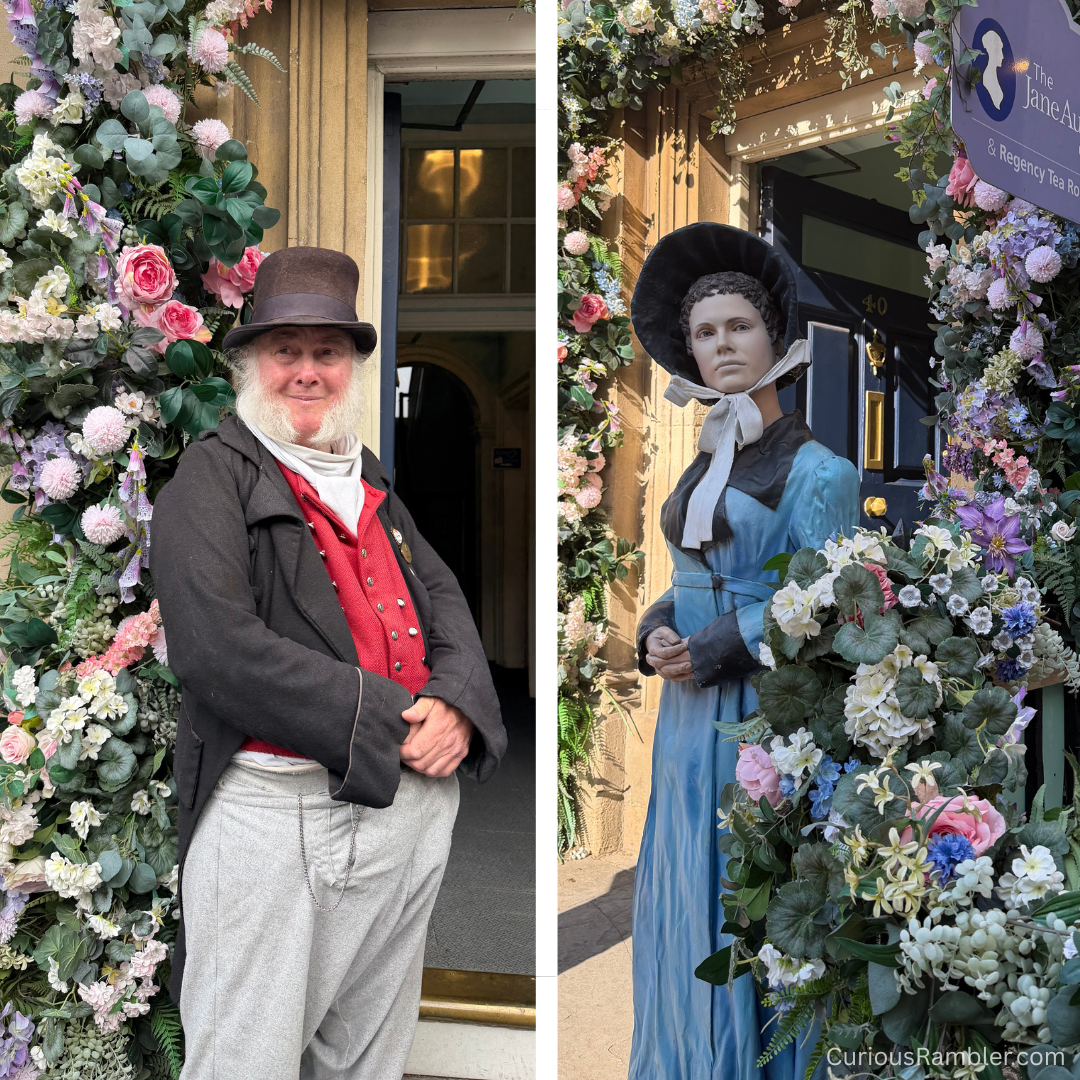
Start walking up Gay Street and you’ll probably spot Jane (or a mannequin dressed like Jane) standing out on the porch to greet you.
The Jane Austen Centre, at 40 Gay Street, is not a Jane Austen home, but it’s in a Georgian townhouse typical of the period. And it’s just a few doors away from where Jane actually lived in 1805.
The Centre explores Jane’s life, books, and years in Bath. You can dress in Regency costume, try writing with a quill and ink, play period games, and meet costumed characters. There’s also a gift shop and a Regency Tea Room – in case you need a little break.
Continue up Gay Street.
16. Mary Shelley’s House of Frankenstein
FRANKENSTEIN
At 37 Gay Street is Mary Shelley’s House of Frankenstein. It’s an interesting coincidence: museums dedicated to two famous female novelists sit almost side by side in Bath – even though the books they produced could hardly be more different.
This is not a house where Mary Shelley lived. It’s a modern immersive attraction devoted to Mary’s life and her famous creation, with scary exhibits, escape rooms, and a horror basement.
Continue up Gay Street.
17. No. 25 Gay Street
JANE AUSTEN
No. 25 Gay Street: This is where Jane, Cassandra and their mother moved in 1805 after George Austen’s death left them with a reduced income and in need of cheaper lodgings.
Continue up Gay Street to the top of the hill.

18. The Circus
GEORGIAN BATH
At the top of Gay Street you’ll emerge into one of Bath’s great Georgian showpieces: the Circus. It’s made up of three curved terraces of townhouses arranged in a circle around a green central space.
Look closely at the façades and you’ll see classical columns, decorative friezes and all sorts of carved symbols. Note the acorns around the top. These are said to be a nod to Bladud, the mythical founder of Bath and his pigs who, while looking for acorns, discovered the healing hot spring.
The Circus was already part of fashionable Bath when Jane knew the city, and it would have been on the route between Gay Street and the Upper Assembly Rooms.
👉🏼 Directions: Turn right onto Bennett Street.
19. Bath Assembly Rooms
JANE AUSTEN • JANE’S LETTERS • IN THE NOVELS: NORTHANGER ABBEY & PERSUASION • BRIDGERTON
⚠️ Please note: The Bath Assembly Rooms are currently closed for restoration, with reopening planned for 2027. You can’t see anything, but we can talk about them…
In Jane’s day, these Assembly Rooms (also known as the Upper Rooms) were at the heart of fashionable Bath society. People came for balls, concerts, cards, conversation, flirtation and – naturally – to see who else was there. And we know that Jane herself attended social events here and wrote about them in her letters.
Northanger Abbey
The Assembly Rooms are central to Catherine Morland’s Bath experience. She attends balls in both the Upper and Lower Rooms. Her first rather unsuccessful ball takes place here, at the Upper Rooms. Her first meeting with Henry Tilney, however, takes place at the Lower Rooms, which once stood elsewhere in central Bath and no longer exist.
Persuasion
The Upper Rooms also appear in Persuasion. Anne Elliot attends a concert here, where she encounters Captain Wentworth during one of the many frustrating attempts to understand one another.
Bridgerton
The magnificent interiors of the Assembly Rooms have also been used for lavish ball scenes in Bridgerton and Queen Charlotte: A Bridgerton Story.
👉🏼 Directions: Return to the Circus and take Brock Street toward the Royal Crescent.

20. No. 1 Royal Crescent
GEORGIAN BATH • BRIDGERTON
No. 1 Royal Crescent is a historic house museum decorated and furnished as a wealthy Georgian home might have been during Jane Austen’s lifetime. It offers a peek inside a Georgian Bath lifestyle.
ON SCREEN: The house appeared in the 1987 adaptation of Northanger Abbey, and Bridgerton fans may recognize its exterior as the Featherington family home.
👉🏼 Directions: Walk around the side of No. 1 and the rest of the Royal Crescent will reveal itself rather spectacularly.
21. Royal Crescent
IN THE NOVELS: NORTHANGER ABBEY • GEORGIAN BATH • BRIDGERTON
The Royal Crescent is one of the great symbols of Georgian Bath. Its 30 attached houses form a sweeping classical façade overlooking the open green space below.
Jane knew the Crescent and gave it a small role in Northanger Abbey. Catherine Morland and Isabella Thorpe come here after church to:
“breathe the fresh air of better company.”
In other words, they have come for the air… But preferably the air surrounding the right sort of people.

Sedan Chairs
Standing here also highlights one practical problem for fashionable Bathonians living at the Crescent… We’ve just walked uphill from the city center. Wealthy Georgians wouldn’t necessarily do the same. They might hire a sedan chair – much like a taxi – to carry them up and down the hill. They would be protected from the weather, and they could save their energy for dancing or promenading. No. 1 Royal Crescent often has a sedan chair sitting outside as well as one inside.
BRIDGERTON: The Crescent and the road in front of it appear in multiple scenes: for carriage arrivals, promenades and London street scenes.
👉🏼 Directions: Head back toward No. 1 Royal Crescent and take the first pathway leading away on your right. Follow it a short distance until you see another path branching to the left. This is the Gravel Walk. Today, there is a paved pathway alongside the gravel one, so feel free to choose.

22. Gravel Walk
IN THE NOVELS: PERSUASION
For Persuasion fans, this is one of the most important places on the tour. Near the end of the novel, Captain Wentworth writes Anne Elliot the famous letter containing the declaration:
“You pierce my soul.”
Anne reads the letter and then encounters Wentworth in Union Street – where we walked earlier. Anne and Wentworth then continue to what Jane calls the:
“comparatively quiet and retired gravel walk”
Here, they talk about their mistakes and misunderstandings and finally reconcile – to the delight of the reader. So if you followed Anne Elliot through Union Street earlier, you have now followed her almost to the end of her story.
At the end of the Gravel Walk, you’ll descend a wide set of stairs. If you continue straight ahead through a parking area, you will find Queen Square, or if you go left, you will see the Jane Austen Centre where we began this section of the tour.
THE BRIDGE AND BEYOND
Pulteney Bridge, Sydney Gardens & Jane Austen’s Home
Our final main section takes us across the River Avon into the neighborhood where Jane lived when her family first moved to Bath.

23. Pulteney Bridge
JANE AUSTEN • GEORGIAN BATH
Pulteney Bridge was completed in 1774 to connect the old city with the new development taking shape across the river.
It’s an unusual bridge in that shops line both sides. So while crossing it, it can be easy to forget there is a river beneath you.
When the Austens lived at 4 Sydney Place, crossing the bridge was the main route between their home and central Bath. So, Jane would have known it well and crossed it frequently.
👉🏼 Cross the bridge and continue straight ahead.
24. Laura Place
JANE AUSTEN • JANE’S LETTERS • IN THE NOVELS: NORTHANGER ABBEY & PERSUASION
Almost immediately after crossing the bridge, you’ll come to a roundabout with a fountain in the center. This is Laura Place. In Jane’s time, this was a new and fashionable address and she used it in both of her Bath novels.
In Persuasion:
“Lady Dalrymple had taken a house, for three months, in Laura-place, and would be living in style.”
Persuasion, Chapter 16
In Northanger Abbey:
Laura Place also appears in Northanger Abbey. John Thorpe is driving Catherine Morland out of Bath when she suddenly sees Henry and Eleanor Tilney. Catherine desperately wants Thorpe to stop, but:
“They passed briskly down Pulteney Street, and through Laura Place…”
and the Tilneys disappear from view.
Jane also mentions Laura Place in her own correspondence. While the Austen family was considering where to live in 1801, she says they are considering:
“some of the short streets leading from Laura Place or Pulteney Street.”
They ended up very close by – just at the end of the street.
25. Great Pulteney Street
JANE AUSTEN • IN THE NOVELS: NORTHANGER ABBEY • GEORGIAN BATH
Stretching ahead is Great Pulteney Street, one of Bath’s grandest Georgian streets. Jane’s home at 4 Sydney Place was at the far end, close to Sydney Gardens, so this was very much part of her neighborhood.
Great Pulteney Street also has an important fictional resident. When Catherine Morland arrives in Bath with Mr. and Mrs. Allen in Northanger Abbey, they take lodgings in Pulteney Street.
Continue along Great Pulteney Street until you see the grand building at the far end.

26. Holburne Museum – Former Sydney Hotel
JANE AUSTEN • GEORGIAN BATH • BRIDGERTON
Today this elegant building is the Holburne Museum. But when Jane lived across the street, it was the Sydney Hotel and formed the grand entrance to Sydney Pleasure Gardens. The hotel provided refreshment and entertainment for visitors to the gardens.
BRIDGERTON: Fans of Bridgerton will immediately recognize this majestic building as the exterior of Lady Danbury’s house.
27. Sydney Gardens
JANE AUSTEN • JANE’S LETTERS • GEORGIAN BATH
Just behind the former Sydney Hotel was the Sydney Pleasure Gardens. Georgian pleasure gardens offered much more than a pleasant walk. Visitors could promenade, play games, sit and read, attend breakfasts, concerts and evening galas.
And Sydney Gardens had another attraction that particularly appealed to Jane: A labyrinth. When the family was considering the move to Bath in January 1801, Jane wrote:
“It would be very pleasant to be near Sydney Gardens; we might go into the labyrinth every day.”
Jane Austen to Cassandra Austen, 21 January 1801
Unfortunately, Jane’s labyrinth no longer survives, but we can see her home just across the street.

28. 4 Sydney Place
JANE AUSTEN
Across from Sydney Gardens you’ll find 4 Sydney Place. This was Jane’s first home after the family moved to Bath in 1801. She was 25 when she lived here with her parents and her sister, Cassandra. Out of all the places she lived in Bath, this is probably the grandest and best located. It’s also where she lived the longest.
The family remained in this house until 1804. You may notice a plaque near the door stating that Jane lived here until 1805. However, Historic England confirms that the Austen family left Sydney Place in 1804.
When Jane lived here, there was entertainment across the street at the pleasure gardens, and all that Bath society lay just the other side of Pulteney Bridge. It was a busy social scene, and she portrayed much of it for us in Northanger Abbey and Persuasion.
And more than two centuries later, it’s pretty wonderful that we can still see Bath much as Jane did. We can see where she lived and socialized and walk the streets where she imagined her characters living their lives.
👉🏼 Directions: Go back to Great Pulteney Street and head back toward Pulteney Bridge.
29. Beazer Garden Maze
MODERN BATH • GEORGIAN BATH
If Jane’s remark about visiting the labyrinth every day has given you a hankering to meander through a maze or lumber through a labyrinth, you are in luck… There’s one more optional stop on the way back toward central Bath.
Down beside the river near the bridge, there’s a small labyrinth that you can follow and contemplate Jane’s life in Bath or your favorite novel. Although it’s called Beazer Garden Maze, it’s really a labyrinth. You can’t get lost – you just meander along the path.
So, if you would like a little diversion at this point, you can spend a bit of time at Beazer Garden Maze. You will find the stairs just at the beginning of the bridge on the left. Or there is a step-free (but longer) route on the right: Turn right on “Grove Street – Leading to St John’s Road” – at the first opportunity, turn left and cross back under the bridge.
The Beazer Garden Maze is on the site of the 18th-century Spring Gardens. This modern maze dates from 1984, but sits on the site of Bath’s Georgian Spring Gardens, which were established in the 1730s and closed just before the Austens moved to Bath. So while Jane wouldn’t have seen this maze, she would have enjoyed a similar experience in Sydney Gardens.
WORTH A DETOUR
More Jane Austen
The main route may be finished, but Bath still has a few more Austen connections to discover.
These places don’t fit neatly into the walk, but each has a genuine Austen story attached to it.

30. St Swithin’s Church
JANE AUSTEN
St Swithin’s Church on Walcot Street has two important connections with Jane’s family: Jane’s parents, George Austen and Cassandra Leigh were married at this church in 1764. And George Austen was buried here in 1805. It’s likely that Jane would have attended services here when staying nearby with her aunt and uncle, the Leigh-Perrots, at 1 The Paragon.
Jane’s father’s gravestone can be seen in the small cemetery attached to the church. There is a more modern plaque beside it that also mentions his famous daughter. There may be a bit more Austen history inside.
31. No. 1 The Paragon
JANE AUSTEN
No. 1 The Paragon was the Bath home of Jane’s aunt and uncle, Jane and James Leigh-Perrot. Uncle James was the elder brother of Jane’s mother. They were considerably wealthier than the Austens and divided their time between their Berkshire estate and their Bath residence.
And if Aunt Jane’s name sounds familiar, it should… This is the same Aunt Jane Leigh-Perrot who was arrested – and finally acquitted – of stealing some lace from the shop at No. 1 Bath Street.
Jane Austen stayed with her aunt and uncle during visits to Bath before the family moved here. We know she was there in May 1801, when she and her mother were house-hunting for the move to Bath.
So, this area formed part of Jane’s Bath experience before Bath became her home.

32. Old Theatre Royal
JANE AUSTEN • JANE’S LETTERS • IN THE NOVELS: NORTHANGER ABBEY
⚠️ Check the Old Theatre Royal’s website before going as their hours can vary.
The Old Theatre Royal on 12 Old Orchard Street opened in 1750 and was Bath’s first purpose-built theatre… And Jane came here.
On 22 June 1799, during the same visit when her brother Edward was taking the waters, Jane attended an evening here. The program included The Birth-Day and Blue-Beard; or, Female Curiosity!
That Jane watched Blue-Beard here is especially interesting because at around this same time, she was writingNorthanger Abbey (1798-1799). And in that book, General Tilney is portrayed as a very “Blue Beard-like character” – at least in Catherine’s gothic imagination. Influenced by the novels she had read, Catherine is convinced that he has either murdered his wife or locked her away in some dungeon.
We can’t say whether the play had any influence on Jane’s story, but it’s fun to picture her sitting in this very theatre watching Blue Beard and getting ideas for her book.
Today, the former theatre is Bath Masonic Hall and museum. But the theatre area still looks the same as it would have in Jane’s day. Guided tours are sometimes available, so check opening and tour times before visiting.
33. Abbey Green
GEORGIAN BATH • BRIDGERTON
This cobbled courtyard behind Bath Abbey is one of the older parts of Bath. And the large old plane tree in the middle was planted in 1793, so it was already growing here when Jane knew Bath.
And if the square looks familiar, there may be another reason… The Abbey Deli became Madame Delacroix’s Modiste shop in Bridgerton.
34. No. 27 Green Park (Formerly No. 3 Green Park Buildings East)
JANE AUSTEN
In October 1804, after leaving their comfortable home at 4 Sydney Place, the Austen family moved to No. 3 Green Park Buildings East, now 27 Green Park.
They had been here for only a few months when George Austen died on 21 January 1805. His death dramatically changed the financial circumstances of his wife and unmarried daughters.
In March, Jane, Cassandra and their mother moved to the cheaper lodgings at 25 Gay Street. And eventually to Trim Street. Then, in July 1806, they left Bath altogether.
So although 27 Green Park is not one of Bath’s most famous Austen addresses, it represents a major turning point in Jane’s life.
Following Jane Austen Through Bath
If you’ve completed the main walks and some – or all – of these detours, I hope you feel that you have a better understanding of Jane and her relationship with the city of Bath.
We’ve seen the fashionable city she first visited as a young woman, we’ve walked the streets she wrote into her novels, and we’ve followed Jane’s own changing circumstances through the places she lived.
Jane Austen was a keen observer of human nature, and Bath gave her plenty to observe: wealth and status, fashion and flirtation, alongside absurd social codes and disappointment. And fortunately for us, she put a good deal of it into her novels – and more than two centuries later, we can still walk the streets that helped inspire them.
You can use the below map to help follow this tour:


Follow Me on Social Media:

- Curious History Review: October 2026 – 1 October 2026
- How Johanna van Gogh-Bonger Made the World See Vincent Van Gogh – 28 September 2026
- A Tragic Medieval Bedtime Story: The Chatelaine of Vergy – 18 September 2026


COMMENT HERE: Can’t wait to hear what you think… (email not required)