
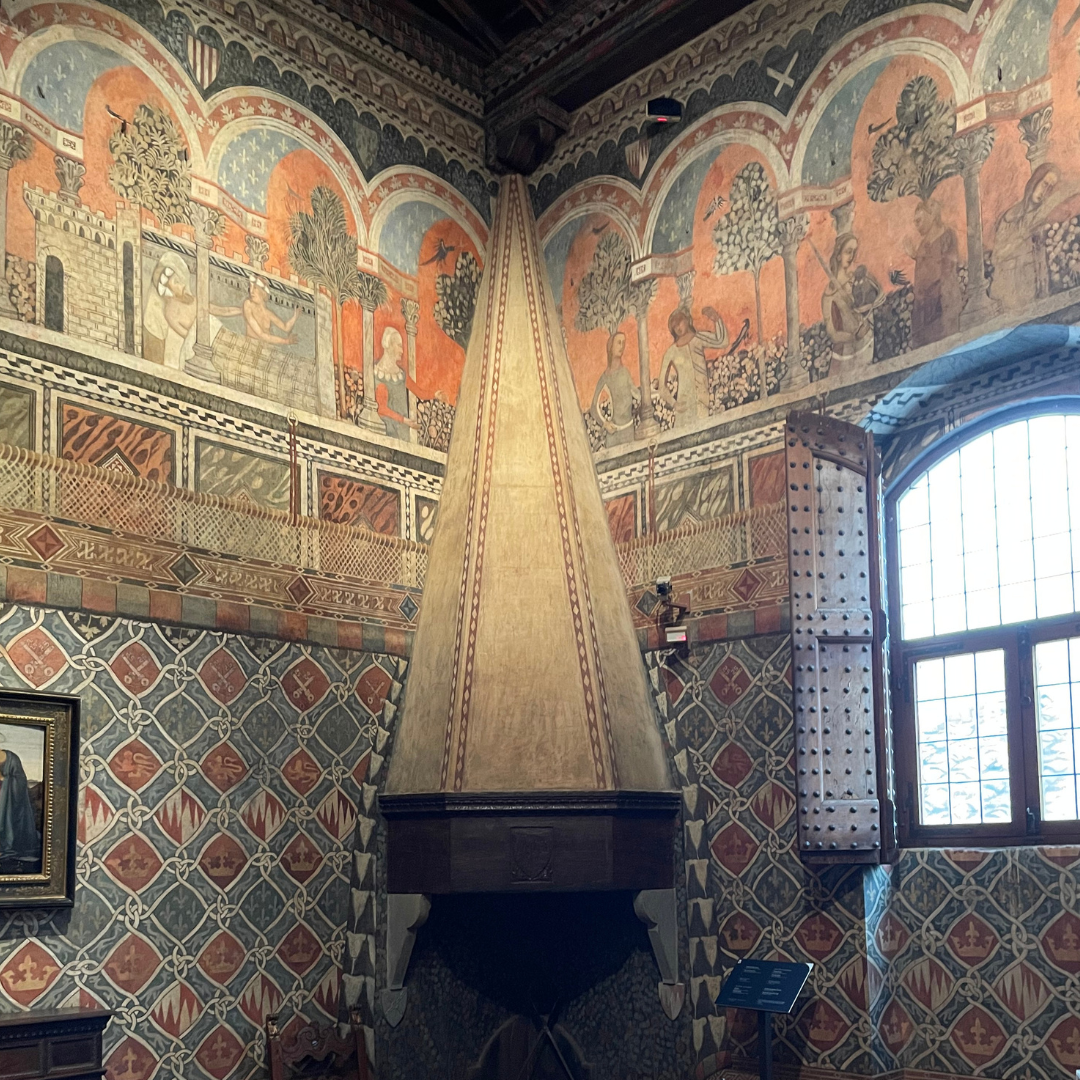
Palazzo Davanzati
Palazzo Davanzati in Florence, Italy is a medieval palace with incredible painted walls dating from the 1300s. And in one of the bedrooms – the master bedroom – there is a series of frescoes that run around the upper walls like a medieval comic strip. They tell us the story of the Chatelaine of Vergy.
The wealthy couple who slept in this room would have seen this story every night as they went to bed and every morning when they awoke. After you read it, you might wonder why…

A Bit About the Story
The story of the Chatelaine of Vergy comes from a 13th-century French poem. It would have been read or recited aloud as entertainment at various gatherings, and it became extremely popular and widely known, spreading throughout Europe.
It was so popular that around 1350, it ended up in Florence, Italy on the bedroom walls of newlyweds, Paolo Davizzi and Lisa degli Alberti.
Let’s take a closer look at some of these frescoes and the story that goes with them. I’ve added some speech bubbles on the images to help us understand what’s happening.
But First, a Quick Look at the Characters
- The Chatelaine – The term just means the lady in charge of the castle. Our Chatelaine is also the niece of the Duke of Burgundy and her castle is near his. She is secretly in love with the Duke’s favorite knight.
- The Knight – He faithfully serves the Duke and is secretly in love with the Chatelaine.
- The Duke – The Duke of Burgundy. He’s the boss of everyone.
- The Duchess – Wife of the Duke. She secretly has the hots for the Knight.
Now let’s begin…
A Secret Love Story

Our Knight meets the Chatelaine, and they fall deeply in love. However, because of lots of medieval social rules, their love must remain a secret. The Chatelaine warns the Knight that if word ever gets out about their affair, he will immediately lose her love forever.

The Knight and the Chatelaine plan how they can keep their meetings on the down low with the help of the Chatelaine’s little dog. The Knight will come at the appointed time and hide in the orchard. When he sees the little dog run out to him, it means the Chatelaine is alone and waiting for him.

The Knight rides back to the Duke’s castle dreaming about his Lady Love. The Duchess pops her head out the top of the castle and tells him that her husband, the Duke, is going away and the Knight must stay and protect her. The Knight is happy to oblige, as he’s very loyal to the Duke.

The Duchess says she’s lonely and asks the Knight to play a game of chess with her to keep her entertained. He agrees but feels that something is not quite right.

The Duchess has other things on her mind… She fancies the Knight and tries to kiss him, but he’s just not into it. After all, he has a girlfriend, remember. The Duchess doesn’t like being rebuffed and swears revenge.

The Duke returns, and the Duchess tells him that the Knight has tried to put the moves on her. She demands that he banish the Knight from his Dukedom.

The Duke confronts the Knight about the affair, and the Knight denies messing around with the Duchess. He tells the Duke that he is in love with someone else. The Duke doesn’t believe the Knight and demands to know the name of his lover.

The Knight is in a conundrum. He swore to the Chatelaine he would keep their love secret. If she finds out he told anyone, it’s over… But if he doesn’t tell the Duke, he’ll be exiled and never be able to see her again anyway.

So, after the Duke promises to keep the secret, the Knight confides in him and, as proof, he allows the Duke to secretly observe one of their meetings – including the “dog signal.”

The Duke reports back to his wife that she is mistaken because the Knight is in love with someone else. The Duchess begs to know who it is, but the Duke refuses (he promised, after all). However, in a moment of weakness during their “nap time” he gives in and tells her.

Now the Duchess wants revenge on the Knight and his lover. So, at a party she comments on the Chatelaine’s little dog and what a cute little trick it does – because the Duke had even spilled the beans about the dog’s part in the plan.
The Chatelaine now knows that her Knight has betrayed their secret and believes everything between them has been destroyed.

The Chatelaine goes into another room and dies from a broken heart. The Knight finds her and knows he caused her death by revealing their secret. He then kills himself with his sword.

The Duke sees his niece (the Chatelaine) and his favorite Knight both dead, and he immediately takes a sword and kills his wife for causing it all. The end.
Today, this would seem like an odd theme for a master bedroom. But I guess in 1350 when Paolo Davizzi and Lisa degli Alberti got married, this was the perfect way to decorate their bed chamber.
So, what did the couple think when they sat on their bed and “read” the story running around their room? What did it mean to them?
An Old Romantic Story
Just like we might rewatch a favorite romantic movie, perhaps Paolo and Lisa held hands and shed a tear as they “re-read” the story of the Chatelaine and the Knight.
This story was written about 100 years before it was painted on their bedroom wall. So, it would have been considered a classic. And it wasn’t so different from our modern romances. It just had a slightly modified plot…
Today our romantic plots often follow:
Boy meets girl. Boy loses girl. Boy gets girl back.
However, this medieval courtly love plot went something like:
Knight meets Lady. Knight betrays Lady’s secret. Knight loses Lady – and everyone dies.
Very similar… except for the ending.

A Cautionary Tale?
At first, it seems that this story is meant as a warning of the dire consequences of not being able to hold your tongue and keep a secret. And it surely is.
However, the Knight’s situation is not quite that simple. He has made a promise to the Chatelaine, yet he also owes loyalty and obedience to the Duke.
If he keeps the secret, he will be banished and lose his lover. If he tells the truth, he betrays her confidence and loses her love. He’s in a tight spot.
Maybe that was part of the story’s lasting appeal. Medieval listeners could argue about who was really to blame: the Knight who revealed the secret, the Duke who passed it on, or the Duchess who weaponized it? Or was it really the rigid social rules that trapped them all?
So, what might Paolo and Lisa have taken from the story as they lay beneath it in their marriage bed?
Was it just a familiar romantic bedtime story? Or did it make them think about society’s rules and the importance of keeping secrets?
After all, telling secrets caused a lot of trouble in this story. The Knight, the Duke, and the Duchess all told secrets and suffered for it. The sweet Chatelaine was the only person in the story who kept her vow of secrecy…
She died anyway, of course, but at least she got the title role in the poem.
What’s your take on this “romantic” tale? Would you have something like this in your bedroom? Let me know in the comments section.


Follow Me on Social Media:

- A Tragic Medieval Bedtime Story: The Chatelaine of Vergy – 18 September 2026
- Bath’s Jane Austen Festival: Books, Balls, and Bonnets – 5 September 2026
- Curious History Review: September 2026 – 3 September 2026



COMMENT HERE: Can't wait to hear what you think… (email not required)