
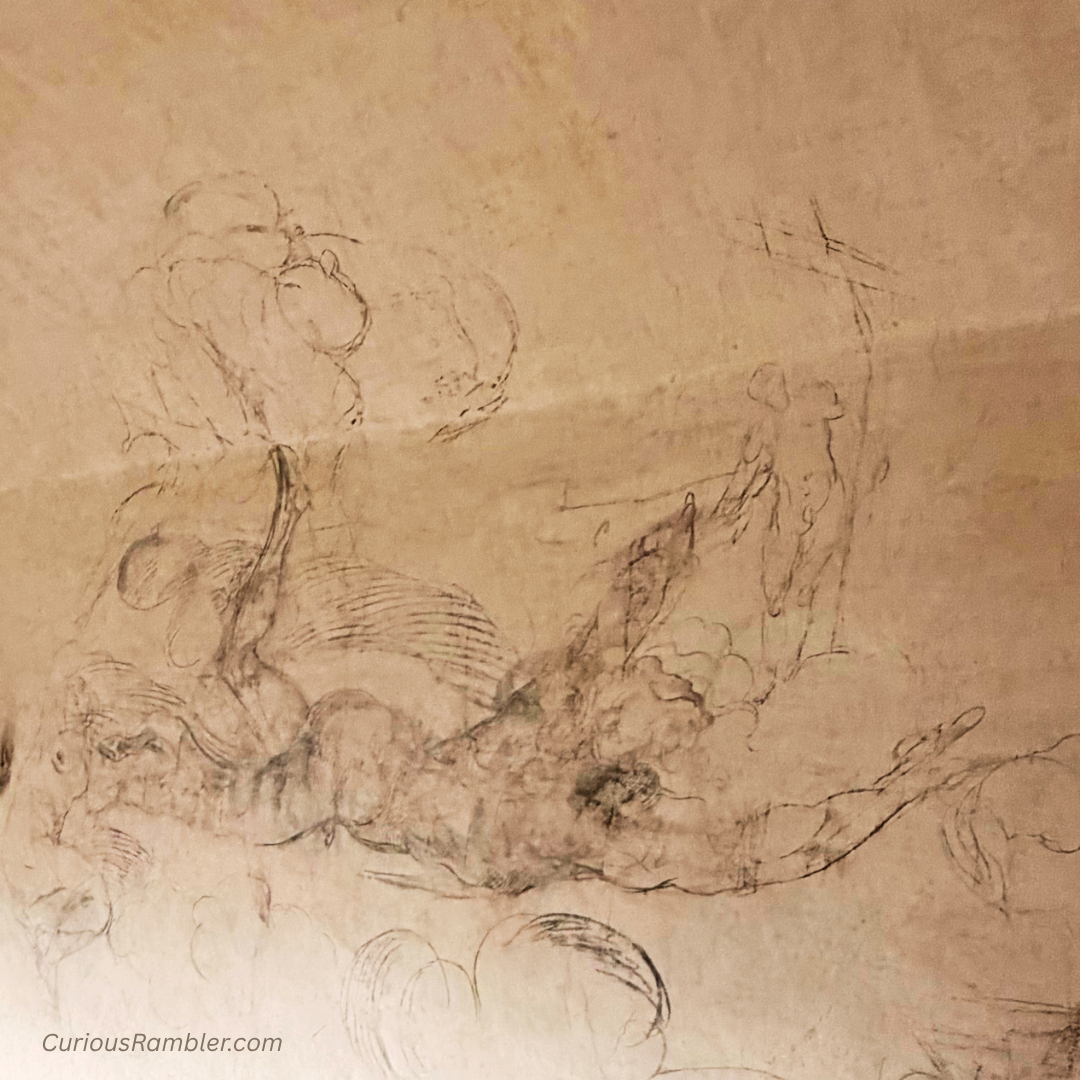
It’s called Michelangelo’s Secret Room or Stanza Segreta di Michelangelo. A trap door in the floor reveals a steep staircase that leads down to a narrow room with a low barrel-vaulted ceiling.

I had been waiting a long time to see this, and I wasn’t disappointed. As I entered the little room, I felt as if I had stepped inside one of Michelangelo’s sketchbooks. The walls were covered in charcoal sketches – sketches that ran into each other and over each other.
Unlike the Sistine Chapel paintings, which are vibrant and exciting, this room was intimate, quiet, and monochromatic. Because these “doodles” were never meant to be seen by anyone else, it felt quite personal. And it was easy to imagine the great artist hiding for his life in there with his mind full of art that just had to come out. And, of course, he used what he had: charcoal and walls.
In some places it appears as if he might have been remembering previous projects. And on other walls you could see the foreshadowing of what would appear later in his work.


But why was Michelangelo hiding? Who was he hiding from? And was he really hiding in this room? Let’s see if we can find out…
The Medici Want Revenge
The Medici family had dominated Florence, on and off, for most of the previous century. When they were kicked out in 1527, Michelangelo supported the new Florentine republic. That was fine, until the Medici came back into power after the siege of 1529-1530 and went looking for revenge on those who had turned against them.
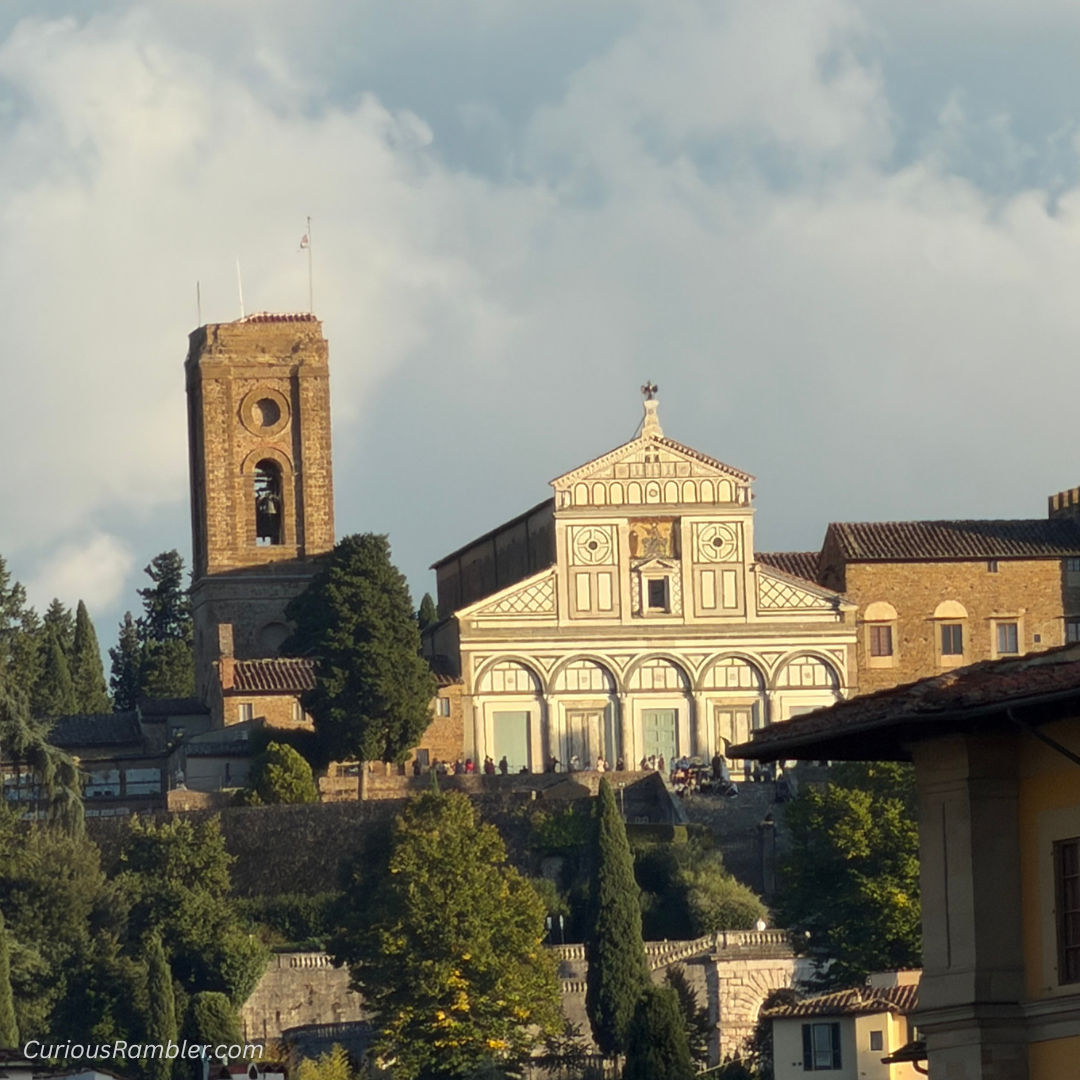
They knew that Michelangelo had been in charge of fortifying the city’s defenses against them. And they remembered the “mattresses on the tower” incident, when he’d hung mattresses on San Miniato’s bell tower to shield it from their cannons, so he was definitely on their naughty list.
As the restored Medici government set about rounding up, imprisoning, exiling, and in some cases, executing its opponents, Michelangelo feared for his freedom – and even for his life. His art and his close relationship with the former Medici rulers might save him… but he wasn’t going to wait around to find out.
So, when the Medici officers turned up at his house to arrest him, Michelangelo was long gone. He had fled and gone into hiding.

Into Hiding
He had disappeared and no one knew where he was – at least, no one was telling. Some contemporaries later wrote that he took refuge with a friend. But it was never recorded which friend or where he was hiding.
So, think about it – if you needed to hide from the powerful Medici family, where would you go? Somewhere far away from anything with their name on it? Maybe…
However, evidence seems to point to Michelangelo choosing a much closer location. He may have actually hidden in a secret room just beneath the Medici family tombs in the Medici Chapels at San Lorenzo where he had been working for the family before they were expelled.
A Secret Room


A clue about the location of Michelangelo’s hiding place came to light in 1975, when the director of the Medici Chapels Museum, Paolo Dal Poggetto, was looking for a new exit – a way to move tourists through the space more efficiently.
A longtime employee remembered a trapdoor leading down to a room that had been used for storage. Staff removed the furniture covering it and opened it up. It wasn’t an exit, and wouldn’t help traffic flow, but the museum director wanted to investigate. He commissioned a restorer to carry out exploratory cleaning tests on the walls. As two layers of plaster were removed, drawings began to emerge.

Walls as Sketchbook
Some of the sketches on the walls looked very familiar. They resembled figures in some of Michelangelo’s sculptures and paintings… Could this have been where Michelangelo was hiding from the Medici in 1530? The museum director felt confident that at least some of the drawings could be attributed to Michelangelo.
And there were other clues: Michelangelo had been working on the Medici tombs just before the political upheaval and would have been very familiar with the building. In addition, he knew Giovan Battista Figiovanni, the prior of San Lorenzo who later, in his personal writings, said that he had saved Michelangelo’s life.
So, while we can’t say for sure that Michelangelo hid in this very room when the Medici were out to get him, there is evidence pointing to it, and it seems like a plausible theory to me. However, some experts disagree and think the drawings could have been done when Michelangelo was working on the Medici tombs or at another time.

Back to the Tombs
Michelangelo hid for about two months until eventually, Pope Clement VII (who also belonged to the Medici family) ordered that he be left unharmed – as long as he resumed work on the Medici commissions.
So, if Dal Poggetto’s theory is correct, we can imagine the priest opening up the trap door, Michelangelo climbing the stairs from where he had been hiding from the Medici and going right back to work sculpting their tombs.
Maybe one day we’ll find out for sure, but like the Italians, I like to think of this as Michelangelo’s secret hiding place.

How to Visit
By booking well in advance, you can visit Michelangelo’s Secret Room. The ticket is combined with the Medici Chapels which are worth seeing and can also be visited on their own.
The number of visitors to the Secret Room is restricted to four at a time to protect the drawings and their microclimate – and it also makes for a nice, intimate visit. You get to stay in the room for 15 minutes which gives you plenty of time to soak up the ambiance and imagine you are inside a giant Michelangelo sketchbook. Tickets are available through B-ticket.


Follow Me on Social Media:

- Curious History Review: November 2026 – 5 November 2026
- Michelangelo’s Secret Room in Florence: A Hiding Place Beneath the Tombs – 5 November 2026
- Why Michelangelo Hung Mattresses from a Bell Tower – 26 October 2026


COMMENT HERE: Can’t wait to hear what you think… (email not required)