
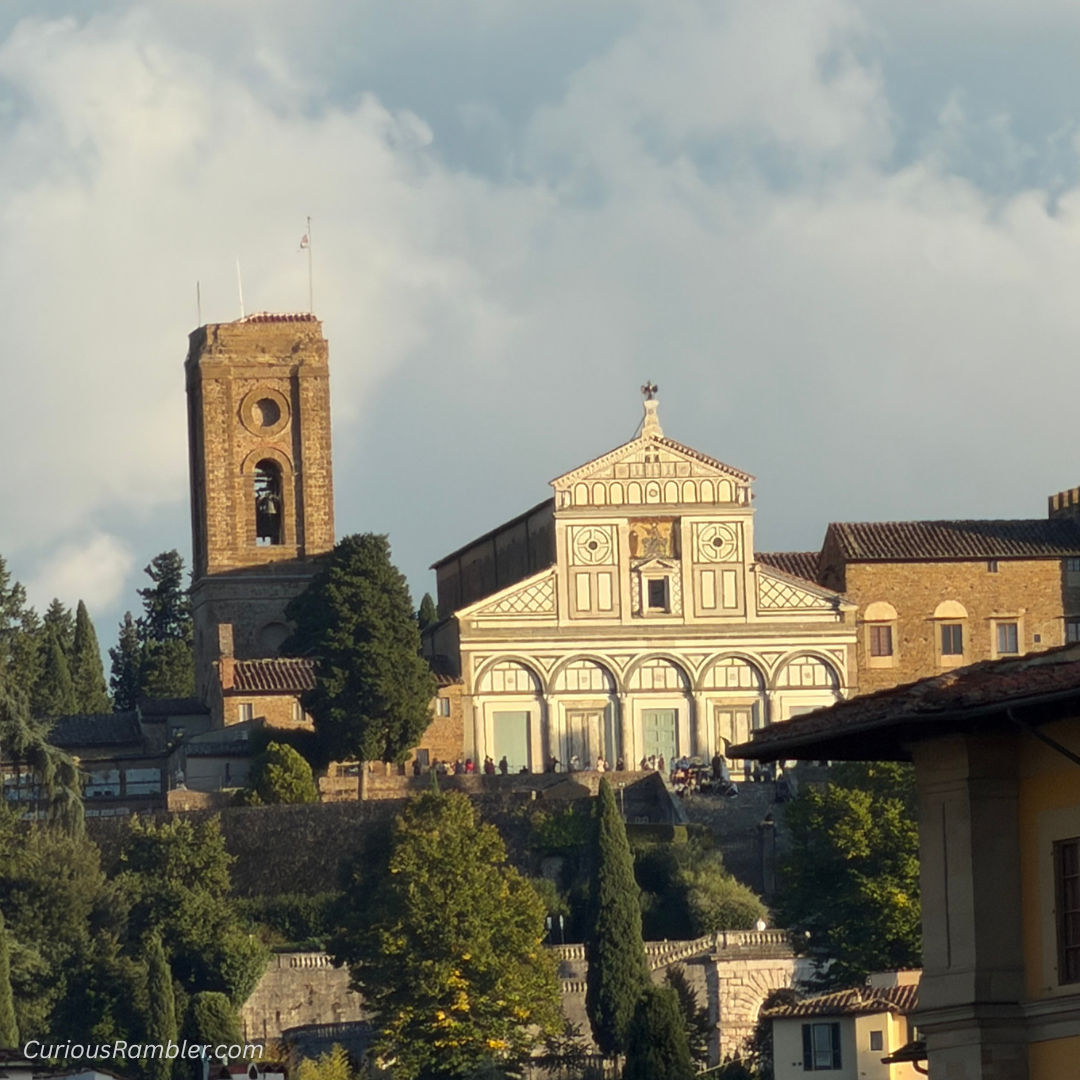
San Miniato al Monte’s distinctive marble facade can be seen from the city-center side of the Arno River. Stand near the Uffizi, look across the water and up into the hills to the left. Find the church and notice the tall bell tower beside it.
Now, imagine looking up at that bell tower and seeing mattresses dangling from its sides and wrapped all around it. You might think someone had taken “airing the bedding” a little too far.
But no, it was actually wrapped in mattresses to protect it from the cannonballs of invading forces. And the engineer behind this unusual sight was none other than that great artist, Michelangelo. He was better known for his marble statues or painted ceilings, but being a man of many talents, he could do tower protection as well when required.

Florence, the Medici, and Michelangelo
So how did it come to this? Well, it was 1529, and Florence had a problem…
Two years earlier, the Florentines had seized their chance and thrown out the Medici, the family that had dominated their city for most of a century. They had restored their republic and were rather proud of it. But the Medici didn’t take being evicted very well, and one of those Medici just happened to be the Pope.
Pope Clement VII wanted his family (the Medici) back in charge of Florence, and he found a powerful ally in the Holy Roman Emperor, Charles V. It was an awkward friendship. In 1527, the Emperor’s troops had sacked Rome and sent Pope Clement running for cover. But a new shared goal of taking over Florence helped smooth things over. By autumn 1529, an imperial army had marched into Tuscany and set up camp outside Florence’s walls.
Inside those walls, Michelangelo had picked his side. He stood with the republic, even though he’d spent years working for the Medici. Now the city named him governor-general of fortifications. The man who had carved David, the giant-slayer, was put in charge of keeping out a massive army equipped with some of the most powerful artillery of the day.

The Tower Comes Under Fire
The Florentine troops were stationed on San Miniato’s hill, which was an important part of the city’s defense. And the bell tower was playing a key role in the fighting. The Florentines had hoisted two cannons to the top of the tower – which must have been quite a feat.
The tower’s height made it a great place for spotting the enemy and taking shots at them. However, that tall tower was also an easy target. The imperial army began bombarding it with cannon fire, and it was at risk of coming down.
So Michelangelo, the great artist who was more used to carving stone, now had to figure out how to keep this stone tower from tumbling down. He needed a quick solution – and he found one. It was low tech, but it was effective.
According to Vasari, Michelangelo decided mattresses and bales of wool were the answer. He hung them on ropes from the tower to cushion the sides from the cannon fire. History doesn’t tell us who might have given up their comfy mattresses and slept on the hard floor or who might have been expecting a nice new wool outfit that never came, but I like to think that everyone pitched in and gave what was needed.

A Tower Saved, but a Republic Lost
Michelangelo’s mattress idea might have saved the bell tower, but it just wasn’t enough to save the Florentine republic.
In August 1530, after about ten months of resistance, the city surrendered to the invading forces, and the Medici returned to power.
Of course, the returning Medici didn’t look very kindly on those who had stood against them, and Michelangelo was on that list. To save himself, Michelangelo had to go into hiding. It’s thought that he hid in a small room beneath the New Sacristy at San Lorenzo, the very chapel the Pope wanted him to finish.

But after a few months, Pope Clement VII must have decided that he wanted his sculptures finished more than he wanted to punish Michelangelo. He declared that Michelangelo would be forgiven, and his punishment forgotten – on the condition that he continue the work he had begun on the Medici sculptures in San Lorenzo.
And so, the artist who had helped Florence resist a Medici restoration came out of hiding and went back to work carving their tombs.
Today Michelangelo is remembered for his sculptures and the Sistine Chapel. And San Miniato al Monte is admired for its beautiful geometric marble facade and its views across Florence. But I like to look up at that old stone bell tower and imagine Michelangelo covering it with mattresses to protect it from cannonballs.
Have you ever heard of this story or visited San Miniato? Let me know in the comments. And if you would like to read more stories like this, subscribe and follow my blog – and feel free to share this with a friend who might enjoy it too.


Follow Me on Social Media:

- Why Michelangelo Hung Mattresses from a Bell Tower – 26 October 2026
- Following the Medici Tortoises Through Florence – 23 October 2026
- Curious History Review: October 2026 – 1 October 2026



COMMENT HERE: Can’t wait to hear what you think… (email not required)