

Welcome to October’s Curious History Review
19th-Century Art and Medieval Tales
In this month’s historical ramble, we’ll begin in the 19th century with the work of Vincent van Gogh in Provence. And we’ll see how his sister-in-law, Jo, dedicated her life to helping the world realize that he was a genius ahead of his time.
Then we’ll jump back several centuries, to a time when medieval troubadours were writing songs and poems of courtly love and romance. One tale traveled from France to Italy and ended up on a bedroom wall in Florence. And another medieval legend leads us to a big round table in Winchester, England.
So, settle in for our monthly time travel through history.
Nearly everyone is familiar with Vincent van Gogh and can recognize at least a few of his paintings. But have you heard of his sister-in-law? This amazing woman played a major part in making the world aware of Vincent’s talent.

Johanna van Gogh-Bonger: Without This Woman We Might Not Know Vincent
When Vincent van Gogh died in 1890, he wasn’t a successful artist. His brother, Theo, had done his best to promote his work, but there was little interest. And Vincent’s paintings could have ended up in attics, barns, or secondhand shops – if it hadn’t been for his sister-in-law.
Johanna van Gogh-Bonger (or Jo, as she was known) had married Theo, and when he died just six months after Vincent, she found herself a young widow with a baby and lots of Vincent’s paintings, drawings, and letters. Today, that would be a windfall, but at the time, no one wanted to buy them.
Jo, like Theo, believed that someday the world would recognize Vincent’s talent. And she spent the rest of her life making sure that happened.
I hate to think what might have happened without her. Perhaps we would never have seen The Starry Night… which we’ll be looking at next.
Discover how Jo van Gogh-Bonger convinced the world to see Vincent and his work differently.
Now, let’s take a fresh look at one of Vincent van Gogh’s most recognized paintings and see if we can find something new in it…

FROM THE ARCHIVES
Starry Night or Windy Night?
One of Vincent van Gogh’s most famous paintings is called The Starry Night, and he painted it while living in Provence, France. Vincent was a keen observer of the Provence landscape, and in many of his paintings, we can see trees and vegetation bending and swaying in the breeze.
But was it just a breeze? Or could it have been the mighty Mistral wind that roars through Provence? The locals say it’s strong enough to blow the horns off a cow or the tail off a donkey.
Vincent was definitely familiar with this powerful wind and complained about it in his letters. But did it make its way into his painting of The Starry Night? Should it actually be called The Windy Night?
I think so. I’m pretty sure I can see that strong, howling Provence wind swirling around in this painting.
Take a closer look and decide for yourself whether it should be called The Starry Night or The Windy Night.
Van Gogh found inspiration in Provence’s swirling skies and bright colors. But several centuries earlier, in medieval Provence, the troubadours were making courtly love fashionable. That tradition of courtly love spread across medieval Europe, and one French romance ended up on the painted walls of a Florentine palace…

The Chatelaine of Vergy: A Medieval Tale of Courtly Love
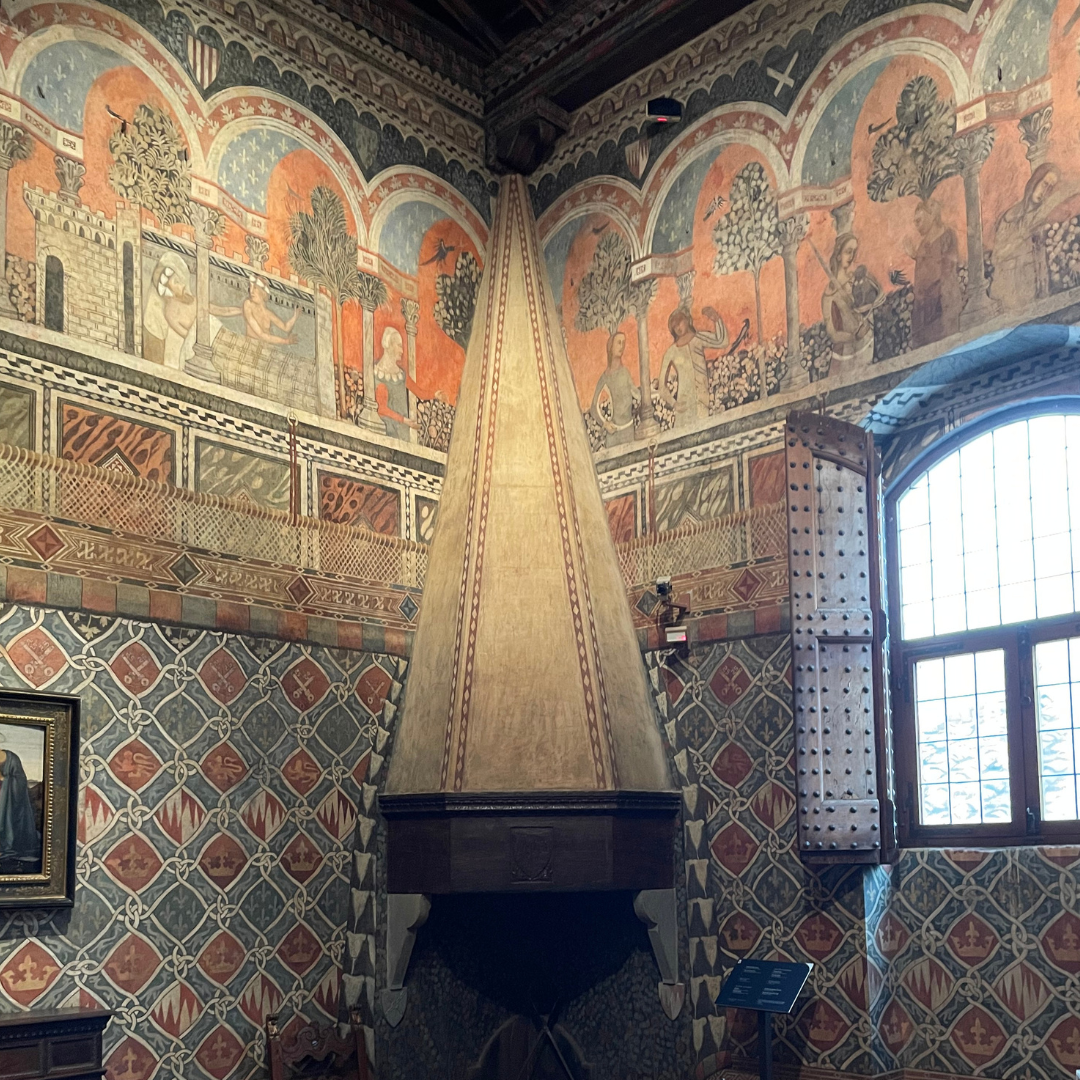
When I go to Florence, I always visit the Palazzo Davanzati Museum. It’s a medieval house museum that is furnished and decorated as it would have been in the 14th century. It has amazing painted walls that look like they are covered in patterned wallpaper, but every detail was painted by hand.
In the master bedroom, running around the top of the walls are frescoed images of a medieval courtly romance called the Chatelaine of Vergy. The plot is a bit different from the romantic stories we’re used to today… And the tragic twists hardly seem suitable for master bedroom décor.
But it’s an interesting story, so it’s worth taking a look. It’s told in images that remind me of a comic book, so I’ve added speech bubbles to help us modern folk understand what’s going on in this medieval tale.
Want to find out what happens to the Chatelaine (Lady of the Castle), the Knight, the Duke, and the Duchess?
Staying in the Middle Ages, let’s move on to a more widely known tale and two of England’s favorite medieval characters: King Arthur and Guinevere – and their big round table.

FROM THE ARCHIVES
Arthur, Guinevere and their Round Table
Most people have heard of King Arthur and his knights of the Round Table. But did you ever wonder where that big round table came from and who actually thought of using it for the knights? Maybe it wasn’t Arthur after all…
And what happened to that table? Did it end up in Winchester, England? There’s a huge 700-year-old round tabletop there, and for centuries, people believed it was King Arthur’s.
Later English kings (including Henry VIII) used it to try to associate themselves with King Arthur and his legendary court – and to strengthen their own image as powerful and rightful rulers. Henry VIII had the table painted and even added a King Arthur that looked very much like himself.
The Winchester table may not have been King Arthur’s, but it’s quite impressive. And I’m pretty sure that over the centuries, it has taken on a bit of that Arthurian magic.
Learn more about King Arthur’s (I mean Guinevere’s) Round Table – and the one in Winchester too.
History Fun Fact
I’ve been spending a bit of time in Florence, Italy, so here is a fun fact about Florence…

Did you know? Florence Nightingale was named after Florence, Italy, where she was born. Her parents took a three-year honeymoon tour of Italy and had two daughters along the way. Florence got lucky with her birthplace name.
Her older sister, born in Naples, was named Frances Parthenope (Parthenope is the ancient Greek name for Naples). And since her mother was also named Frances, she had to make do with Parthenope or the nickname Parthe.
That’s it for this month’s Curious History Review. I hope you found something here that sparked your curiosity.
Which story was your favorite? Do you have a favorite van Gogh painting or medieval tale? Leave a comment below – or, if you’re reading this by email, simply hit reply. I’d love to hear from you.
If you enjoy strange and lesser-known stories from history, make sure you’re subscribed – and feel free to share this with a friend who might enjoy it too.
See you next month for more curious histories!

- Curious History Review: October 2026 – 1 October 2026
- How Johanna van Gogh-Bonger Made the World See Vincent Van Gogh – 28 September 2026
- A Tragic Medieval Bedtime Story: The Chatelaine of Vergy – 18 September 2026


COMMENT HERE: Can't wait to hear what you think… (email not required)