
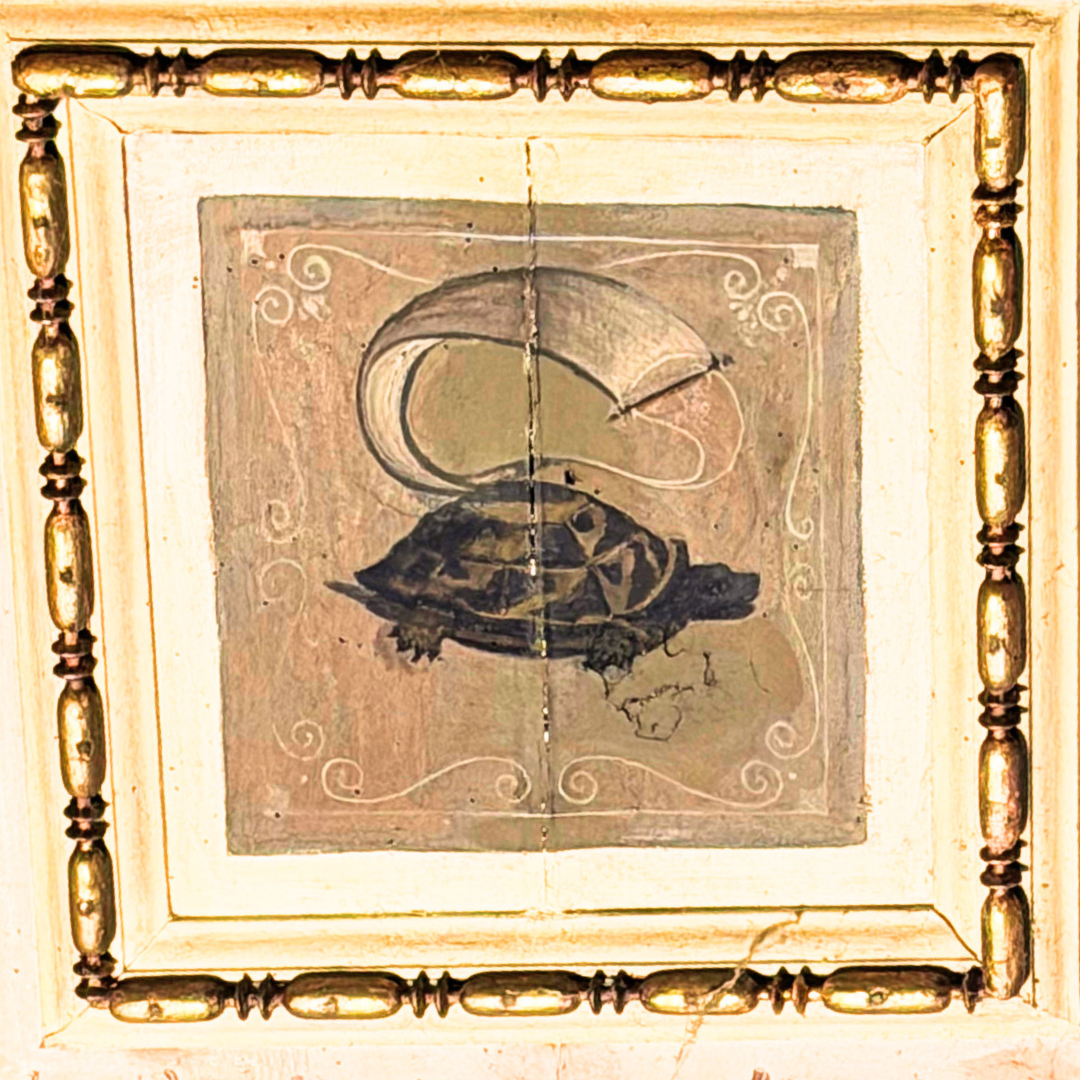
Florence is famous for its art, architecture, and marble men. But look beyond the Davids and the grand facades, and you’ll find some smaller characters worth noticing… like tortoises.

First, Are They Turtles or Tortoises?
You’ll see both words used for these little critters. Tortoises belong to the wider turtle family, and while all tortoises are turtles, not all turtles are tortoises. In American English “turtle” is often used as a general term. In British English, the land-dwelling variety is called a tortoise. And in Italian, it’s a tartaruga.
I’ll call them tortoises as we follow their trail through Florentine history. And, of course, we’ll take our time, as there’s no need to hurry.
The story begins with Cosimo I de’ Medici and the tortoise with a sail.

Sailing Tortoises and Cosimo I
The Medici family had been dominating Florentine politics for more than a century when seventeen-year-old Cosimo I came into power in 1537. And since all powerful men needed a motto, Cosimo adopted festina lente as his.
It was an ancient motto meaning “make haste slowly” – and his marketing team came up with the logo of a tortoise with a wind-filled sail on its back to represent it. The tortoise was slow and cautious, and the sail supplied speed. Together, they expressed a balance between moving forward and taking care.

Sailing Tortoises and Palazzo Vecchio
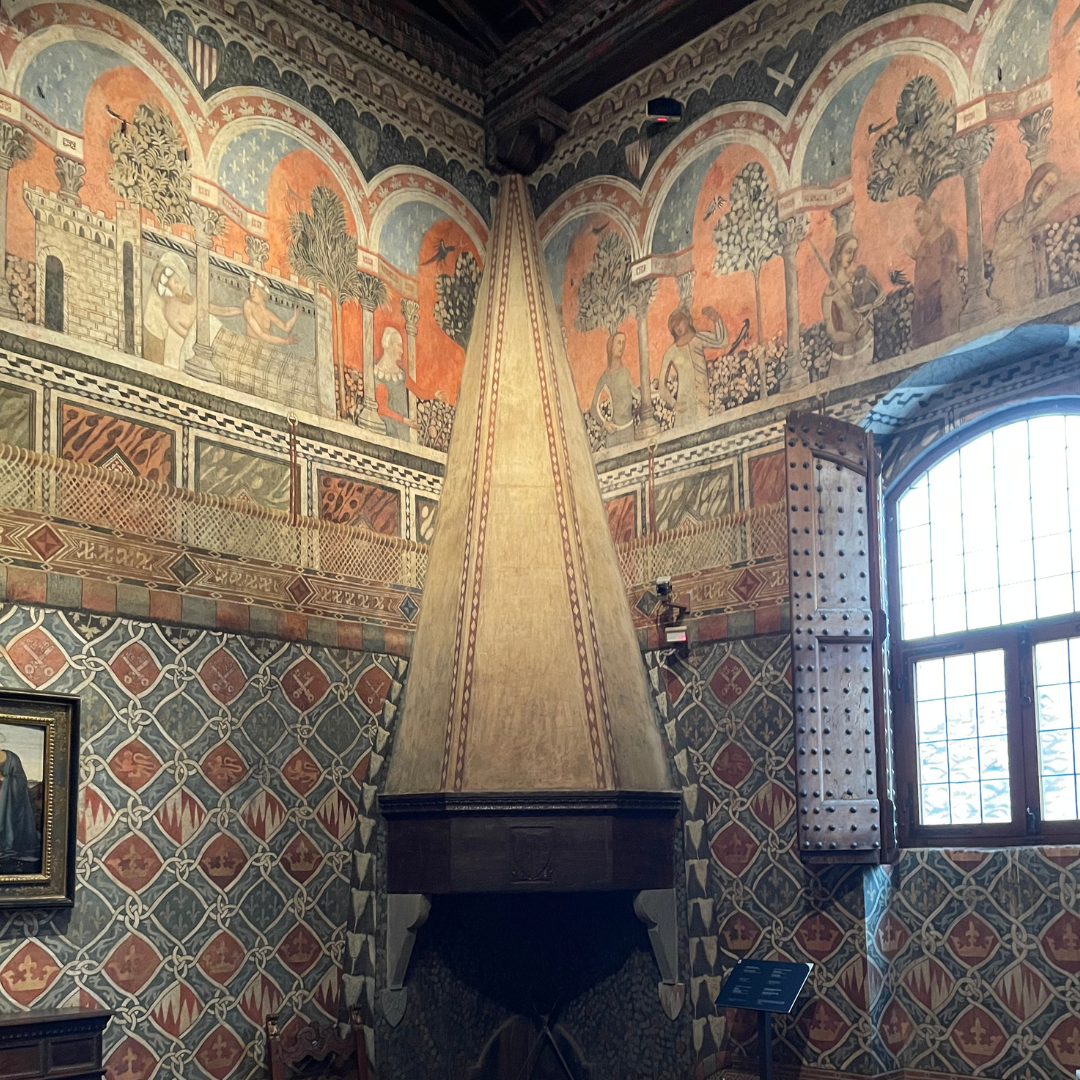
At age 20, just three years after coming into power, Cosimo moved into what we now call Palazzo Vecchio with his wife and newborn daughter. The building had been a government palace and there was a lot that needed doing to make it into a lavish display of Medici power.
During all this renovation, Cosimo’s logo was worked into the decoration. Sailing tortoises ended up in the floor tiles, ceiling decorations, and painted walls. In fact, my tour guide told me there are around 100 tortoises sailing throughout the building. (I haven’t managed to find them all yet.)
From time to time, there are even guided “tortoise hunts” for children. So, as you walk around this palace, be sure to look out for those sailing tortoises.

Tortoises at the Santa Maria Novella Racecourse
In Piazza Santa Maria Novella, the tortoises have abandoned sailing for a more demanding occupation. They are charged with holding up the two marble obelisks in front of the church. Each obelisk rests on the shells of four bronze tortoises.
The story of these tortoises is also related to Cosimo I. In 1563, Cosimo established the Palio dei Cocchi, a carriage race inspired by ancient chariot racing. It took place in the square in front of Santa Maria Novella Church every year on June 23, the eve of the feast of John the Baptist, Florence’s patron saint.
Four carriages, each hitched to two horses, raced three times around the course. They bore the colors of the city’s four districts. Where visitors now stroll or stop to admire the church, spectators once watched horse and carriage races.

To make sure there were no shortcuts, the racetrack needed turning posts at each end, so temporary markers were put into place. The first ones were wooden obelisk-type structures. The marble obelisks we see today were installed in 1608 (after Cosimo I’s death) and were each set on four bronze tortoises attributed to the workshop of Giambologna.
We don’t know whether the original turning posts had tortoises, but the bronze ones holding up the obelisks today are a fitting reminder of Cosimo I and his festina lente motto. Placing the turning posts of a racetrack on the backs of animals known for taking their time points back to Cosimo’s philosophy of making haste slowly.

Tortoise as Morgante’s Mount
We’ll find our final tortoise near the Bacchus Gate in the Boboli Gardens, beside Pitti Palace. Instead of having a sail or an obelisk on its back, this one is carrying a passenger.
The rider is a naked man called Morgante. His real name was Braccio di Bartolo, a man with dwarfism who served at Cosimo I’s court.
His family lived near Bologna, and it’s said that his parents sold him to Cosimo’s court when he was a child in hopes that he would have a better life there. He lived at Cosimo I’s court when it was at Palazzo Vecchio, and he went with them when they moved across the river to Pitti Palace.
Known for his sharp tongue and quick wit, he became one of the duke’s favorite court jesters and was even given a farm for his services.

Inspired by a Roman Sculpture
The sculpture of Morgante riding a tortoise was carved by Valerio Cioli around 1564–1568. It’s thought to be a humorous carving inspired by a statue of Marcus Aurelius seated on his horse with his hand raised as if to quiet his subjects before he makes an important speech.
Morgante sits astride his unlikely mount, the tortoise, in the same sort of serious and commanding pose. But his ride is rather less impressive than a warhorse. The tortoise alludes to Cosimo’s own emblem, making this an amusing meeting of the duke’s serious symbolism and his court’s taste for irreverent humor.
The sculpture became a fountain in 1579. The fountain we see outside Pitti Palace today is a modern copy, while the original is protected from the weather.

Learn From the Tortoises: Take Your Time
These tortoises offer three different insights into Cosimo I de’ Medici’s era: a ruler with a carefully chosen emblem, the memory of a noisy race, and a court personality immortalized on an improbable mount.
They also offer a good excuse to slow down. Florence has enough famous sights to keep anyone rushing from one masterpiece to the next. But sometimes it’s nice to notice the smaller details and learn about their stories.
Make haste slowly. The tortoises would approve.
Which tortoise story is your favorite: festina lente, the racecourse, or Morgante’s steed? Let me know in the comments. And if you would like to read more stories like this, subscribe and follow my blog – and feel free to share this with a friend who might enjoy it too.


Follow Me on Social Media:

- Following the Medici Tortoises through Florence – 23 October 2026
- Curious History Review: October 2026 – 1 October 2026
- How Johanna van Gogh-Bonger Made the World See Vincent Van Gogh – 28 September 2026


COMMENT HERE: Can’t wait to hear what you think… (email not required)