
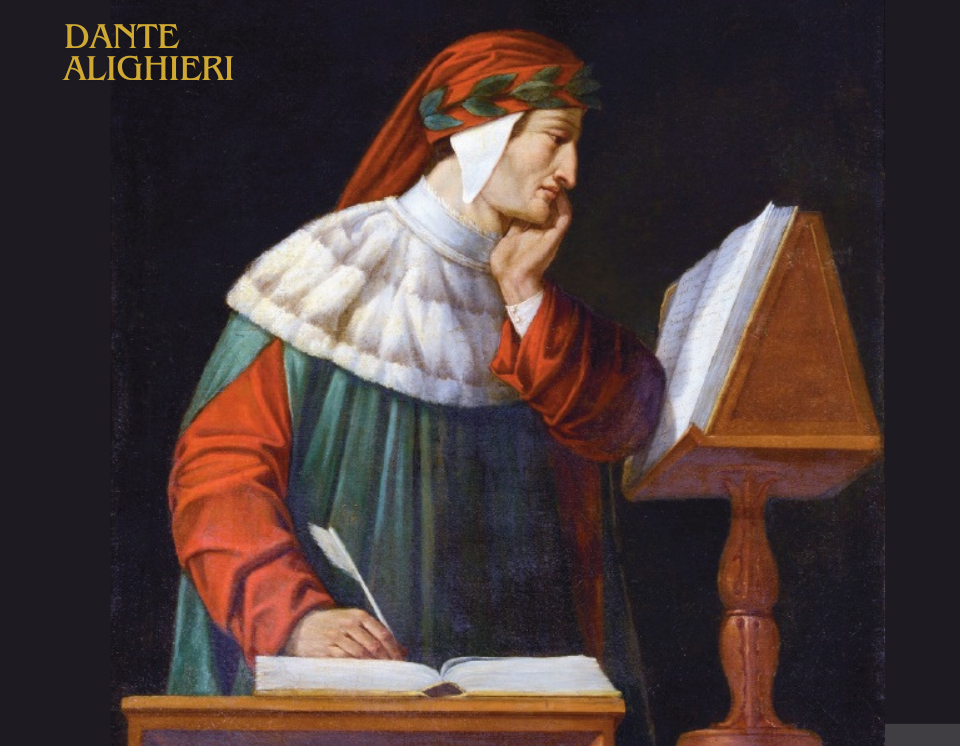
EXPLORING THE GREAT POET’S CITY

I became interested in Dante years ago when I lived in Florence. I had the good fortune to live in his old neighborhood and walk the same streets that he had walked. I developed an attachment to the Great Poet and the places he inhabited. Every time I go back, I visit these Dante sites. I hope you’ll enjoy them too.
But before we start walking, let’s just talk a bit about the man himself.
Dante, the Poet
In 1265, Dante Alighieri was born in Florence. He was a poet, and one of the first to write in the language of the people instead of Latin. Because of this, he’s known as the Father of the Italian Language as well as the Supreme Poet.
Dante, the Politician
When he wasn’t writing poetry, Dante was a soldier and a politician. But politics got him into trouble when he found himself on the losing side.

In those days there were two political factions in Florence: The White Guelfs, who wanted the Pope to have a bit less power, and the Black Guelfs, who wanted to give him full authority.
Dante was a White Guelf, and in 1301, when he was 36, he was part of a delegation sent to Rome to find out what the Pope’s intentions were. But while they were away, the Black Guelfs invaded Florence and all White Guelfs were banned from the city.
Dante, the Exile
So Dante was banned from Florence for two years. After two years they said he could come back… if he would apologize and pay a fine. He flatly refused, claiming that he had done no wrong, so the ban was extended to his lifetime. If he should ever dare to show his face in Florence, he would be burned at the stake!
For the rest of his life, he was never allowed to set foot in his beloved Florence. But the city of his birth never left his heart, and his works are full of references to it.
There are still reminders of Dante throughout Florence, so put on your walking shoes and let’s begin our tour.
PIAZZA DEL DUOMO (CATHEDRAL SQUARE)

Let’s start our Dante tour in beautiful Piazza del Duomo which is named after the cathedral (duomo being the Italian word for cathedral). Three buildings occupy this area. From oldest to newest, they are the baptistry, the cathedral, and the bell tower.
Baptistry – dedicated to John the Baptist (San Giovanni)
This octagonal building was finished in 1128, and Dante was baptized here in 1266. In the Divine Comedy, he calls it “my beautiful San Giovanni.” And he claims to have once broken one of the baptismal fonts inside it to save a child from drowning. For the rest of his life, Dante dreamed of returning to the place of his baptism and being recognized as a great poet by receiving a laurel crown. Sadly, this never happened.
Cathedral (Duomo) – dedicated to St. Mary of the Flowers (Santa Maria del Fiore)
In Dante’s early years, a different church called Santa Reparata would have stood here. You can visit the remains of it in the lower level of the current cathedral. In 1296, when Dante was 31, they demolished it and began construction on the cathedral we see today. Dante would have seen only the first 6 years of construction of this building.
Work started in 1296, and 84 years later, the building was nearly done. It was just missing one important detail – the dome. But there was a problem. No one knew how to make a dome to cover the space that had been left for it.
It was another 40 years before Brunelleschi figured it out, and then it took 16 more years to build it. It was finished in 1436 (140 years from start to finish). However, the façade with the beautiful white, pink, and green marble was not completed until 1887.

Inside the cathedral, you’ll find the famous painting of Dante holding his Divine Comedy, with Florence and its domed cathedral in the background. It was painted in 1465 and shows the completed dome, which Dante would never have seen.
This painting was commissioned by the city government for the 200th anniversary of Dante’s birth. The laurel wreath on his head is a very belated fulfillment of Dante’s desire to receive the poet’s crown in Florence.
Bell Tower (Campinile)
The bell tower was started in 1334 and finished in 1359. Dante was already in exile when construction began, so he never saw this structure either.
DANTE’S STONE (IL SASSO DI DANTE)
If you’re standing in front of the cathedral, walk down the street on the right side. Between number 54 and number 55 there is a marble plaque set into the wall. It’s about 3 feet off the ground and is very easy to miss if you’re not looking.

Legend tells us that Dante used to sit at this very spot, watch the construction of the cathedral, and read or write poetry.
The plaque says “Sasso di Dante” which means Dante’s stone. In Dante’s time, there was a building here with a stone bench attached. You’ll see many examples of these stone benches as you walk around the city.

Dante came to the attention of the English-speaking world in the 19th century when a translation of the Divine Comedy was published in Britain. British poets began making pilgrimages to Florence. They would sit near Dante’s stone hoping for inspiration to strike and make them great poets like Dante. More about Dante’s Stone.
RESTAURANT AND ANOTHER STONE
Continue walking on this street. In a little piazza on your right you will see a restaurant called Il Saso di Dante.

The owner (who obviously has a sense of humor) has placed a large stone to the right of the building with a little plaque that says “I Vero Sasso di Dante” which means “the real Dante’s Stone.” This is only a joke and has nothing to do with Dante – it’s just for giggles.

BEATRICE PORTINARI’S HOME
Continue past Il Sasso di Dante restaurant, go to the next street (Via del Proconsolo) and turn right. When you come to the next street (Via del Corso), turn right again.

No. 6 via del Corso is where Beatrice (Dante’s muse) lived as a child. Now it’s a beautiful hotel called Palazzo Portinari Salviati. It’ll cost you many a pretty penny to stay here, but a very tasty lunch will be more affordable.
Dante famously fell in love with Beatrice when they were both nine years old. However, at twelve, Dante was betrothed to another girl and Beatrice was married to another man. They rarely ever spoke, other than to exchange greetings as they passed in the street.
Even so, throughout his life, Dante held a type of courtly love for Beatrice that was never meant to be acted upon. In Dante’s mind, Beatrice was perfection itself. He made her his muse, and her presence is felt in his written works.
Now look across the street from Beatrice’s home, and you’ll see an old archway. Enter through this archway (via Santa Margherita) and step back into Dante’s world. This is a medieval section of the city that Dante would have been well familiar with.

DANTE AND BEATRICE’S CHURCH (CHIESA DI DANTE)
Not far down this little street, you’ll come to the doorway of a small church on your left. This is Chiesa di Santa Margarita, which is called Dante’s church. The opening hours are rather random, so if it’s not open when you walk by, come back and try again.

Dante and Beatrice went to church here and Beatrice is buried here. Even though Beatrice died young, Dante continued to write about her and felt that she guided him from heaven.
In his writings, Beatrice (and Dante’s love for her) are portrayed as pure. Perhaps it’s for this reason that people visiting this church leave letters to Beatrice asking for guidance in matters of the heart. On her tomb (on the left), you’ll see a red basket filled with notes from the lovelorn.

This little church has become a shrine to Dante and Beatrice’s love, and along with the saintly pictures that you would expect in a church, there are also several paintings of Dante and Beatrice.
DANTE’S HOUSE MUSEUM
Continue just a bit farther past the church, and on your right, you’ll see the Museum of Dante’s House. Dante’s actual house is no longer standing but it was in this area. The museum is built in the style of a medieval tower house, just as Dante’s would have been. Outside the house, in a little courtyard, you’ll see a bust of Dante. Inside you’ll find out more about the medieval Florence in which he lived.


Continue straight ahead, and on the wall of Via Dante Alighieri you’ll see a white marble plaque showing a map of the area as it was during Dante’s time.

CHESTNUT TOWER (TORRE DELLA CASTAGNA)
Turn right on via Dante Alighieri and go a short distance to the next little piazza (Piazza San Martino). There, at number 1, you’ll see another tall tower which is called the Torre della Castagna. This is where the priory would go to vote during the time that Dante was a prior (a political position). It’s called the Chestnut Tower (Castagna means chestnut) because they used to vote by placing chestnuts in a bag.

BADIA FIORENTINA
Now retrace your steps and go back down Via Dante Alighieri toward Via del Proconsolo. Just before you get to the end of the street, on your right you will see Badia Fiorentina which is an abbey and a church. If the side door isn’t open, try going around the front and pop in for a look.

In Paradiso Canto XV, Dante wrote that the bell tower of this Abbey beat the time of the Florentines’ working day.
And it was in this church in 1373, 52 years after Dante’s death, that Boccaccio held the first public readings of the Divine Comedy. Dante’s work was originally titled, The Comedy, which just means that it was not a tragedy and had a happy ending. Boccaccio was the first to refer to it as the Divine Comedy and that name stuck.
OLDEST FRESCO OF DANTE
When you reach Via del Proconsolo, look to your left and, on the corner, you’ll see a privately owned building at No. 16. During a remodel, a fresco was discovered that is considered to be the oldest known representation of Dante.

Unfortunately, only part of his head is left, but you can see his nose and his red garment, and he’s holding a book which is how he’s always represented.
Depending on what business is in this building at the time of your visit, you may, or may not, be able to enter and see the fresco.
BARGELLO MUSEUM
Now continue on Via del Proconsolo to No. 4, which is the Bargello Museum. Inside the Bargello there’s another very old fresco of Dante. It was considered the oldest until the one at No. 16 was found.
The Bargello was also important in Dante’s life because it’s where meetings were held that he might have attended when he was a prior. And, most importantly, it was here, on 10 March 1302, that he was sentenced and banned from Florence.

There’s a lot to see inside the museum, but if you don’t want to enter now, continue straight on Via del Proconsolo. As you pass the Bargello there are several windows where you can have a peek at what awaits you.
Via del Proconsolo goes directly into Piazza San Firenze, where at No.5, you’ll pass a beautiful building that houses the Franco Zeffirelli museum. Just past this, you will see a street that is called Borgo dei Greci on the left and Via dei Gondi on the right. Turn right, and Via dei Gondi will lead you into Piazza della Signoria.
PALAZZO VECCHIO
When you enter Piazza della Signora, the main building is Palazzo Vecchio.

At the time of Dante’s exile, construction had begun on Palazzo Vecchio, but the building hadn’t been completed. It served as the seat of the city government and later became the Medici family palace. In the mid 1500s, the Medicis moved their residence across the river to Pitti Palace and this building took its present name, Palazzo Vecchio, which means “old palace.” This museum now houses many magnificent paintings and works of art – including Dante’s mask.


You’ll find the mask on the third floor. It was once thought to be a death mask, but now it’s considered more likely to be a cast of a sculpture on his tomb.
On this same floor you can find a wooden door with a Dante image carved into it. There are double doors and the other has a carving of Petrarch.
STATUE IN FRONT OF UFFIZI
Just beside Palazzo Vecchio is the Uffizi Gallery. And in front of the Uffizi, there are 28 niches which were originally designed as architectural features. However, in the 1800s, a local printer decided that they needed to house statues of great Florentines. He gathered a group of artists, and they held three lotteries to raise the funds for statues to fill the niches.

You can see a Dante statue in one of these niches. He is the eighth statue on the left side.
SANTA CROCE PIAZZA
If you are standing in front of Palazzo Vecchio, head back down the left side (Via dei Gondi) which turns into Borgo dei Greci when you cross the street. Follow Borgo dei Greci straight until you come to Piazza Santa Croce.

Construction of the Basilica of Santa Croce began in 1294, when Dante was 29. It sits in the lowest part of the city and suffered a lot of damage in 1966 when the Arno River flooded.
Dante was banned from Florence in 1302 and was never allowed to return. He died 19 years later, at age 56 in Ravenna and was buried there. By then the city of Florence had recognized the importance of Dante’s work and wanted to reclaim his body. But, of course, Ravenna refused, and his burial site was hidden – just in case the Florentine’s tried to come and steal his body.
In 1829 (508 years later) a still-hopeful Florence had an elaborate tomb built for Dante inside the Santa Croce Basilica. However, it remains empty.

Outside, in the piazza, you will see a statue of Dante standing in front of the church. It was placed here in 1865 to celebrate the 600-year anniversary of Dante’s birth.

We’ll leave you here to wander around the rest of Florence and see if you can spot any other references to Dante. Hope you’ve enjoyed your tour.
The walking route and the mentioned sites can be seen on the map below.
Let me know what you think in the comment section below. And if you want to read more of my curious histories, subscribe to my blog (at the top or bottom of this page).
Follow Me on Social Media:
This article is now featured on GPSmyCity. To download this article for offline reading or travel directions to the attractions highlighted in this article, go to Walking Tours and Articles in Florence, Italy on GPSmyCity. See all my articles on GPSmyCity HERE.


- A Tragic Medieval Bedtime Story: The Chatelaine of Vergy – 18 September 2026
- Bath’s Jane Austen Festival: Books, Balls, and Bonnets – 5 September 2026
- Curious History Review: September 2026 – 3 September 2026



COMMENT HERE: Can't wait to hear what you think… (email not required)