
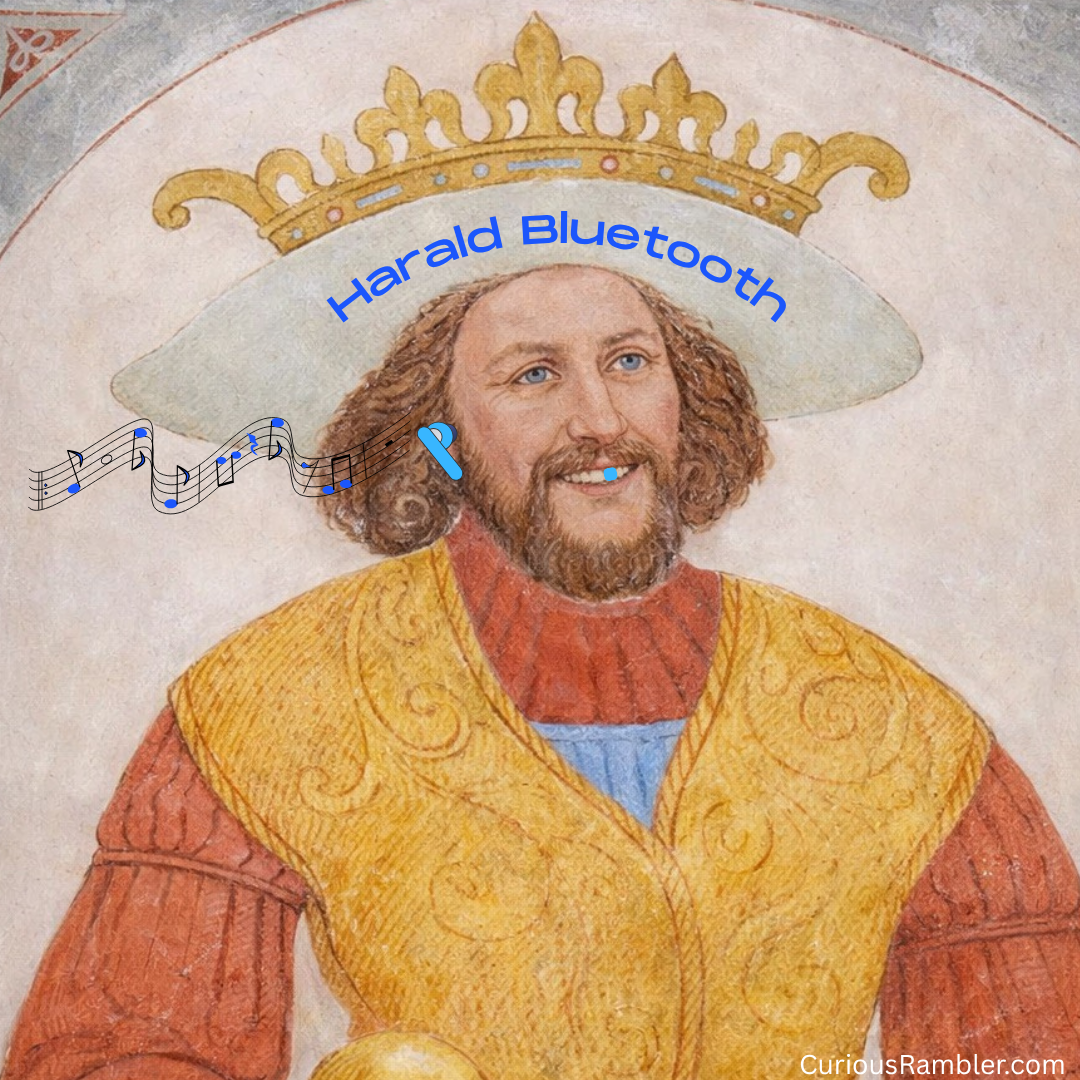
We all know that Bluetooth is what allows our various devices to talk to one another. But have you ever wondered about that odd name – Bluetooth? Well, as it turns out, the name was inspired by a 10th-century Viking king called Harald Bluetooth.
But why name a modern wireless system after a Viking king? The answer is a fascinating blend of history, symbolism, and the idea of unification.
Let’s find out more about this blue-toothed Viking…
Who Was Harald Bluetooth?
Harald Bluetooth was a Viking king who ruled Denmark and parts of Norway in the late 10th century (around 958–986 AD).
He is known for three important things – well two important things and one odd one:
Firstly, he unified Denmark, parts of Norway, (and possibly Sweden) into one kingdom – and he was their king.
Secondly, he introduced Christianity to the region and brought the Pagans and Christians together.
Thirdly, he had a really odd name – Harald Bluetooth.

Why Was He Called Bluetooth?
Vikings didn’t have surnames, and maybe they didn’t have enough first names to go around — since they tended to use the same ones over and over. Therefore, they had to add a little descriptive nickname to make sure everyone knew which Harald, Erik, or Olaf they were talking about.
As Harald’s name suggests, he must have had a blue tooth. Perhaps it was a tooth that was bad, and it had a bluish cast. His father, “Gorm the Old,” must have lived a long time, and Harald’s son “Sweyn Forkbeard” must have had a beard that split into two parts. All very sensibly descriptive monikers.
Now that we know about Harald’s name — and his tooth — let’s jump ahead more than 1,000 years after his lifetime.
20th Century Problem – 10th Century Inspiration
It was the 1990s, and the major tech companies were working on a new breakthrough. It would allow different devices (phones, computers, headsets, etc.) to talk to each other without cables. It would revolutionize our lives. But what would they call it?
One day, two engineers began chatting about their shared love of history. One of them mentioned that he had been reading a book about the Vikings and about one particular Viking king with a weird name. He was called Harald Bluetooth and he had united Denmark.
They spotted the link between Harald Bluetooth connecting different people and religions and their new technology that would connect various devices. It seemed like serendipity.
They would call the project “Bluetooth” as a temporary codename with a little nod to the Viking king. The company would later choose a more appropriate name. Names under consideration were “RadioWire” or “PAN” (Personal Area Network).
But eventually, the execs decided that “Bluetooth” was a name with personality and history, and they should stick with it.

The Bluetooth Logo
And what about the logo? That odd Bluetooth logo isn’t just a random symbol either — it’s actually formed from Harald Bluetooth’s initials in ancient Nordic runes.
The perfect name for the new connectivity technology was the name of a Viking king with a blue tooth, so, of course, the logo should be his initials.
Harald’s Deeds Written in Jelling Stones
In Harald’s day, if you wanted to proclaim something, you set up a big stone and had someone carve a design and an inscription (written in runes). These stones were the equivalent of large, permanent roadside billboards.
Harald’s father, Gorm the Old, had erected such a stone in what is now the town of Jelling, Denmark. The carvings tell us that it was put there to honor the memory of his wife.
So Jelling was the logical place for Harald to raise his own — even larger — stone billboard. The runic inscriptions honored his parents first, then told of his own great achievements: Basically, it said, “I united Denmark and Norway,” and “I made the Danes Christian.”
This stone is often referred to as Denmark’s birth certificate because it’s the first clear mention of a unified Denmark. On one side, an intricate design represents Jesus with outstretched arms and traditional style knots and vines wrapping around him. This design has become an unofficial symbol of Denmark’s history – even appearing on the inside cover of Danish passports.

So What Happened to Harald?
Reading Harald’s Jelling stone, you might think that everything went smoothly – that different tribes came together peacefully and changed religions without any conflict. But that wouldn’t quite be true.
In fact, Harald’s son, Sweyn Forkbeard decided he would be a better ruler than his father and led a rebellion against him. Harald was wounded and forced to flee the city. Accounts written at the time tell us he died shortly afterwards.
However, a few hundred years later, medieval storytellers – who were known for adding funny or humiliating endings to the lives of important people – added that Harald had been shot by an arrow while in the middle of relieving himself. Ouch! Poor Harald.
But never mind – let’s hop back into the 21st century…
A Viking Legacy in Your Pocket
Today, we all keep our lives synced via Bluetooth. So next time you connect your earbuds or sync your phone to your computer or car, give a thought to Harald Bluetooth, the Viking king with a blue tooth who lived over 1,000 years ago.
He connected people – just like his namesake connects our devices, and his legacy of “bringing together” was reborn in a very modern way.
Do you know of any other modern items named after historical figures? I’d love to hear about it in the comments section.
If you enjoy strange and lesser-known stories from history, make sure you’re subscribed (at the top or bottom of this page) – and feel free to share this with a friend who might enjoy it too.


- A Tragic Medieval Bedtime Story: The Chatelaine of Vergy – 18 September 2026
- Bath’s Jane Austen Festival: Books, Balls, and Bonnets – 5 September 2026
- Curious History Review: September 2026 – 3 September 2026



COMMENT HERE: Can't wait to hear what you think… (email not required)