
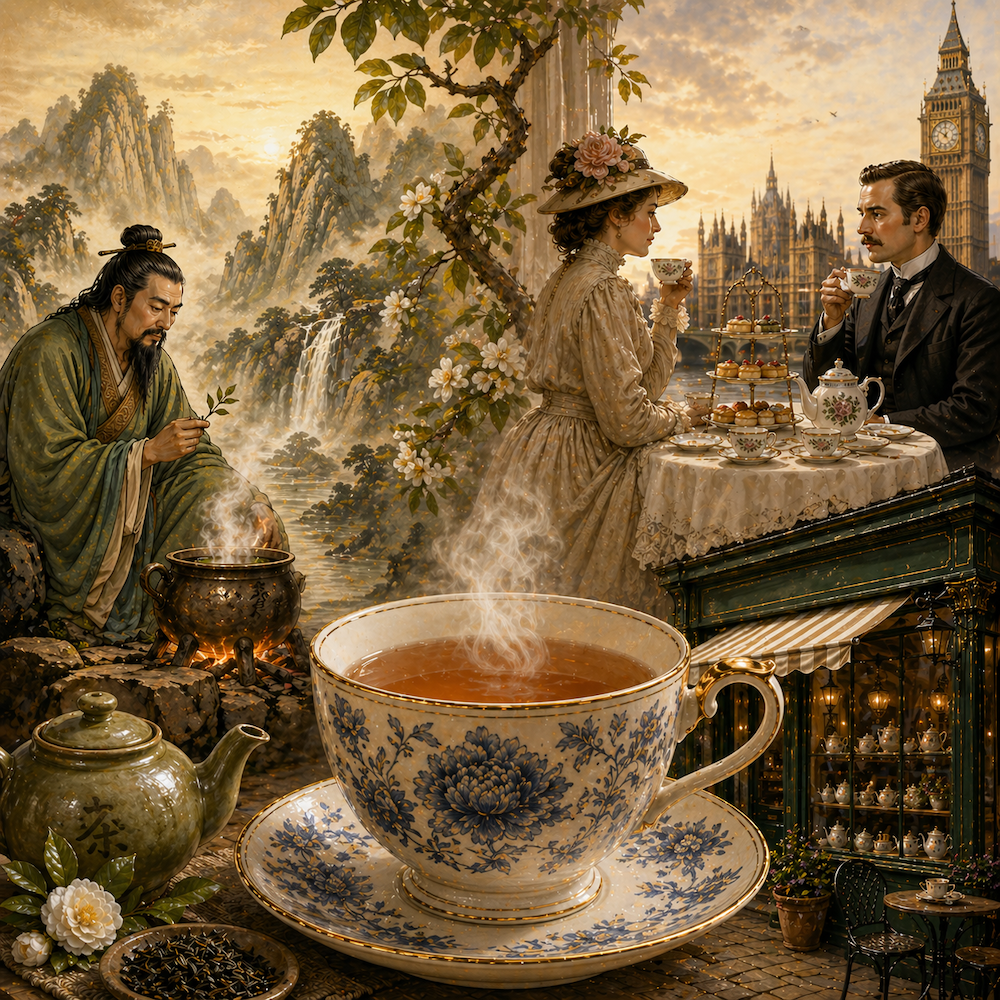
Is there anything more comforting than a nice, steaming hot cup of tea? Whether you’re having a bad day, settling in with a good book, or simply trying to figure out whether milk goes in first or last, tea has a way of making everything feel a little more manageable.
It’s also steeped in history, folklore, rituals, and even the most legendary tea address in London. Over the past few years, I’ve written stories about tea from various angles, and thought it would be fun to gather them together in one place. So put the kettle on, settle in, and read on.

A Proper Cup of Tea
Let’s start with the first cup of tea ever brewed.
It all began 4,500 years ago with the delightful legend of Shen Nung — the father of Chinese medicine. He accidentally discovered tea around 2500 BC when dried leaves from a tea plant blew into his pot of boiling water. He tasted it, loved it, and became the world’s first tea drinker. However, his story takes a bitter turn… but let’s save that for the full article.
Today we are a bit more particular than Shen Nung – a few leaves in a pot of boiling water just won’t do. We have some basic guidelines for brewing a truly great cup of tea, such as using fresh cold water, letting the boiled water rest for a couple of minutes before pouring, and removing the tea before it over-steeps and turns bitter.
And then we have to consider one of Britain’s most enduring debates: should you add the milk first, or the tea? This turns out to be a surprisingly historical question — and both camps have a name. “Miffys” put milk in first; “Tiffys” put tea in first.
👉🏼 Discover more about the history of Britain’s favorite beverage and how to brew a proper cup of tea.

From how we drink tea to what we call it, the story only gets more interesting…
What’s the Difference Between Tea, Afternoon Tea, and High Tea?
Did you know that “tea” can mean three completely different things in Britain? It’s the drink, of course — but it can also be a light afternoon snack around 4 p.m., and it can be another word for dinner. Even living here, it took me a while to get my head around it.
In this article I untangle the wonderful muddle that is British tea culture by tracing it all the way back to its origins. The story begins in 1662, with Catherine de Braganza, a Portuguese princess who married King Charles II. She arrived in England thirsty and craving a cup of tea – only to be offered… an ale!
Horrified but gracious, she endured it. But as soon as she could, she hurried to her room to unpack the tea she had brought from Portugal. She ended up sparking a tea craze at court. The fashionable ladies of England began copying her every habit, tea drinking included.
Then from an aristocratic novelty, tea evolved into a national institution. And the word itself came to describe everything from a dainty finger sandwich to a hearty working-class supper.
👉🏼 Find out about early tea “influencers” and how the word “tea” came to have so many meanings.

Is Tea the Solution to Your Sticky Situation?
Tea isn’t just tradition and terminology – in Britain, tea has taken on an almost magical role in everyday life.
I’ll admit it — after moving from America to England, I’ve become something of a tea convert. In the US, I used to drink mostly herbal teas, but here I discovered what I can only describe as “real” tea: strong, restorative, and apparently capable of solving almost any problem. The British certainly seem to think so, and after a while, I think their philosophy has rubbed off on me.
This article is a lighthearted look at that very British idea that a nice cup of tea is the proper response to just about any situation. This is a tongue-in-cheek ode to tea’s ability to calm frayed nerves, restore clarity, and make the world feel a little less catastrophic – whether you’ve lost your cat, burned the toast, or made the mistake of watching the news. I will say, though: I still think some situations call for tea and chocolate…
👉🏼 Read this cheeky tribute to that delightful drink called tea.

Twinings: Tiniest Tea Shop in London
If there’s one place in London that every tea lover should visit, it’s the Twinings shop at 216 Strand. It’s easy to walk right past — it’s barely wider than its double doors — but this narrow little store has been selling tea here for over 300 years, across ten generations of the Twining family.
The story begins not with tea, but with coffee. In the 1600s, London was awash with coffee houses — places where men gathered to discuss politics and sip their brew. When tea arrived from China, it was added it to their menu and praised in pamphlets claiming it could improve health, sharpen the mind, and even make the body “active and lusty.”
It was during this time that Thomas Twining, who had learned the tea trade at the East India Company, opened his own coffee (and tea) house. His blends quickly became the talk of the town.
Respectable ladies couldn’t set foot in a coffee house, so they sent their servants in to buy Tom’s teas while they waited outside in their carriages.
The shop’s charming facade, which can still be seen today, was redesigned by Tom’s grandson. Look for the golden lion, two Chinese figurines, and the royal coat of arms — a reminder that Twinings has supplied tea to the British royal family for centuries.
👉🏼 Discover this little slice of tea heaven tucked away on a London street.

Time to Put the Kettle On
Whether you’re a lifelong tea devotee or just discovering what all the fuss is about, I hope these articles have deepened your appreciation for this remarkable drink. To me, tea is history in a cup — from an accidental brew in ancient China to a three-century-old shop on a London street, from royal courts to working-class supper tables. It’s poetry and politics and the eternal question of milk first or last.
I hope you enjoy reading these stories as much as I enjoyed writing them. And now, if you’ll excuse me, I’m off to put the kettle on…
What is your favorite tea? I’d love to hear about it in the comments!
If you enjoy strange and lesser-known stories from history, make sure you’re subscribed (at the top or bottom of this page) – and feel free to share this with a friend who might enjoy it too.


- Curious History Review: October 2026 – 1 October 2026
- How Johanna van Gogh-Bonger Made the World See Vincent Van Gogh – 28 September 2026
- A Tragic Medieval Bedtime Story: The Chatelaine of Vergy – 18 September 2026


COMMENT HERE: Can't wait to hear what you think… (email not required)