
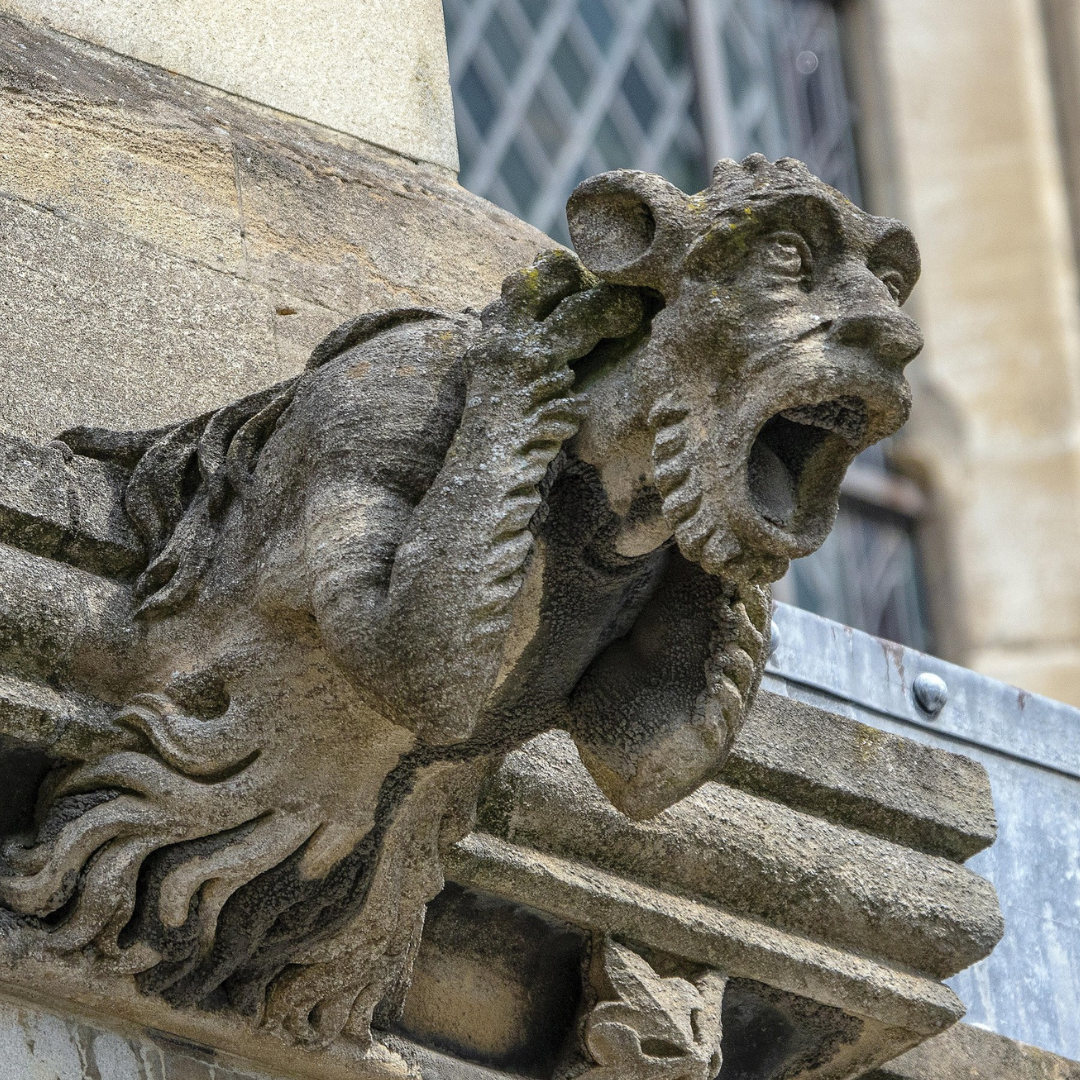
Have you ever looked up at a gothic cathedral and found yourself staring into the stony face of a strange creature — half-human, half-something else? Gargoyles and grotesques have been watching us from the walls and rooftops of Europe’s great churches for centuries. And the more you look, the more fascinating they become.
Over the years I’ve written a few articles that have become rather popular on this site — one about the legend behind gargoyles and another about gargoyles, grotesques, and hunky punks. So I thought it was time to bring everything together in one place. Consider this your complete guide to those wonderfully weird carved creations.
In this article
- What exactly is a gargoyle?
- Where did gargoyles come from? (The dragon story)
- Gargoyles vs grotesques vs hunky punks
- What were they for?
- The word “gargoyle” — and that time I told my French doctor…
- Modern gargoyles: aliens, astronauts, and NHS nurses
- Where to spot them

1. What Exactly Is a Gargoyle?
Technically, not all of those strange stone-faced beings on churches are gargoyles. A true gargoyle has a job to do. It’s a form of guttering: an elongated figure extending from the building with an opening (usually its mouth) through which rainwater is directed away from the walls. Without them, the water would run straight down the stonework and cause serious damage over time.
So a gargoyle is basically a very characterful drainpipe.
A gargoyle carries water. Anything similar that doesn’t carry water is called a grotesque. Both can look equally alarming or amusing.

2. Where Did Gargoyles Come From? (The Dragon Story)
There’s a wonderful French legend that explains it all, and it begins — as the best stories do — with a monster.
In seventh-century Rouen, Normandy, a fearsome creature called La Gargouille had taken up residence in the marshes along the Seine. Unlike your typical dragon, he didn’t breathe fire. Instead, he belched floods of water — sinking ships, drowning fields, and eating anyone unfortunate enough to cross his path.
The desperate city leaders struck a deal: to keep the townsfolk safe within the walls, La Gargouille would receive one human per year. He had requested tender young virgins (of course) but the town couldn’t bring themselves to go that far. They settled on condemned prisoners instead. The monster gobbled them up and didn’t seem to notice the difference.
Then along came a young, enthusiastic priest named Father Romain, who was quite sure he could handle the situation. Armed with a large gold cross and a nervous prisoner as bait, he marched into the marsh. When the dragon lunged, Romain flashed the cross — it stopped the beast in his tracks. The prisoner nervously tied Romain’s scarf around the monster’s neck, and the unlikely trio walked back into the city, with the dragon on a leash.
La Gargouille was sentenced to burn at the stake. But when the fire died down, his head and neck were completely unscorched. So they were mounted on the church as a symbol of God’s power. When it rained, water poured from the dragon’s mouth — and a clever architect got the idea to carve similar stone heads to channel rainwater away from the masonry. He named them after the beast: gargoyles.
The prisoner was pardoned, starting a tradition in Rouen of pardoning one condemned criminal each year on the feast of Ascension — a practice that continued until the French Revolution. Father Romain, meanwhile, became Saint Romain. He’s still recognisable in art by his faithful gargoyle on a leash.
Want the full story? Read: Legend of the Gargoyles

3. Gargoyles vs Grotesques vs Hunky Punks
As I mentioned, a gargoyle is specifically a water-carrier. But medieval churches are covered in all manner of strange carvings that don’t carry water at all — and those are called grotesques.
Grotesques can be funny, frightening, human, animal, or a bizarre combination of all the above. They lurk in doorways, peer down from high vaulted ceilings, and pop up in the most unexpected corners. The trouble is, they’re often small and placed very high up — so if you go grotesque-hunting, bring binoculars or a good zoom lens.
Interestingly, the word grotesque had nothing to do with their lack of beauty. In the late 15th century, some underground rooms were discovered in Rome — initially mistaken for caves (or grottos). They were decorated with fantastical figures, and this style of decoration became known as grottesca. The word eventually migrated to the walls of our medieval cathedrals, and from there into everyday language, where today it means something more like hideous or absurd. The original carvings, though, are often just amusing.
In the Middle Ages, both gargoyles and grotesques were sometimes called babewyns — from the Italian word babuino, meaning baboon. Whether the resemblance was the point, or whether the stone masons were simply doing a bit of monkeying around, we may never know.
And then there’s my personal favourite term: hunky punk. This is a word used in Somerset, England for a particular type of grotesque — a creature with short legs in a squatting position. I don’t know about you, but “hunky punk” makes me smile every time I hear it.
Full details, including wonderful examples from UK cathedrals: Gargoyles, Grotesques, and Hunky Punks: Ancient and Modern

4. What Were They For?
Gargoyles: practical. They kept rainwater away from the stonework and saved the masonry from costly damage. Simple enough.
Grotesques: nobody really knows. The stone masons didn’t leave notes, and there’s no mention of them in church records. Some believe they were placed there to ward off evil spirits — a kind of spiritual security system for the building. And others think they were simply decorative — or perhaps the stone carvers just really enjoyed their work and had a healthy sense of humour.
Looking at some of them — sticking out their tongues, picking their noses, or clearly winking at you — the latter theory feels very plausible indeed.
5. The Word “Gargoyle” — and That Time I Told my French Doctor…
Gargouille is the French word for gargoyle, and gargouillement means a gurgling sound. Which brings me to a personal confession.
When I was living in France and went to see my doctor with a chest infection, I wanted to tell him that when I breathed, there was a gurgling sound in my chest. What I actually told him was that there was a gargoyle in my chest. The amused look on his face told me something had gone amiss. Alas, the story of the writer, the doctor, and the gargoyle is perhaps better saved for another time.

6. Modern Gargoyles: Queens, Aliens, Astronauts, and Nurses
I love that this tradition is continuing. Many of Europe’s great medieval cathedrals are constantly being maintained and repaired, and when old gargoyles or grotesques wear away, they need to be replaced. And when they do, the stone masons of today — just like their medieval predecessors — add something from their own time.
At Chichester Cathedral, you’ll find Queen Elizabeth II and Prince Philip carved into the façade on either side of the main entrance, placed there to mark a royal visit. On the other side of the building, a local lawyer named Clifford Hodgetts has been immortalised as a caricature gargoyle, complete with a drainpipe coming out his mouth.
In Salamanca, Spain, when repairs were carried out in 1992, someone added an astronaut to the ancient cathedral. At Paisley Abbey in Scotland, a 1990s restoration produced a gargoyle that is unmistakably inspired by the Alien films. And at Gloucester Cathedral, new gargoyles added in 2019 include a miner with a pickaxe, a rugby player clutching a ball, a female jockey, a cheese-roller, a suffragette, and a sheep shearer — each one representing a different part of Gloucestershire.
Most movingly, when Christchurch Priory in Dorset was replacing worn carvings during the pandemic, they added a mask-wearing nurse as a tribute to the NHS.
There’s something rather wonderful about all of this. These buildings have been telling the story of humanity for a thousand years, and they’re still doing it today. Future visitors will look up at a carved astronaut or alien and be just as confused as we are today when we gaze up at a face sticking out its tongue at us or a half-man half-bird creature.

7. Where to Spot Gargoyles and Grotesques
If you’ve been bitten by the gargoyle bug, here are some wonderful places to go hunting:
France: Notre-Dame de Paris, the Cathedral of Rouen (home of the La Gargouille legend), and the Sainte-Chapelle in Paris.
UK: Wells Cathedral (12th century, extraordinary detail), York Minster, Chichester Cathedral (royals and a lawyer!), Ely Cathedral (nose-picker alert), Paisley Abbey in Scotland (the Alien), and Gloucester Cathedral (modern masterpieces). And don’t miss Lincoln Cathedral, home of the famous Lincoln Imp — a cheeky little stone creature with a gap-toothed grin who, according to legend, was turned to stone by an angel after causing mayhem inside the cathedral. He’s become so beloved that he’s now the unofficial mascot of the entire city.
Italy: The Cathedral of Milan has some extraordinary gargoyles.
Spain: And don’t forget Salamanca in Spain for that famous astronaut.
Wherever you go: look up. Bring binoculars for the really high carvings. And enjoy the feeling that someone, centuries ago, might have carved something purely to make you smile.
Have you spotted a wonderful gargoyle or grotesque on your travels? I’d love to hear about it in the comments!
If you enjoy strange and lesser-known stories from history, make sure you’re subscribed (at the top or bottom of this page) – and feel free to share this with a friend who might enjoy it too.


- Bath’s Jane Austen Festival: Books, Balls, and Bonnets – 5 September 2026
- Curious History Review: September 2026 – 3 September 2026
- Jane Austen Walking Tour of Bath – 27 August 2026




COMMENT HERE: Can't wait to hear what you think… (email not required)