

Two Buildings – Two Georges
Recently we were in Barcelona, and, as I do each time I’m there, I went to visit some of Gaudi’s amazing architecture. His buildings are like no others: they move in waves with nary a straight line in sight. No stodgy soldier-like edifices for him.
Antoni Gaudi was one of the leaders of the Catalan Modernism movement which took hold at the end of the 1800s. Barcelona was at the center of this movement and several wonderful examples of this architectural style can still be found there.
Today, we’ll be looking at two of Gaudi’s buildings and their relationship with two very different Georges: George, the dragon-slayer, and George, the filmmaker – otherwise known as Saint George and George Lucas.
Casa Batllo and Saint George
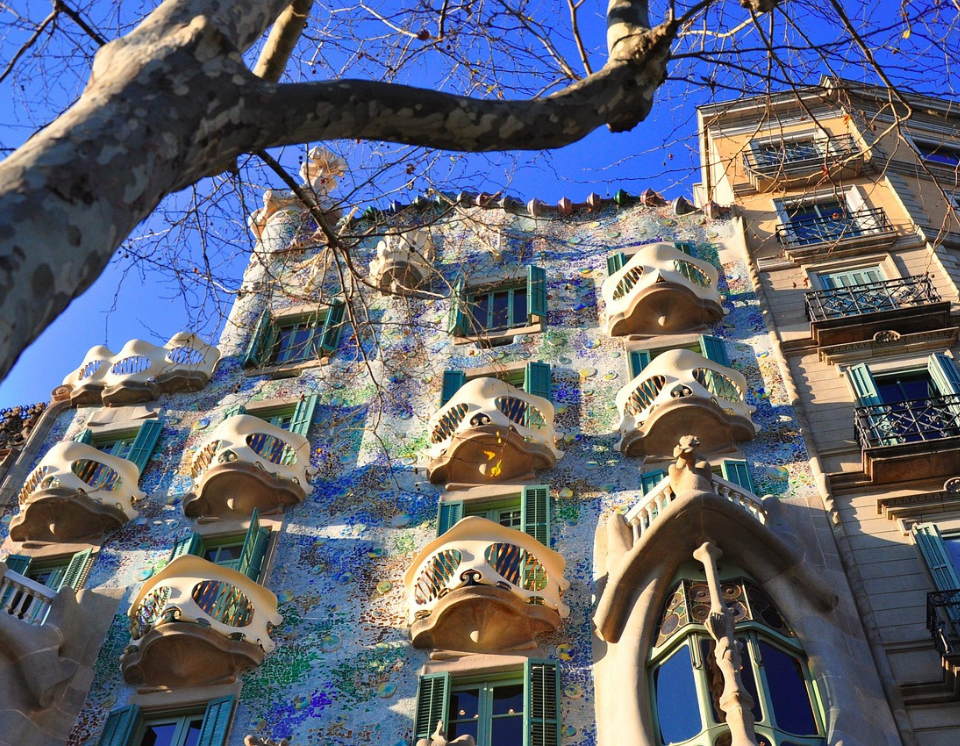
Casa Batllo started life as a “normal” building, but morphed into something extraordinary under Gaudi’s renovation which started in 1904. This incredible house is a full-on Gaudi experience. The interior undulates to an aquatic theme, while the outside tells the tale of Catalonia’s patron saint, Saint George.

The above photo is NOT of Casa Batllo. It shows how the architect of the neighboring house paid homage to Saint George with a sculpture on the wall. Gaudi, on the other hand, turned his entire building into a sculpture symbolizing the story of the Saint and the dragon.
In case you haven’t heard of George, he’s quite a popular saint, well-known for his dragon-slaying abilities. He seems to have chased dragons all over the world, as he is the patron saint of many countries, cities and organizations.
In Catalan he’s known as Sant Jordi and the local version of his story goes something like this…
A small village outside of Barcelona was being terrorized by a fearsome dragon. The monster ate all the animals then started munching on people – preferring tender young virgins (as dragons do). Each year all the names were put into a hat and one unlucky virgin was chosen to be the dragon’s dinner. One year, the king’s lovely, young daughter’s name was drawn and as she was being taken out to the dragon’s den, George galloped up on his gallant steed, killed the dragon with his mighty sword, and saved the princess. On the spot where the dragon’s blood stained the ground, a red rose bloomed. Of course, George got to marry the princess and she probably sat at home in her castle while he was out traveling the world killing dragons in other countries.
George became Catalonia’s beloved saint and is celebrated every year on April 23. The tradition on this day is for men to give roses to their ladies – in remembrance of the rose that bloomed from the dragon’s blood. The women give books to their gentlemen because two great writers, Shakespeare and Cervantes, both died on St. George’s Day, April 23, 1616.

So How Does Casa Batllo Symbolize This Story?
The Dragon: If you look at the roof, you can see the shape of the dragon, with the small arched opening on the right forming the space under his neck. The shiny green-blue tiles represent scaly dragon skin, and the rounded tiles running atop the ridge form his backbone.
The Sword: On the top left, there is a small rounded tower with a cross on the top, representing Saint George’s sword thrust into the dragon’s body.
The Bones: The façade of the house has balconies in the shape of skulls and columns resembling bones. These remind us of the bones of the poor victims killed and eaten by the dragon.
The Rose: In the center, at the top is a small balcony in the shape of the rose that sprang from the ground where the dragon’s blood soaked in.

This house is nicknamed the “house of bones.” Others call it the “yawning house” because of the first floor windows which could be seen as an open mouth. Still others see a carnival theme, with the balconies being masks, the roof a harlequin hat, and the colorful façade, confetti. What do you see?
Casa Mila and George Lucas

Senor and Senora Mila lived just down the street from the Batllo house and admired it so much that they wanted one of their own. But they wanted a much larger apartment building where they could live on two floors and rent out the rest.
However, the finished product was a disappointment to them, as well as to the general public. Everyone thought it was ugly and called it “La Pedrera” which means quarry, because they thought that’s what it resembled. But Gaudi had a mind of his own and built what pleased him. Today it’s considered one of his finest works.
One feature of this building, which may be the most admired, is the roof where you can see Gaudi’s forest of thirty-plus striking chimneys. Some of them might look familiar to you if you’re a Star Wars fan. Do you see a resemblance to the Star Wars Stormtroopers helmets?


Some say that George Lucas, visited here in the early 1970s and was inspired by Gaudi’s futuristic-looking chimneys and that they were his inspiration for the helmets in his science fiction film. I can’t confirm whether this is true or not, but there does seem to be a resemblance.
The same “chimney helmet” design is used on the Passion Façade of the Sagrada Familia Church as Roman soldier helmets. This façade was finished after Gaudi’s death, but according to his design.

I love architecture that tells a story and Gaudi was a master at storytelling in stone. George Lucas uses a different medium to tell his stories, but it’s just possible that he was inspired by that eccentric Spanish architect, Antoni Gaudi.
When Gaudi received his architecture degree, one of his professors said…
“We’ve given this degree to either a genius or a madman… only time will tell.”
Let me know what you think in the comment section below. And if you want to read more of my curious histories, subscribe to my blog (at the top or bottom of this page).
Follow Me on Social Media:
GPSmyCity – This article is now featured on GPSmyCity. To download this article for offline reading or travel directions to the attractions highlighted in this article, go to Walking Tours and Articles in Barcelona, Spain on GPSmyCity. See all my articles on GPSmyCity HERE.


- Bath’s Jane Austen Festival: Books, Balls, and Bonnets – 5 September 2026
- Curious History Review: September 2026 – 3 September 2026
- Jane Austen Walking Tour of Bath – 27 August 2026



COMMENT HERE: Can't wait to hear what you think… (email not required)