
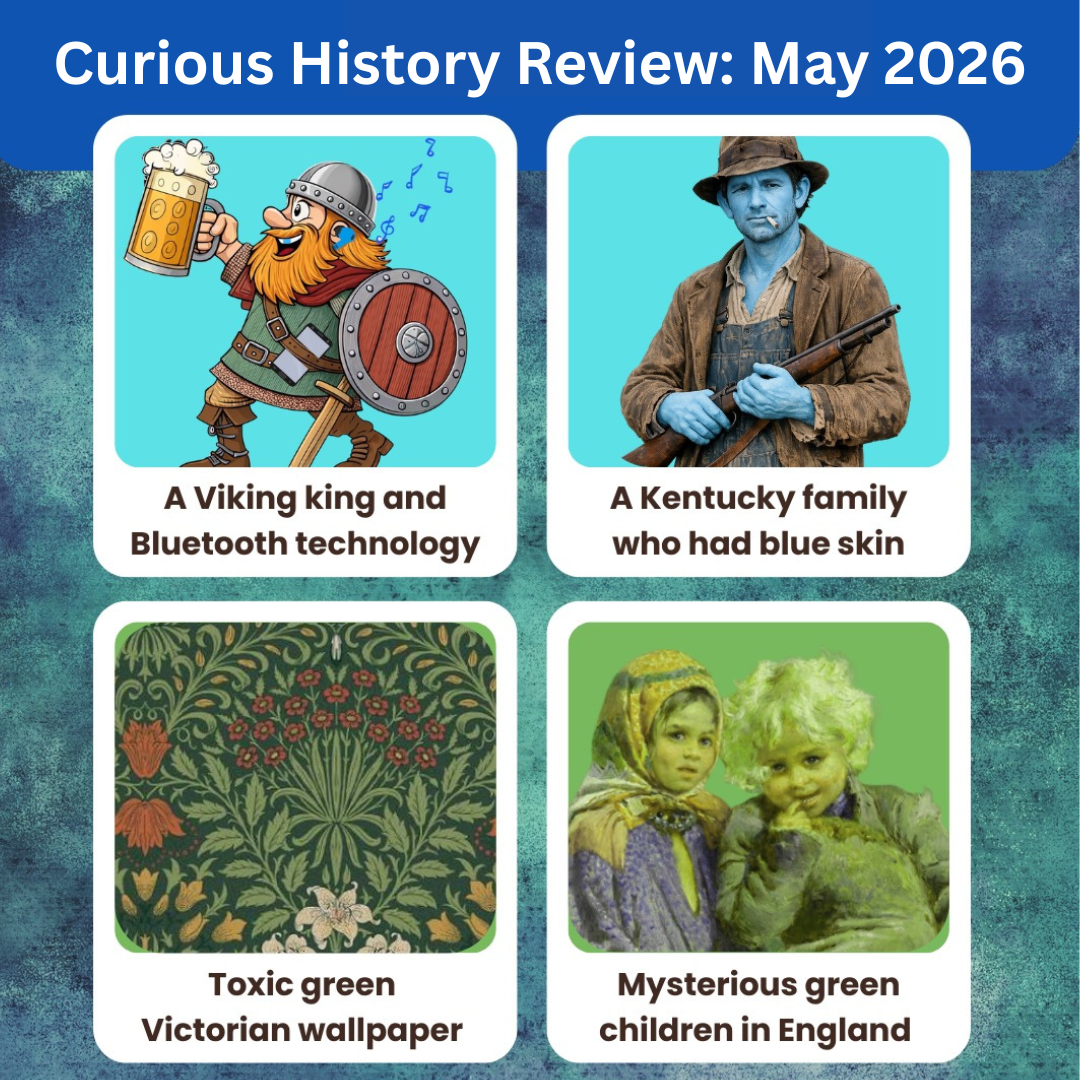
This month’s Curious History Review is all about color – specifically blue and green.
It all started when I was pairing my wireless mouse to my computer. I wondered, “Why is Bluetooth called Bluetooth?” That simple question led me to a Viking King, Harald Bluetooth, and the surprising reason his name lives on in modern technology…

What Does a Viking King Have to Do with Bluetooth Technology?
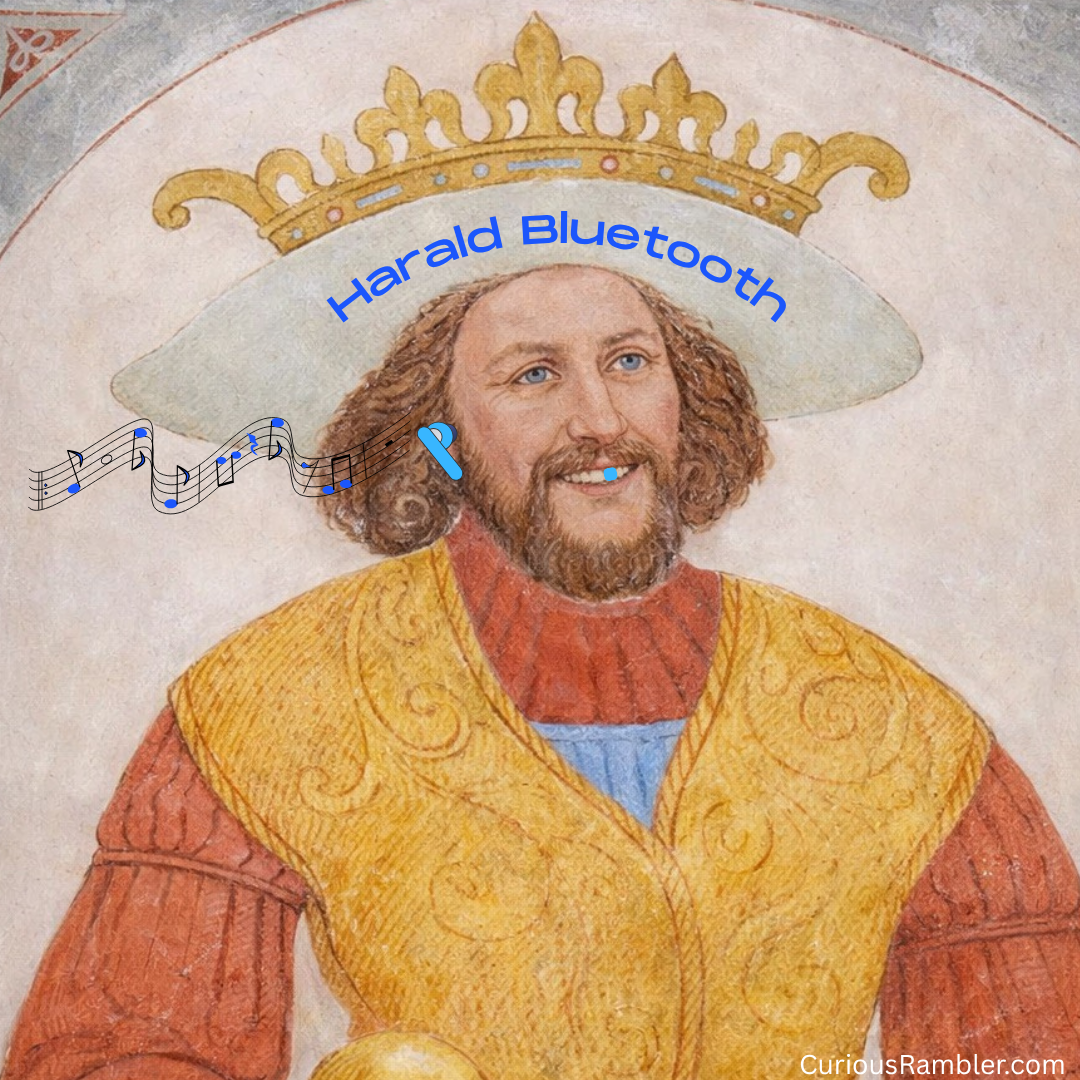
We all know that Bluetooth is what allows our various devices to talk to one another. But what about that odd name – Bluetooth? As it turns out, the name was inspired by a 10th-century Viking king called Harald Bluetooth.
So why name a modern wireless system after a Viking ruler? The answer is a fascinating blend of history, symbolism, and the idea of unification.
Let’s find out more about this blue-toothed Viking…
Who Was Harald Bluetooth?
Harald Bluetooth ruled Denmark and parts of Norway in the late 10th century (c. 958–986 AD).
He is remembered for three important things – well two important things and one curious one:
Firstly, he unified Denmark, parts of Norway, (and possibly Sweden) into a single kingdom – which he ruled.
Secondly, he introduced Christianity to the region and melded Pagans and Christians together into one religion.
Thirdly, he had a really odd name – Harald Bluetooth.
👉🏼 Discover the rest of the story behind this blue-toothed Viking and his namesake technology.
From a Viking with a blue tooth, we move on to a group of Kentuckians with blue skin. How did this isolated group of people end up with such an unusual skin color?

FROM THE ARCHIVES
Blue People of Kentucky
In the hills of Kentucky, entire families once had blue-tinted skin… and for years, no one knew why.
From around 1820 through the mid 1900s there were some very unusual-looking people living in an isolated area of Eastern Kentucky. What made them unusual was the color of their skin – it was blue. They were varying shades of blue: Some were pale blue, others a deeper blue, and still others just had blue tinges to their fingernails and lips.
While it wasn’t unusual to see Blues, as they were called, in this Kentucky hollow, not everyone there was blue. Out of a family with eight children, perhaps four or five of them might be born blue.
What caused this striking phenomenon?
👉🏼 To find out more about this rare blue skin condition, read the full story.
🗓️ Curious History Calendar 🗓️
Here are a few Curious Rambler articles related to upcoming dates:
- May 12: International Nurse’s Day → Florence Nightingale
- May 21: World Tea Day →All About Tea: History in a Cup
- May 23: World Turtle Day→ Mock Turtle and Mock Turtle Soup
- June 4 → Next issue of Curious History Review – First Thursday of June
Now let’s move around the color wheel from blue to green. The Victorian’s adored green – perhaps a little too much. Their bright green wallpaper was elegant, modern… and deadly.

Victorians Were Keen on Green: Wallpaper to Die For
In the 1800s, few colors captured the Victorian imagination quite like the new vivid green color called Scheele’s Green. It symbolized nature, health, and modernity – the perfect complement to a stylish Victorian interior.
But behind this beautiful hue lurked a sinister secret. The very pigment that brightened the walls was laced with arsenic, and under certain conditions, it could poison the people who lived with it.
The Beginning – Scheele’s Green
It all began in 1775 when Swedish chemist Carl Scheele mixed arsenic oxide and copper. It produced a bright, long-lasting green pigment – later known as Scheele’s Green.
The world suddenly became brilliantly green as this new pigments swept across Europe. It found its way into clothing, artificial flowers, children’s toys, and most famously… wallpaper.
👉🏼 Discover more about this beautiful… but deadly wallpaper.
Staying with the green theme, let’s look into one of England’s strangest medieval mysteries… one that has never been explained.

FROM THE ARCHIVES
Green Children of Woolpit
In twelfth-century England in the small East Anglian town we now call Woolpit, two very strange visitors arrived. The harvesters in the fields were surprised to see two children emerge from one of the ancient cavities, called wolf pits. There was a girl, maybe around ten-years-old, and a slightly younger boy.
The two children seemed dazed and disoriented as they stumbled through the field. At first they looked like normal children, but as they got closer, the workers were shocked. Their skin had a distinct green tint. Their clothes were strange and made of an unfamiliar fabric, and when they spoke, it was a peculiar language that no one had ever heard.
👉🏼 Discover the theories about where these children could have come from.
BONUS VIDEO
Keukenhof Garden
I’ve recently been in the Netherlands and will probably share some related stories next month… In the meantime, here is a video of some of the amazing flowers at Keukenhof garden. It’s quite a sight to see in the springtime when the tulips and other spring bulbs are blooming.

I hope you enjoyed our blue and green themed stories and the colorful garden video today. See you next month with more curious histories!
Do you know a story about something with an unusual color? I’d love to hear it – share it in the comments section.
If you enjoy strange and lesser-known stories from history, make sure you’re subscribed (at the top or bottom of this page) – and feel free to share this with a friend who might enjoy it too.
Follow Me on Social Media:

- Curious History Review: May 2026 – 7 May 2026
- What Does a Viking King Have to Do with Bluetooth Technology? – 6 May 2026
- All About Tea: History in a Cup – 30 April 2026



COMMENT HERE: Can't wait to hear what you think… (email not required)