
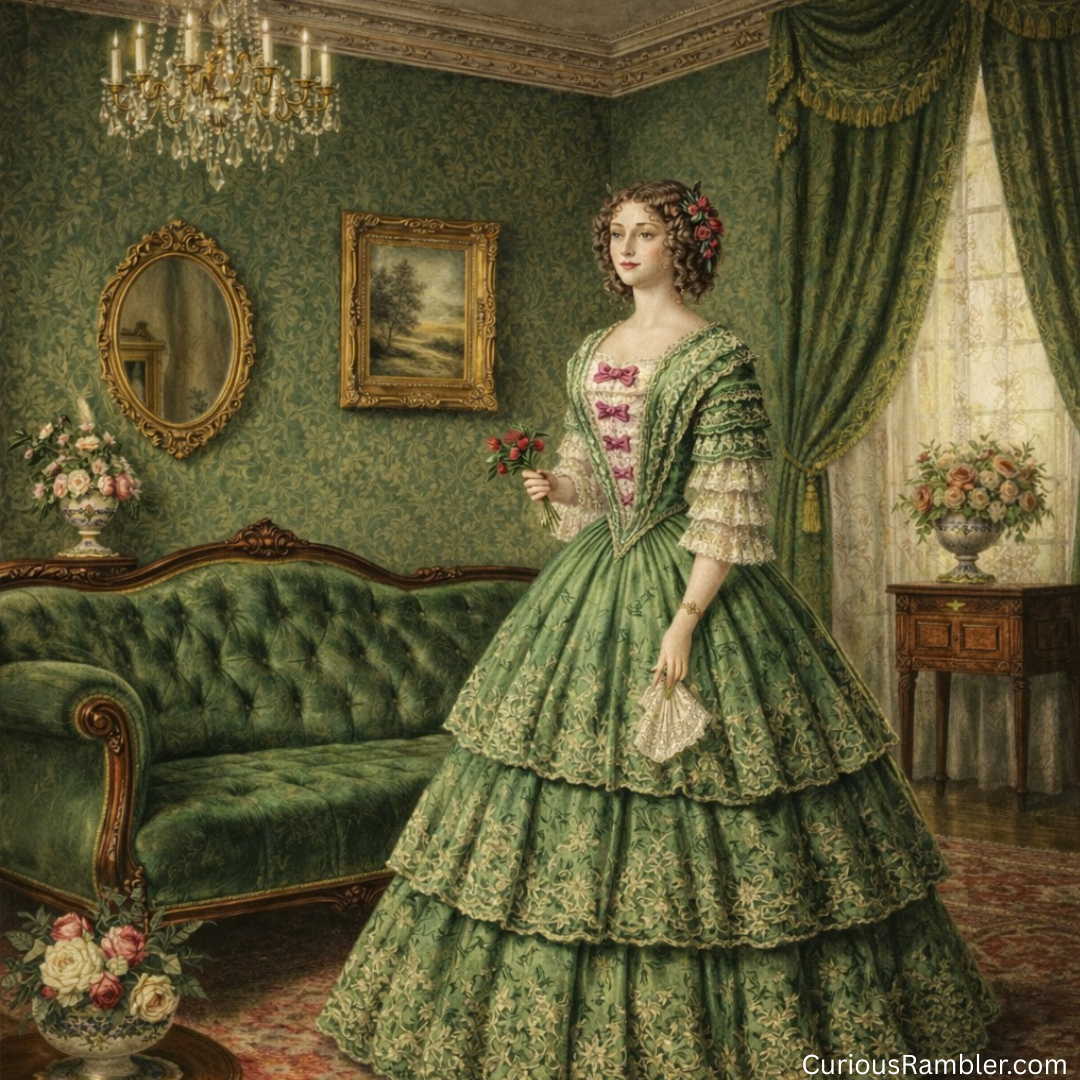
In the 1800s, few colors captured the Victorian imagination quite like the new vivid green color called Scheele’s Green. It symbolized nature, health, and modernity – the perfect complement to a stylish Victorian interior.
But behind this beautiful hue lurked a sinister secret. The very pigment that brightened the walls was laced with arsenic, and under certain conditions, it could poison the people who lived with it.

The Beginning – Scheele’s Green
It all began in 1775 when Swedish chemist Carl Scheele mixed arsenic oxide and copper. It produced a bright, long-lasting green pigment – later known as Scheele’s Green.
He knew at once that he had a winner. Up until then, green dyes had been dull and faded quickly. Scheele’s discovery changed everything. This new color was vibrant, durable, and unlike anything people had seen before.
Others soon invented similar pigments, most notably Paris Green, which had even richer tones. The world suddenly became brilliantly green as these new pigments swept across Europe. They found their way into clothing, artificial flowers, children’s toys, and most famously… wallpaper.
Green Wallpaper
Wallpaper had been considered a luxury item for centuries. But by the early 1800s, industrial production made it widely affordable. At the same time, the use of new gas lighting in homes meant the walls could be darker, so deep reds and greens became the colors of choice.
And, of course, the preferred green color was the new arsenic-laden Scheele’s Green or the even more toxic Paris Green. Entire rooms were papered in intricate green patterns – often with botanical themes that celebrated nature. Ironically, those nature-inspired designs were anything but natural.
Poison in the Parlor
At first, the wallpaper seemed harmless. The pigment appeared to be stable when dry and undisturbed. But in damp conditions, something sinister happened.
When mold grew on arsenic-laced wallpaper, the lovely green pigment could produce a toxic gas. Even without moisture, microscopic particles could flake off and be inhaled. What looked like harmless decoration could become a slow-acting poison.

The Mystery Illness
Some families began to experience mysterious symptoms: headaches, fatigue, skin irritation, respiratory problems, and in severe cases, even death.
Doctors were baffled. The symptoms were vague and resembled other conditions, allowing the true cause to remain hidden.
Children were particularly vulnerable. Crawling on floors, touching walls, and putting objects into their mouths, they were more exposed to arsenic dust than adults. Nurseries decorated with cheerful green patterns were sometimes the most dangerous rooms in the house.
Suspicion Grows
At first, doctors couldn’t explain these cases. They examined water supplies, sanitation, and general living conditions, but found no clear cause.
However, as they compared notes, they noticed one strange common factor: Many of the sick patients were spending time in, or sleeping in, rooms with bright green wallpaper.
But could green wallpaper really make people ill? The idea seemed absurd. How could a color make someone ill? And not everyone in these households was ill. This mystery illness seemed to afflict children, those already suffering from other illnesses, and the elderly – while normally healthy adults were unaffected.
Although the dangers of ingesting arsenic were well known, no one thought that breathing near a color made with arsenic could be deadly.
Warnings Ignored
Some doctors began to speak out. They published case studies and reported that when patients were removed from green-papered rooms, they often recovered, only to become ill again when they returned. And when the wallpaper was removed completely, patients frequently made a full recovery. In addition, autopsies had revealed signs of arsenic poisoning in those who died of these strange symptoms.
Yet despite this growing medical evidence, many remained skeptical. Homeowners who had suffered no ill effects didn’t believe their stylish wallpaper could be dangerous. And manufacturers were even more adamant that it was safe.

Denial and Profit
The manufacturers argued that thousands of families had rooms decorated with arsenic-based wallpaper, and only a small percentage of them experienced symptoms. In addition, not everyone in the family became ill. If the wallpaper was truly dangerous, shouldn’t everyone exposed to it be affected?
William Morris, one of the most prestigious wallpaper makers of the time, dismissed the doctors’ warnings. He had green wallpaper containing arsenic in his home and many of his friends did as well – and none of them were ill. So, there you go! That was proof enough for him.
However, it should be noted that William Morris was a shareholder in a major mining company, one of the largest arsenic producers in the world at that time. And it supplied the green arsenic pigments that were used in his early wallpapers – so perhaps he could have been a bit biased…
A Slow Retreat from Danger
Over time, reports of illness became harder to ignore, and public pressure forced manufacturers to adapt. By the late 1800s, safer alternatives began to replace arsenic-based pigments, but the deadly green did not disappear overnight.
Dangerous arsenic wallpapers remained in circulation for years – mainly because they were cheap, pretty, and profitable.
Napoleon and the Green Walls of Exile
Even emperors may not have escaped the reach of this wallpaper poisoning.
After Napoleon’s defeat, he was exiled to the island of Saint Helena, where he lived in a damp residence called Longwood House. The walls were decorated with fashionable green wallpaper – likely containing arsenic-based pigments.
Years later, scientists discovered elevated levels of arsenic in samples of Napoleon’s hair. While modern historians generally agree that he died of stomach cancer, some believe that chronic arsenic exposure may have worsened his condition – or at least contributed to his decline.

The Hidden Danger at Home
For the Victorian family, their home was meant to be more than just a place to live. It was a safe refuge from the outside world and a symbol of their identity and success. They wanted their homes to be cozy, comfortable, and colorful places.
However, in their pursuit of style, many had unknowingly surrounded themselves with a poison – one that turned their beautiful, safe homes into places of unseen danger. And in the end, the color they loved the most became the one that could kill them.
Would you use something in your home if there were “suggestions” that it was unhealthy but no definitive proof? Let me know in the comments section.
If you enjoy strange and lesser-known stories from history, make sure you’re subscribed (at the top or bottom of this page) – and feel free to share this with a friend who might enjoy it too.


- A Tragic Medieval Bedtime Story: The Chatelaine of Vergy – 18 September 2026
- Bath’s Jane Austen Festival: Books, Balls, and Bonnets – 5 September 2026
- Curious History Review: September 2026 – 3 September 2026




COMMENT HERE: Can't wait to hear what you think… (email not required)