
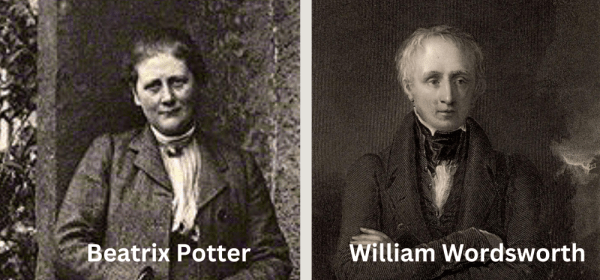
Do you like to visit sites where authors once dwelt and scribbled? If so, the Lake District in northwest England might just be the perfect place for your next holiday.
Last summer my husband and I visited the Lake District. Many people go there to walk the hills, as it’s a trekker’s paradise. You see people everywhere kitted out in hiking gear with large backpacks and walking sticks.
But that wasn’t me. I didn’t go there to walk those lovely hills; I went to see how they inspired two great literary figures: Beatrix Potter and William Wordsworth. Both of them lived in this area and were influenced by its natural beauty.
BEATRIX POTTER IN THE LAKE DISTRICT


Lindeth Howe Hotel
We stayed at Lindeth Howe Hotel and made it the base for our exploration. In the early 1900s, before it was a hotel, the Potter family rented this house for holidays, and two of Beatrix’s books were illustrated here: Timmy Tiptoes and Pigling Bland.
Then in 1915 after Beatrix’s father died, she bought the house for her mother. It’s a lovely place with décor that’s a bit over the top but in keeping with Beatrix’s love of animals, flowers, and colors.
Armitt Museum in Ambleside
Before she started writing about bunnies and other creatures, Beatrix was fascinated by mushrooms. And in the Armitt museum you can see many of her early fungi illustrations.


Hill Top Farm
Beatrix always had a warm spot in her heart for the Lake District, and she bought Hill Top Farm in 1905 with the proceeds of her first book. She used the cottage as a place to do her writing, and it was a quiet refuge for her during turbulent times in her life.
Many of Beatrix’s stories were written here. As you walk from room to room in the cottage, you can see drawings that Beatrix made in that very room, and the very same furniture still sitting in the same place.

Beatrix Potter Gallery
This 17th century building used to be the office of William Heelis, the man that Beatrix married after she moved to the Lake District. He was a solicitor and advised her on land purchases.
In this gallery you can see the original illustrations and some of the original small books of her most beloved characters. The gallery takes us on the journey of Beatrix’s life: from children’s author to conservationist.
Beatrix bought up lots of farms in the area to keep them from going to developers. Upon her death, she left 14 farms and 4,000 acres of countryside to the National Trust, and she and husband, William Heelis, also helped the National Trust to purchase other lands.


The World of Beatrix Potter
This attraction might be aimed at children, but I can assure you that those of us way beyond childhood can enjoy it too. It’s filled with models of Beatrix’s most beloved critters and there’s a small theatre inside where you can watch a play with humans and animal puppets.
Beatrix Potter loved the Lake District and her legacy lives on. Not only did she save much of the farm land, but her books and lovable characters have also brought a lot of tourism to the area and added revenue.
WILLIAM WORDSWORTH IN THE LAKE DISTRICT
The Lake District isn’t just about Beatrix Potter and her charming critters. In 1770, long before Beatrix arrived, the famous poet William Wordsworth was born here. And there are plenty of Wordsworth sites to be seen here too. It’s easy see sites related to both literary figures in one trip.
William Wordsworth lived much of his life in the Lake District with his sister, Dorothy. They both enjoyed nature and were avid walkers.


Hawkshead Grammar School
William Wordsworth was born in 1770, the second of five children. His sister Dorothy was born the following year, and they remained close throughout their lives.
In 1778, when William was 8, his mother died, and his father sent the children out to live with various family members. William went to Hawkshead, where he attended the Hawkshead Grammar School while Dorothy was sent to Yorkshire.
William attended this school from age 8 to 16. The building is now a museum where you can see what school life was like for Wordsworth. The boys sat on wooden benches that look very uncomfortable, and it seems that they all carved their names on their desks (including Wordsworth.) I wonder if that was before or after they had their three pints of beer…


Dove Cottage – Grasmere
In 1799, after attending university in Cambridge, traveling in France, and living in Dorset where he met and worked with fellow poet Coleridge, William and his sister Dorothy moved into Dove Cottage in Grasmere. Wordsworth described it as “the loveliest spot that man hath ever found,” and he wrote some of his most famous poetry here.
Dorothy was a dedicated sister, and she would take notes as William dictated his poetry, but she was also a writer in her own right. It was actually Dorothy’s journal that provided inspiration for some of her famous brother’s most loved poetry such as “I Wandered Lonely as a Cloud” (Daffodils).
Three years after moving to Dove Cottage, William married Mary Hutchinson, and she moved into Dove cottage with William and his sister. William and Mary had 4 children – 2 of whom died in childhood.
Dove Cottage is now open to the public as a writer’s home museum. It remains much as it was when the Wordsworths lived there.


Rydal Mount
In 1813 William, Mary, their 2 children and Dorothy moved into Rydal Mount. William lived there for 37 years until his death in 1850.
This house is still owned by the Wordsworth family but is open to the public for visits. The house and furnishing are still very much as they were when the Wordsworths lived there.
After visiting the house, you can wander through the beautiful gardens that were laid out by William and Dorothy who were both avid gardeners.
The Lake District had a great impact on William Wordsworth, his sister Dorothy, and Beatrix Potter. Thankfully, many sites related to these literary figures are preserved, and we can visit them today. What could be better than a lakeside literary holiday?
Have a look at Beatrix Potter books and William Wordsworth books here. Please note that I am an Amazon Affiliate and will receive a small commission on anything purchased through these links.
What do you think? Let me know in the comments section below. And if you want to read more of my curious histories, subscribe to my blog (at the top or bottom of this page).
Follow Me on Social Media:


- Curious History Review: October 2026 – 1 October 2026
- How Johanna van Gogh-Bonger Made the World See Vincent Van Gogh – 28 September 2026
- A Tragic Medieval Bedtime Story: The Chatelaine of Vergy – 18 September 2026


COMMENT HERE: Can't wait to hear what you think… (email not required)