

A Face You Won’t Forget
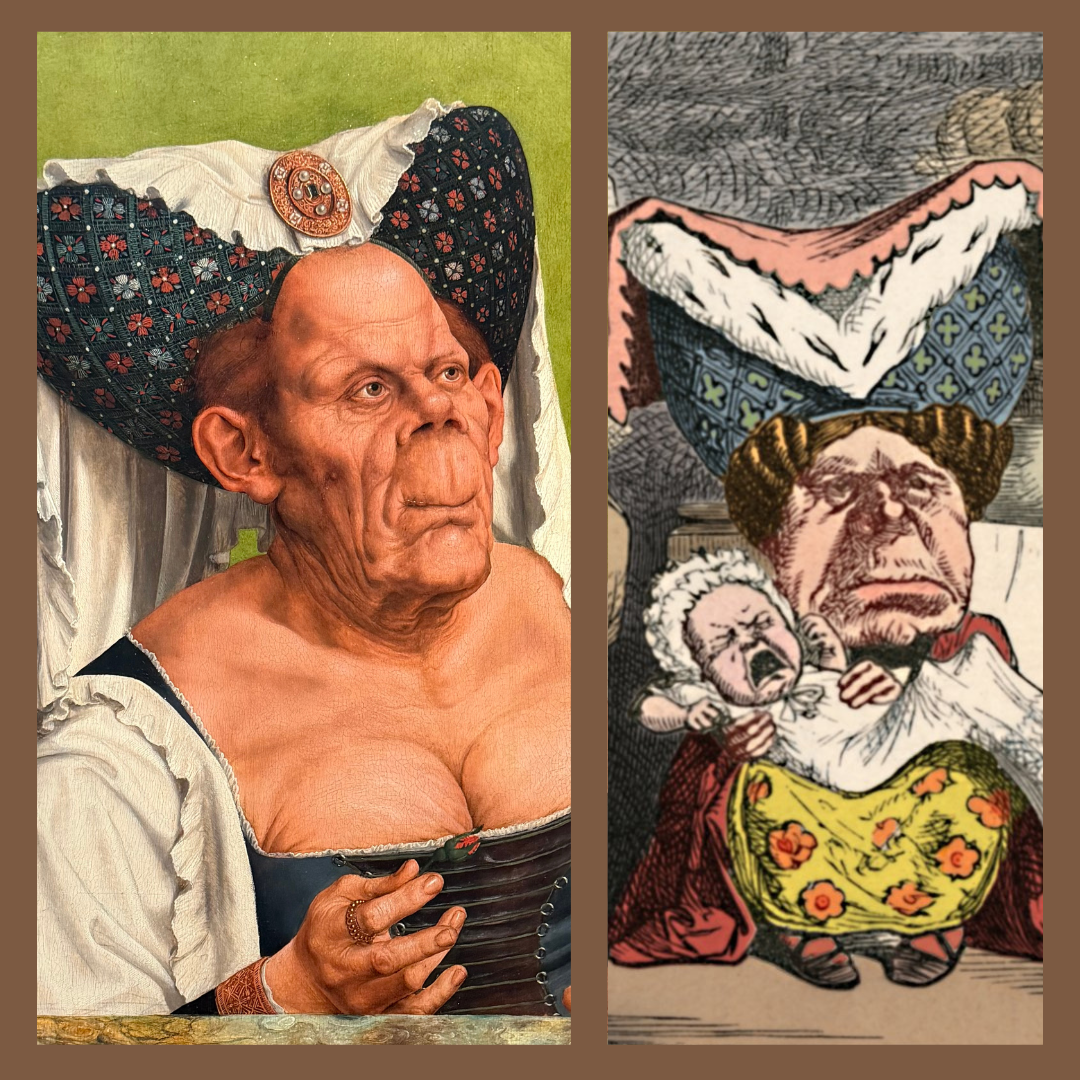
On a recent visit to the National Gallery in London, I met this lovely lady. The official title of this 1513 painting by Quentin Massys is An Old Woman, but she was dubbed The Ugly Duchess during the Victorian era.
With her unusual features and revealing aristocratic dress, the Old Woman defies all the standards of beauty and behaviour of her time.
Why Is She Called the Ugly Duchess?
In Victorian England, more than 350 years after Massys’ painting, This Old Woman became the Ugly Duchess.
John Tenniel was commissioned as the illustrator of the original 1865 version of Alice’s Adventures in Wonderland. When it came time to draw the “The Duchess,” who was described by Lewis Carroll as very ugly, he turned to the painting of The Old Woman for inspiration. Soon, the painting became known as The Ugly Duchess and the name has stuck.

The Old Woman Wasn’t Always Alone
Quentin Massys’ Old Woman was part of a pair. There’s An Old Man too. Could they have been a married couple? No one knows. They were designed to be hung together, but, unfortunately, there has been a separation. The Old Woman lives in London, and the Old Man has moved to a private collection in New York.
They are an odd couple. While the woman’s looks are startling, the man, even with his elongated nose and protruding bottom lip, is fairly “normal” looking.
When viewing the two side by side, you wonder what kind of interaction is going on between them. The Old Woman is dressed in clothing that was probably in style during her youth. And she holds a rosebud which symbolizes youth and beauty (of which she has neither).
The Old Man has his hand raised to her. Is he refusing her? Or is it a friendly greeting?

Leonardo da Vinci’s Versions
You might think this lady surely must be one of a kind. But no. Renaissance artists, including Leonardo da Vinci, were obsessed with the human form and its variations. Beauty and ugliness. Perfection and exaggeration. And Leonardo also had a sketched version of The Ugly Duchess. His original is now lost, but we have a copy by one of his pupils and dates to 1510-1520.
Throughout his career, Leonardo sketched many grotesques, as these faces with exaggerated features are known. It’s important to note that in this use, the word grotesque does not mean ugly or disgusting the way we often use it today. It just means grossly exaggerated or hybridized.

And there is another version of Massys’ couple also attributed to Leonardo. It was engraved by Wenceslaus Hollar around 1645. It’s included in a series of 15 grotesque etchings that Hollar claimed were made from Leonardo da Vinci’s sketches.
This couple, called the King and Queen of Tunis, is easily recognized as the same one in Massys’ paintings.

Who Was the Ugly Duchess?
Was this painting of the Ugly Duchess meant to represent a real woman? Thankfully, no.
With grotesques, the artist would often combine features from different faces and then exaggerate them. So, this woman might have the forehead of one person, the eyes of another, and the nose of yet another.
They were pushing features to the limit until they became almost caricatures. In fact, some scholars even call these the earliest caricatures in European art.
So, Who Drew Her First?
It seems that Leonardo da Vinci and Quentin Massys were both drawing people with exaggerated features at around the same time.
So, who influenced whom? It’s difficult to say because at the time prints would be made of artists’ works and circulated around Europe. One of these booklets of prints is probably what Wenceslaus Hollar used to make engravings of Leonardo’s sketches.
So, da Vinci’s sketch could have made it to Flanders and inspired Massys, or it could have been the other way around and Massys’ sketch influenced da Vinci. Or it could even have been a third artist that they both copied.
There is no definitive proof. But for me, the biggest clue is the headdress. It’s a northern Europe style, so my vote goes to Massys as the creator. (Just my opinion)

Why Paint Her at All?
For Leonardo, the human form was fascinating, and he was constantly studying it for his paintings. However, while he only made sketches of the grotesque faces, he painted portraits of the likes of Mona Lisa.
Massys, on the other hand, put his exaggerated characters right in the middle of his satirical paintings. When we look at the portrait of the Ugly Duchess, it has all the traits of a serious, “real” portrait, but it’s actually ironic and humorous.
Portraits with Purpose
During the Renaissance, portraits were commissioned by wealthy, important people who wanted to be immortalized. They paid large sums to have their portraits painted and they generally wanted to look good in them. Blemishes, wrinkles, or other imperfections were often removed.
So, The Ugly Duchess with her wart and wrinkles seems to be a satire of the portrait. Perhaps it’s just poking a bit of fun at those who have flattering portraits of themselves hanging in their homes.
And I think I get that. It’s a similar idea to the portraits I have hanging in my hallway. They are dog heads placed on human bodies. I got them to imitate the portraits that I’ve seen in stately homes where the various great and powerful ancestors hang in places of honor. Mine make me smile and, just for laughs, I always tell visitors they are portraits of my grandparents.

And if I had the Ugly Duchess painting, I would definitely hang it in a place of honor and tell people it was my great grandmother… just to see their reaction.
If you’d like to meet Massys’ remarkable Old Woman / Ugly Duchess in person, you can find her in Room 54 of the National Gallery in London – still provoking gasps, laughter, and curiosity five centuries later.
What do you think about this portrait? Would you hang it in your home? Let me know in the comments.
If you enjoy strange and lesser-known stories from history, make sure you’re subscribed (at the top or bottom of this page) – and feel free to share this with a friend who might enjoy it too.


Follow Me on Social Media:

- Curious History Review: October 2026 – 1 October 2026
- How Johanna van Gogh-Bonger Made the World See Vincent Van Gogh – 28 September 2026
- A Tragic Medieval Bedtime Story: The Chatelaine of Vergy – 18 September 2026


COMMENT HERE: Can't wait to hear what you think… (email not required)