
When summer rolls around many of us think of heading to the beach. A nice lazy day of lounging on the sand and dipping in the sea.
Did you know that the Victorians loved the sea too? Even though their strict social rules and impractical clothing meant that a simple dip in the sea was a lot more complicated than it is for us today.

Victorian Sea Bathing
If a Victorian family wanted to splash around in the sea, they needed a horse, a changing room on wheels, several layers of wool, and possibly the assistance of a professional sea-dipper.
Welcome to the curious world of Victorian sea bathing… It was all about health, modesty, and strict social etiquette.
Healthy Sea Bathing
The idea of sea bathing gained popularity in the 1700s when doctors became convinced that the sea possessed remarkable healing powers. Suffering from headaches? Try the sea. Troubled by melancholy? The sea is the answer. Digestive complaints? Again, the sea.
According to many doctors, seawater and fresh sea air could cure just about anything. So, wealthy Victorians flocked to seaside resorts in search of health and rejuvenation.
The aim wasn’t really swimming as we think of it today; it was more about wading, dunking, and bobbing around – letting the sea water do its magic. Most people just stayed in the water for 10-15 minutes then emerged feeling refreshed, invigorated, and hopefully cured of whatever had been ailing them.

Modest Sea Bathing
The Victorians wanted the health benefits of the sea, but there was just one problem. Their society was obsessed with propriety – and the way they dressed was a big part of that. They had to be properly covered at all times.
So, what to do? They couldn’t go into the sea wearing their ordinary clothing… and they certainly couldn’t go in without them – or in anything that showed too much skin.
Enter the Bathing Machine
The answer arrived in the form of the bathing machine.
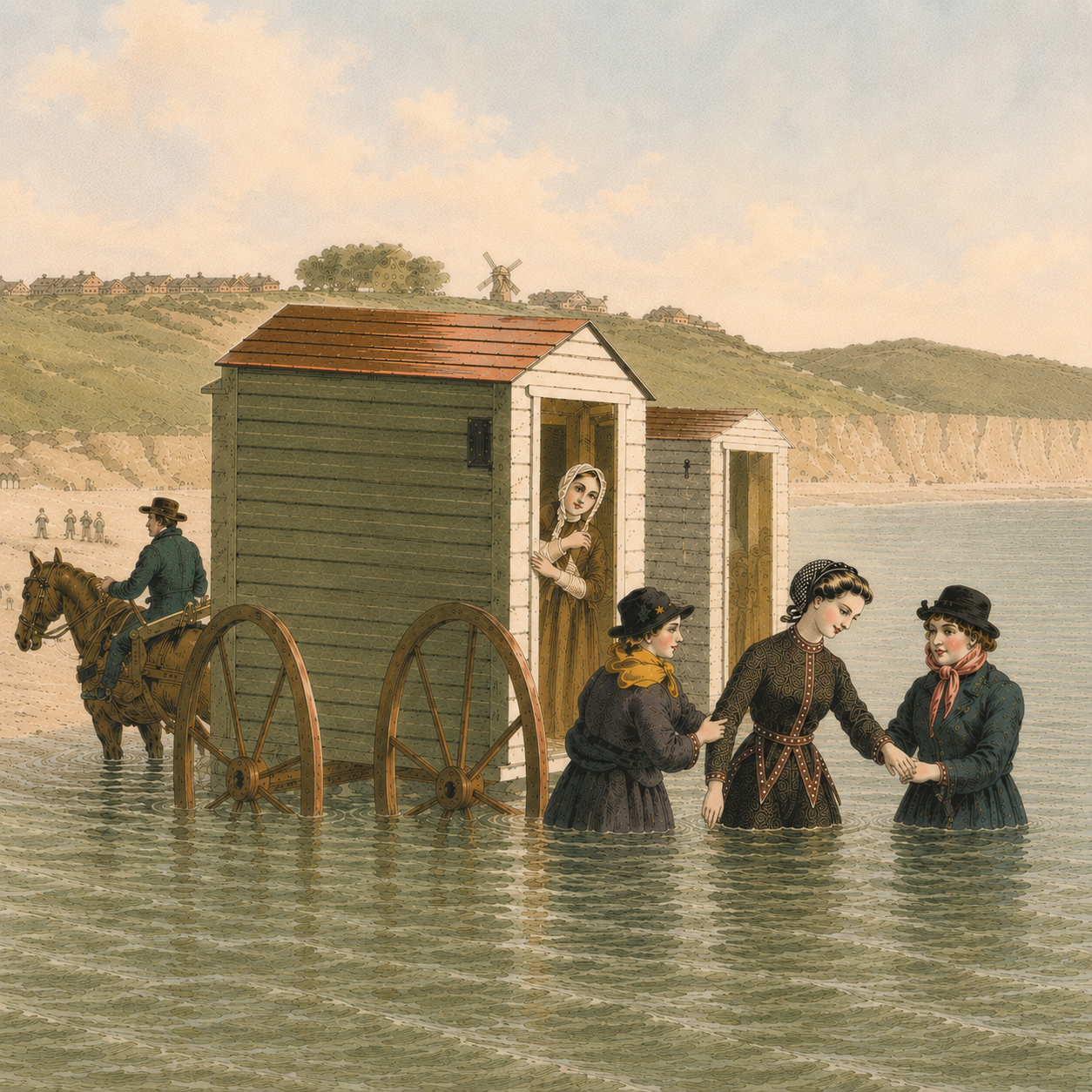
Despite the name, there was very little machinery involved. A bathing machine was basically a small wooden hut mounted on wheels. Think of it as a mobile changing room.
These “machines” had been invented in the 18th century and were still common throughout much of the Victorian era. They lined beaches all across Britain, and their purpose was simple: to preserve modesty while allowing people to enjoy the health benefits of the sea.

Arriving at the Beach
Imagine a Victorian couple arriving at a popular seaside resort such as Brighton or Margate on a summer’s day.
They would see dozens of bathing machines lining the shore. Horses would be plodding back and forth through the surf while attendants helped bathers in and out of the water.
The husband would head towards the men’s area while the wife made her way to the women’s section. Mixed bathing was frowned upon for much of the Victorian period.
Each would hire a bathing machine and climb inside fully dressed in their normal clothes.
Changing for the Sea
Inside this changing room on wheels there was usually a bench, hooks for clothing, and just enough room to change. At the same time, a horse would be harnessed to the machine, and the bumpy ride into the sea would begin. This made it even more difficult to change clothes in that little cabin.
For men, the changing process was relatively straightforward. But for women, it was rather more complicated.
Victorian women wore multiple layers of clothing, and removing dresses, petticoats, corsets, and other garments before putting on a bathing outfit could take a considerable amount of time and effort. The changing process would probably take two to three times longer than the actual swim.

What About Those Victorian Bathing Costumes?
While modern swimwear is designed to be lightweight, flexible, and quick drying,
Victorian swimwear was none of these things.
Most of them were made from wool. While this may sound like a terrible idea, there was a certain logic to it. Wool retained a bit of warmth even when wet, and it was less likely to cling to the body and show outlines of things that shouldn’t be seen.
Once again, it was all about preserving modesty.
Men’s Bathing Costumes
Men generally wore a simple, woolen shirt paired with matching trousers or shorts or a one-piece suit. Compared with women’s outfits, these were much more practical and allowed the wearer freedom of movement.
Women’s Bathing Costumes
Women’s costumes, on the other hand, were considerably more voluminous. A typical bathing suit might include a long woolen dress, full bloomers worn underneath, stockings, bathing shoes, and a hat or bonnet.
A Victorian woman sea bather would be covered from neck to ankle in layers of wool.

Into the Water
The men could just step out of their bathing machine directly into the water and begin splashing around. Even though swimming would become more common by the late Victorian period, many bathers simply waded, floated, or immersed themselves for a few minutes.
For the women, who were enveloped in layers of heavy wool, getting into the water required a bit of help. They would usually be met by two sturdy women known as “dippers” who would help them down the stairs and into the sea.
Once in the water, the ladies would just stand or wade, and occasionally submerge themselves to soak up the benefits of the sea. Wearing all that wet wool, they probably wouldn’t have been able to swim if they had wanted to.

How Long Did They Stay in the Water?
Not very long. The water around Britain was cold, and doctors believed that a short session provided the greatest health benefits.
The actual time in the sea might last only five to fifteen minutes. After all the effort involved in getting changed, being hauled into the sea, and entering the water, many Victorian bathers spent less time in the sea than a modern visitor to the beach might spend deciding where to put their towel.
Returning to Shore
Once refreshed, invigorated, and hopefully cured of all that ailed them, the bather would climb back into the bathing machine where they would remove their wet woolen costume and change back into their everyday clothes.
When they were fully dressed and their bathing machine had been pulled back to the beach, they would step out of their little mobile changing room looking as though nothing unusual had happened at all.

Bathing Machines: A Very Victorian Solution
Today we simply change into swimwear and head for the water. Victorians, on the other hand, required a horse-drawn changing room, several pounds of wool, and a strict code of etiquette.
It may all seem unnecessarily complicated, but for a society determined to preserve both health and modesty, the bathing machine was the perfect solution. It allowed respectable men and women to enter the sea without ever being seen in what was considered a state of undress.
Bathing machines were at the height of their popularity from about 1850-1890. After this, their use began to decline as mixed bathing became more acceptable and attitudes toward exposed skin became more relaxed.
What about you? Would you like to have a bathing machine? Let me know in the comments.
If you enjoy strange and lesser-known stories from history, make sure you’re subscribed (at the top or bottom of this page) – and feel free to share this with a friend who might enjoy it too.


- A Tragic Medieval Bedtime Story: The Chatelaine of Vergy – 18 September 2026
- Bath’s Jane Austen Festival: Books, Balls, and Bonnets – 5 September 2026
- Curious History Review: September 2026 – 3 September 2026


COMMENT HERE: Can't wait to hear what you think… (email not required)