
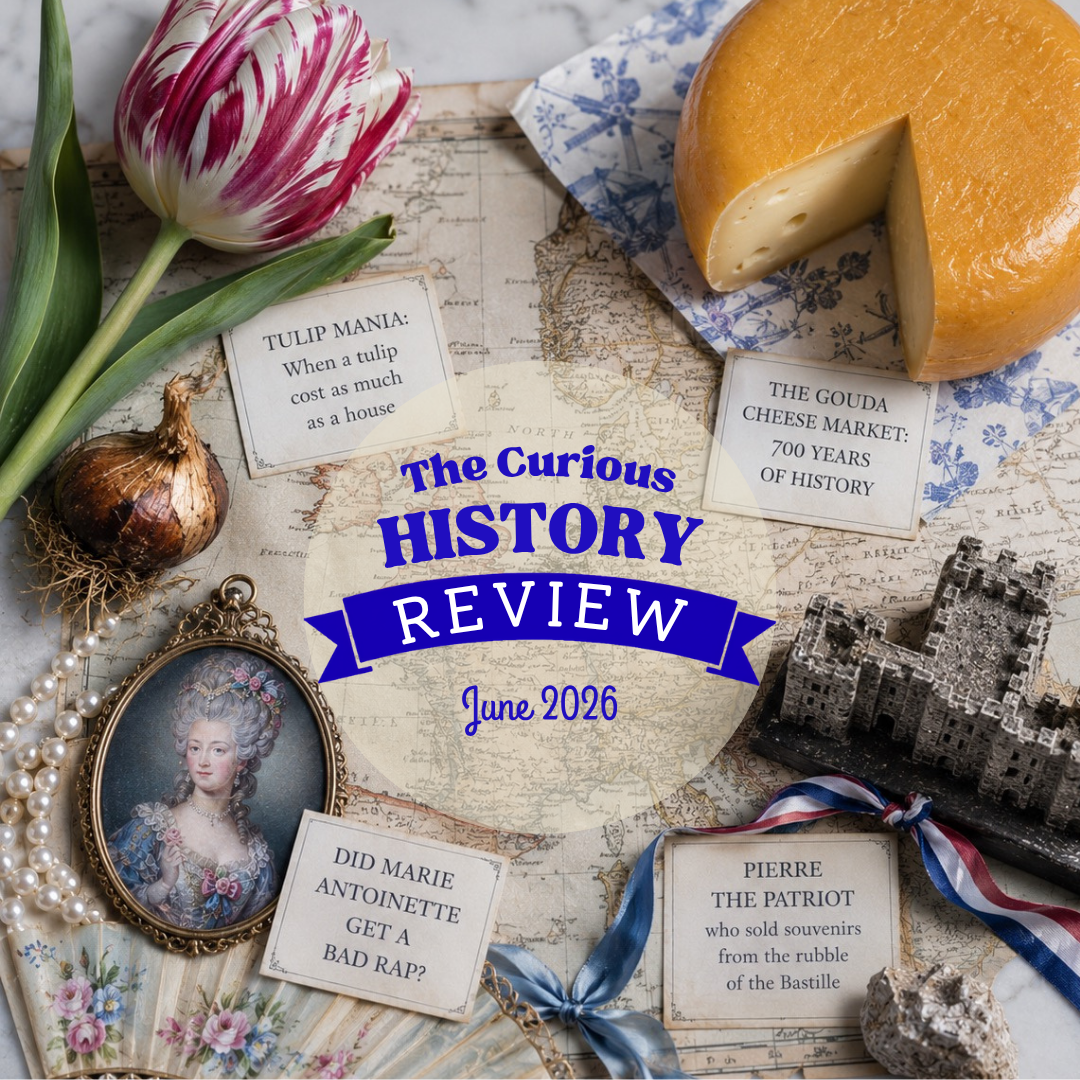
From a recent trip to the Netherlands, I brought back two Dutch stories: one about a flower filled financial bubble, and another about a cheese market where 700-year-old traditions are still alive and well.
From the Netherlands, we’ll travel down to France (where there’s also lots of cheese). But our two French stories are related to the French Revolution. First, we’ll revisit a queen who may have been one of history’s most unfairly judged royals, then we’ll meet an entrepreneur who turned the rubble of the Bastille into a thriving souvenir business.
Let’s begin in the Netherlands in a field of tulips and dig into that strange moment in Dutch history known as Tulip Mania…

Tulip Mania: When a Tulip Cost as Much as a House
Would you trade your house for a flower?
It sounds absurd today, but in the Netherlands of the 1630s, that was a very real choice. At the height of Tulip Mania, a single rare tulip bulb could cost as much as a fine canal house in Amsterdam. Wealthy merchants, professional speculators, and sometimes even ordinary people all rushed to get in on what seemed like a sure thing.
But how did a simple flower become one of history’s most famous investment crazes?
The story begins with the exotic tulip arriving from Turkey and becoming the must-have status symbol of the Dutch Golden Age. Soon, admiration for the beautiful bloom turned into speculation. Prices soared. Contracts for bulbs changed hands repeatedly, often without anyone ever seeing the flower itself. Fortunes appeared to be made overnight.
Then, just as suddenly, confidence in the market disappeared and everything collapsed.
👉🏼 Find out why some Dutch investors chose the flower over the house.
When I think of Holland, I think of two things: tulips and cheese. So, let’s move on to a cheese market that is both a feast for the eyes and the taste buds.

The Gouda Cheese Market
What if I told you there’s a place in the Netherlands where centuries-old cheese-trading traditions are still played out in public every week?
In the charming Dutch city of Gouda, famous for the cheese that bears its name, visitors can step into a living slice of history. Every Thursday during the warmer months, the city’s market square transforms into a spectacle of horse-drawn wagons, towering stacks of orange cheese wheels, and traders reenacting customs that date back more than 700 years.
This bustling market reminds us of a time when cheese was so valuable it could be used to pay taxes and settle debts. You can watch the unusual hand-slapping bargaining ritual known as handjeklap and see why this city became a cog in the big wheel of the Dutch cheese trade.
Gouda’s market is part history lesson, part theatre, and a whole lot of fun. Whether you love history, food, or unique travel experiences, Gouda has something you’ll enjoy.
👉🏼 Read the full story and watch the video to see what happens when a deal is sealed with a slap of the hand.
🗓️ Curious History Calendar 🗓️
Here are a few Curious Rambler articles related to upcoming dates and events:
- Mid June – July: Lavender in Provence, France
- June 25-29: Tarasque Festival in Tarascon, Provence, France
- July 4: Alice Day (Alice in Wonderland) in Oxford, UK
- July 4-26: Festival of Avignon, France
- July 2: Next issue of Curious History Review – First Thursday of July
Now, from Dutch cheese, let’s hop over to France and talk about a queen who is known for making a statement about cake (which she didn’t, by the way).

Did Marie Antoinette Get a Bad Rap?
We’ve all heard the stories about Marie Antoinette: When told that the peasants had no bread, she famously declared, “Let them eat cake.” She was extravagantly wasteful, indifferent to ordinary people, and almost singlehandedly bankrupted France with her lavish spending… At least, that’s what history tells us.
But what if much of it isn’t true?
Long before social media, eighteenth-century France had its own version of tabloids: scandalous pamphlets filled with gossip, accusations, and political propaganda. And no one became a bigger target than the young Austrian queen who arrived at Versailles at just fourteen years old.
Marie Antoinette was one of history’s most maligned queens. She was blamed for problems she didn’t create, she became entangled in a jewel theft she knew nothing about, and she almost certainly never said that famous cake quote.
But there was a very different Marie Antoinette — a woman who quietly cared for orphaned children, worried about their welfare even while imprisoned, and whose softer side was largely ignored by her critics.
Was she perfect? Not at all. But was she the heartless villain history remembers? I don’t think so.
👉🏼 Decide for yourself whether Marie Antoinette was one of history’s greatest scapegoats.
While Marie Antoinette became the living symbol of all that was wrong with the monarchy, there was a building in Paris with a similar reputation. The Bastille was a prison and represented the tyranny of the monarchy. So when the Revolution broke out, the Bastille was the first to go.

FROM THE ARCHIVES
Pierre the Patriot
Most people know that the Bastille was stormed on 14 July 1789, and helped to ignite the French Revolution. But far fewer know about the man who turned those ruins into one of the most successful souvenir businesses in history.
When Parisian builder Pierre François Palloy participated in the taking of the infamous prison, he immediately spotted an opportunity. While others saw a hated symbol of royal tyranny, Pierre saw something else entirely: a mountain of marketable rubble.
Within days, he had managed to get permission for his company to demolish the Bastille. Then he set about transforming its stones, iron, and debris into patriotic keepsakes. Miniature Bastille models, commemorative medallions, jewelry, paperweights, even paving stones were distributed across France and beyond.
But Pierre wasn’t just selling souvenirs. He was also building his own legend.
Calling himself “Pierre the Patriot,” he decorated himself and his possessions with revolutionary symbols. He did his best to make sure everyone knew that he was responsible for preserving the memory of the historic storming of the Bastille.
Was he a devoted revolutionary, a brilliant entrepreneur, or a master of self-promotion? Perhaps all three?
👉🏼 Discover how one ambitious builder dismantled France’s most notorious prison and scattered pieces of it across the world — while turning himself into a revolutionary celebrity along the way.
Well, that’s it for this month. I hope you found something to pique your curiosity and learned a little bit of curious history.
If you could witness one of the events from this month’s newsletter in person, which would you choose: Tulip Mania, the Gouda cheese market, Versailles during Marie Antoinette’s time, or the demolition of the Bastille? – Let me know in the comments section.
If you enjoy strange and lesser-known stories from history, make sure you’re subscribed (at the top or bottom of this page) – and feel free to share this with a friend who might enjoy it too.
See you next month with more curious histories!

- Curious History Review: October 2026 – 1 October 2026
- How Johanna van Gogh-Bonger Made the World See Vincent Van Gogh – 28 September 2026
- A Tragic Medieval Bedtime Story: The Chatelaine of Vergy – 18 September 2026


COMMENT HERE: Can’t wait to hear what you think… (email not required)