
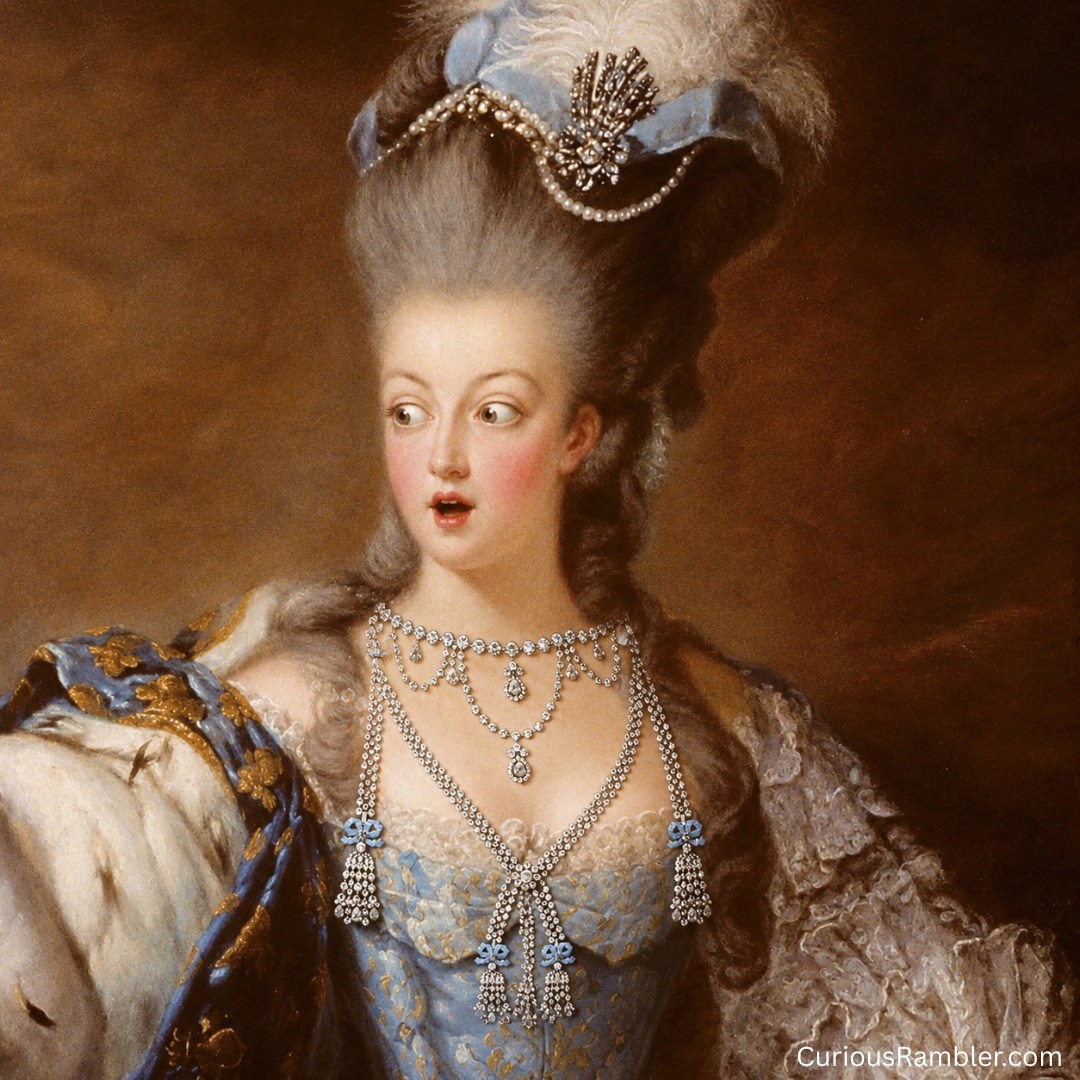
The Affair of the Diamond Necklace
History is full of scandals, but few sparkle like the Affair of the Diamond Necklace. This story features an outrageously expensive necklace, a clueless cardinal, a clever con artist, and a queen with a bad reputation– although in this case she did nothing wrong… but got blamed anyway.

A Gift Fit for a Queen?
Marie Antoinette and Louis XVI were only 18 and 19 years old when they inherited the throne. And it was just a few years later when the royal jewelers paid Louis a visit. They brought with them a diamond necklace that they hoped he would purchase as a gift for the Queen.
Now, this was no ordinary diamond necklace… It contained hundreds of diamonds and would cost around $17 million in today’s money. It was enormous, dazzling, and way over the top.

What to Do with Such a Necklace
This necklace had originally been designed for Louis XV to give to his mistress, Madame du Barry. The jewelers spent years gathering the perfect stones, and they had a fortune invested in it. But before the sale could take place, Louis XV died – leaving the jewelers in quite a pickle.
They hoped that the new King Louis would help them out by buying this magnificent ornament for Queen Marie Antoinette.
But unfortunately for them, the Queen didn’t want it. France was already drowning in debt, and Marie Antoinette reportedly replied that, “France had greater need of a warship than a necklace.” If true, it was a rare moment of financial common sense in Versailles.
A few years later, when the royal couple’s son was born, the jewelers tried again. And once again, the queen refused the necklace. That should have been the end of the story. But it was only the beginning.

Enter the Con Artist
The scam begins with Jeanne de la Motte. She was from an impoverished branch of a noble family, and she was determined to claw her way into high society by whatever means necessary.
She married a minor officer who went by the dubious title, “Count de la Motte.” Jeanne adopted the title “Countess de la Motte” and set about learning how things worked at Versailles.
She observed that appearances mattered more than reality, confidence could substitute for status, and everyone was obsessed with winning royal favor.
To Jeanne, Versailles didn’t look so much like a palace – it looked more like an opportunity.
The Con Meets the Cardinal
Cardinal de Rohan had fallen out of favor with the Queen a while ago. He had tattled to her mother back in Austria about something or other and found himself in the royal doghouse. He desperately wanted to get back in the Queen’s good graces.
Jeanne saw him coming from a mile away. She recognized his desperation and gullibility and came up with a plan.
She convinced the Cardinal that she was a close friend and confidant of the Queen. She claimed that Marie Antoinette really did want that expensive necklace. She just didn’t want it to be publicly known that she was spending so much on jewelry while the French economy was running on fumes. If the Cardinal would help her buy it in secret, she would forgive him.
The Fake Queen
Jeanne began writing forged letters to Cardinal Rohan pretending they were from the Queen. Rohan became convinced that the Queen had forgiven him. But still, he wanted to hear from her personally.
So, Jeanne arranged one of the strangest blind dates in French history; Late one night in the gardens of Versailles, the cardinal met a woman dressed like Marie Antoinette. In reality, she was a prostitute that Jeanne had hired. And, in dim lighting, she vaguely resembled the real Queen.
The fake queen’s role was simple: Meet the cardinal, say, “All is forgiven,” hand him a letter, and leave. Apparently, she nailed the performance because Rohan walked away thrilled that they had reconciled.
Unfortunately for him, he had been catfished by a con.

The Necklace Changes Hands
Certain he was acting on behalf of Marie Antoinette, Cardinal de Rohan agreed with the jewelers to buy the necklace. He took possession of it and handed it over to a man he believed to be the Queen’s servant.
He wasn’t. The “servant” was Jeanne’s accomplice who immediately began selling off pieces of the necklace in London and Paris.
Meanwhile, the blissfully unaware jewelers were ecstatic. Not only had they finally sold their spectacularly overpriced necklace, but when the queen would wear it, all the noble ladies would want one. They could practically hear the cash registers ringing.
It’s a Scam!
When payment day arrived, the jewelers strode confidently into Versailles. They were expecting admiration, gratitude – and money. Instead, they were greeted by a very confused queen who had absolutely no idea what they were talking about.
And then came a collective moment of horror:
- The queen realized someone had stolen her identity and made a huge purchase.
- The cardinal realized he had been spectacularly scammed.
- And the jewelers realized their uninsured $17 million necklace had evaporated into thin air.
It was not a good day for any of them.

The Trial That Became a Public Spectacle
The scandal exploded across France. Long before tabloids and social media, France had libelles — cheap pamphlets filled with gossip, political attacks, satire, conspiracy theories, and a “You won’t BELIEVE what the Queen’s been up to!” section.
Marie Antoinette was already one of their favorite targets. So, they were more than happy to assume that the whole affair was all her doing.
Not Guilty – But…
After all the evidence had been heard, the verdicts were announced:
- Cardinal de Rohan – Although he’s not the sharpest knife in the drawer, he acted in good faith.
- The fake queen – She had no idea she was participating in a massive fraud.
- Jeanne de la Motte – Guilty. She was publicly whipped, branded with a “V” for voleuse (“thief”), and thrown into prison. Later, she escaped, fled to England disguised as a boy, and wrote her memoir.
- Marie Antoinette – Innocent.
The Queen had never touched the necklace, never ordered it, and never even wanted it. But that made absolutely no difference to the public who blamed her for the whole mess anyway.
By this point, the queen’s reputation was already in ruins. The pamphlets mocked her as “Madame Deficit,” portraying her as extravagant, selfish, and wildly out of touch. The necklace scandal simply poured fuel on the fire.

The Necklace and the Revolution
The Affair of the Diamond Necklace wasn’t solely responsible for the French Revolution. France already faced crushing debt, food shortages, political unrest, and growing anger toward the monarchy.
However, the trial was just another nail in the coffin of the French monarchy. It helped transform Marie Antoinette into a symbol of royal excess — ironically because of a necklace she never wanted.
Marie Antoinette certainly made mistakes during her lifetime. But this scandal wasn’t one of them. Yet in the court of public opinion, innocence often matters less than a diamond-studded story.
Be honest: if someone claiming to represent royalty asked you to secretly buy a $17 million necklace… would you ask questions first? Let me know in the comments section.
If you enjoy strange and lesser-known stories from history, make sure you’re subscribed (at the top or bottom of this page) – and feel free to share this with a friend who might enjoy it too.


- Bath’s Jane Austen Festival: Books, Balls, and Bonnets – 5 September 2026
- Curious History Review: September 2026 – 3 September 2026
- Jane Austen Walking Tour of Bath – 27 August 2026



COMMENT HERE: Can't wait to hear what you think… (email not required)