
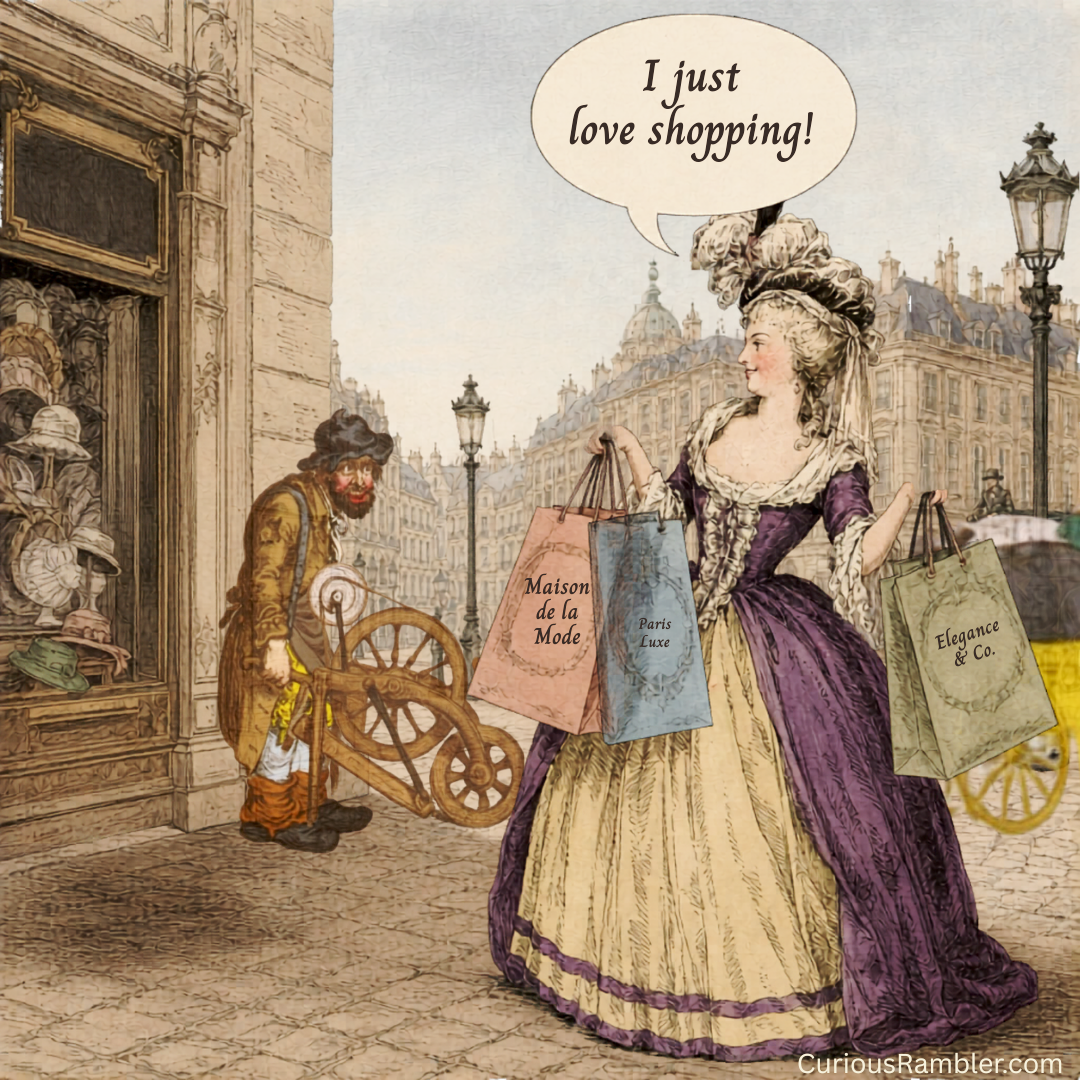
The tabloids of the day called Marie Antoinette “Madame Deficit” and pinned all France’s financial woes on her. But was that really fair, or did she get a bad rap?
The Queen’s reputation for overspending was probably well deserved, but it was also part political propaganda and bad timing. The real Marie Antoinette was more complicated – and more interesting – than the character history presents.

Her Problems Began Before She’d Unpacked
Marie Antoinette arrived in France from Austria in 1770, at just fourteen years old and about to marry the fifteen-year-old future Louis XVI.
The marriage was a political alliance between two countries that had been enemies for generations — and the French hadn’t forgotten that. They decided they didn’t like the foreign princess before she’d even unpacked her suitcase. She was Austrian – that was enough.
Versailles: Where Excess Was the Norm
The court Marie Antoinette stepped into was already out of hand. Versailles was frivolous and extravagant long before Marie Antoinette arrived.
The nobles were already spending enormous sums on lavish clothing, wigs, jewels, and entertainment. And they were already being criticized for being frivolous and out of touch with ordinary people.
So, of course, Marie Antoinette joined in with the extravagant way of life at Versailles. But was she any worse than all the others?

The Age of the Pamphlet
A big part of Marie Antoinette’s PR problems had to do with bad timing. It was a time when new printing technology was flourishing, and pamphlets were the tabloids of the day. They were filled with gossip, slander, and accusations – and the people loved them. But because of these pamphlets, she faced far more public scrutiny than any of the queens before her had.
The pamphlets pointed out the country’s problems: rising prices, food shortages, and crushing national debt. They demanded that someone be held responsible, and the someone they chose was Marie Antoinette. She became their favorite subject. They had one woman – an Austrian woman, nonetheless – that they could blame for pretty much anything.
The fact that France’s financial crisis had been building for decades and was caused far more by government mismanagement, war debts, and taxation problems was never mentioned.
“Let Them Eat Cake” — The Quote She Never Said

Perhaps the most famous example of Marie Antoinette getting a bad rap is the quote: “If the people have no bread, let them eat cake.”
Marie Antoinette never said this. In fact, the quote existed before she even stepped foot on French soil. But once her image as an out-of-touch queen took hold, people were happy to attribute it to her.
The Necklace She Never Wanted

Another example of Marie Antoinette being blamed for something she had nothing to do with was the Affair of the Diamond Necklace — a huge eighteenth-century scandal.
A con artist called Jeanne de la Motte convinced a cardinal to secretly buy an outrageously expensive diamond necklace on behalf of the Queen (who knew nothing about it). The cardinal bought the necklace, then Jeanne stole it and sold it off in pieces.
During the trial, there was no evidence connecting Marie Antoinette to the scheme: She never ordered the necklace, never had it in her possession, she didn’t even want it. In fact, she had refused to buy it on two separate occasions. But none of that kept public opinion from turning against her.
The Queen the Pamphlets Ignored

For all the talk of extravagance and heartlessness in the pamphlets, there was another side to Marie Antoinette they never mentioned — the one with a genuine love and affection for children.
Throughout her time at Versailles, the Queen informally adopted and supported many orphaned children. Some even lived with her in the palace. Whenever she heard of children who had lost their parents, her response was immediate: “I adopt them.”
Even when she was in prison awaiting her execution, she was asking prison guards to check on the welfare of her adopted children.
Four of Marie Antoinette’s adopted children actually lived with her in the palace. It’s a side of her character that doesn’t quite fit the “uncaring monarch” image or the “heartless queen” the pamphlets portrayed.
So, Did Marie Antoinette Get a Bad Rap?
I believe so. There’s no doubt that she enjoyed luxury and often showed poor judgment in her spending – But so did every noble at Versailles. The difference was that she was foreign and an easy target.

The tabloids turned her into “Madame Deficit” – the scapegoat for the failing economy. They targeted her with accusations that were wildly exaggerated. And two of the most damaging ones (the diamond necklace and the “let them eat cake” quote) had nothing to do with her.
She was portrayed as uncaring and aloof, but we’ve seen that Marie Antoinette also had a tender-hearted side. She was a loving mother and cared for many orphaned children.
There’s little doubt that she was the victim of a smear campaign in the pamphlets of the time. And once public opinion had turned against her, it was next to impossible for her to recover her reputation.
Especially since everyone already believed she said that thing about eating cake…
🐈⬛ Footnote:
One curious postscript to Marie Antoinette’s story involves her cats. Several long-haired Angora or Persian cats lived with her at Versailles. After the King’s execution, a group of supporters hatched a rescue plan — a ship bound for Wiscasset, Maine was loaded with royal possessions and sat waiting for the Queen and her children’s escape. The plan collapsed, and the ship sailed without them, taking with it gilded French furniture that ended up in what locals in Maine called the “Marie Antoinette House.” Legend has it that some of Marie Antoinette’s cats may have made the crossing too — and that their descendants eventually became the Maine Coon breed. It might be more legend than history, but to imagine her loving her cats adds another softer bit of humanity to a much-maligned queen. 🐈⬛
Well, what do you think? Did Marie Antoinette get a bad rap? Let me know in the comments section.
If you enjoy strange and lesser-known stories from history, make sure you’re subscribed (at the top or bottom of this page) – and feel free to share this with a friend who might enjoy it too.


- Bath’s Jane Austen Festival: Books, Balls, and Bonnets – 5 September 2026
- Curious History Review: September 2026 – 3 September 2026
- Jane Austen Walking Tour of Bath – 27 August 2026

COMMENT HERE: Can't wait to hear what you think… (email not required)