
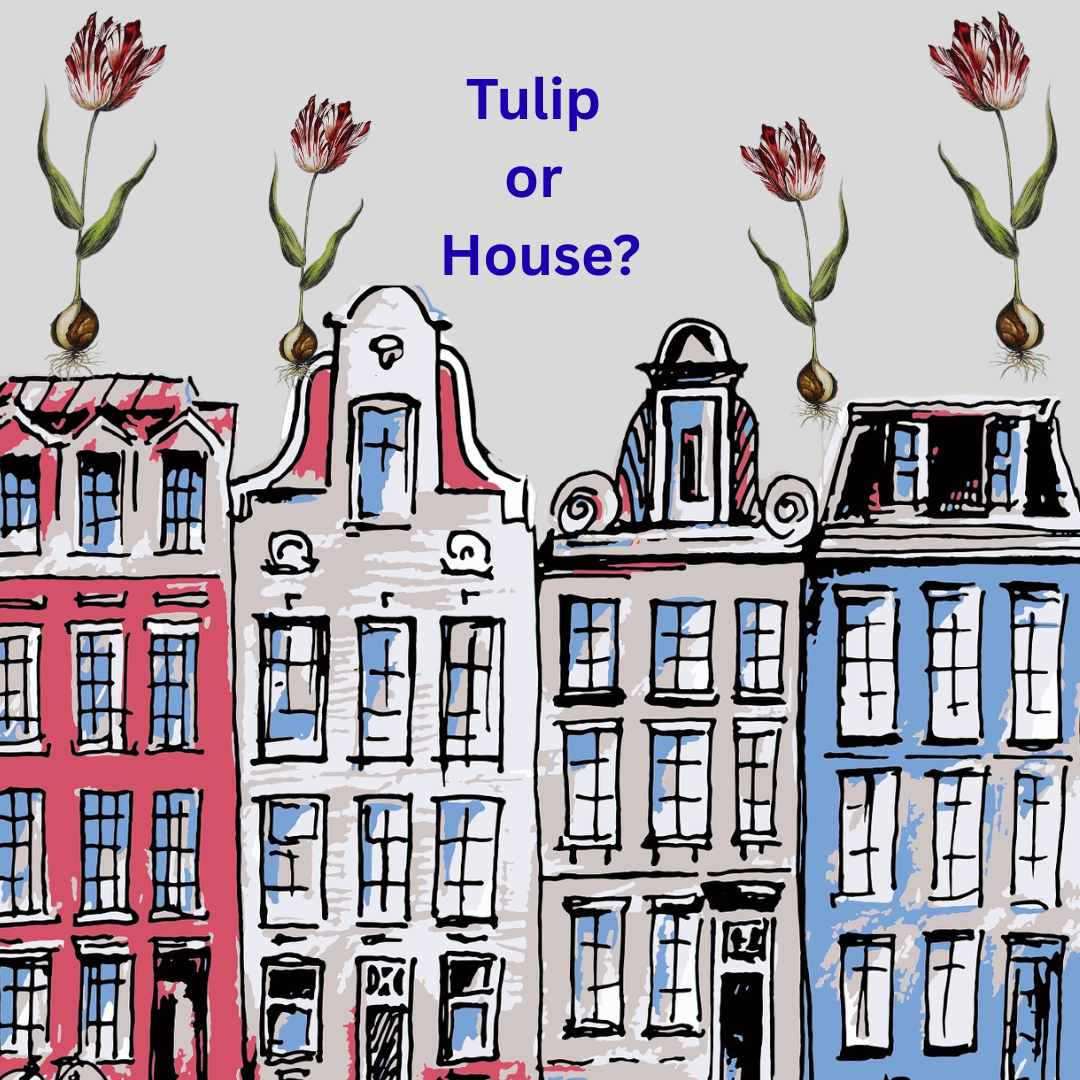
Imagine you are a 17th century Dutch person; the economy is booming, and the hottest new investment is tulips. Their prices keep going up and up. You’ve heard stories about people doubling their money in just days. You have some cash set aside to buy a lovely canal house – but you wonder… What if I bought a tulip instead – then I could sell it on for even more money.
That might sound far-fetched, but in early 1637 the price of a tulip bulb and a fine Amsterdam house were about the same. Tulip Mania was in full swing, and everyone was mad for those bloomin’ bulbs.

From Turkey to Holland
This strange story started in the late 1500s when tulips were first brought to the Dutch Republic from the Ottoman Empire. Today, we think of tulips as a symbol of the Netherlands – but they didn’t originate there.
The Turks had been growing tulips a few hundred years before the Dutch got on board. But the Turkish tulips were slimmer, and the petals were more elongated and pointed.
The Dutch botanists began experimenting with the flowers and breeding new colors, sizes, and patterns. Before long, the Dutch were leading the tulip trade with new varieties in deep reds, bright yellows, and rich purples. And the most coveted of all were the “flamed” varieties which had petals streaked with dramatic contrasting colors. Everyone wanted these beauties in their gardens.

The Dutch Fall for Tulips
By the 1630s, the Dutch Republic had fallen head over heels for tulips. Not just growing and admiring them – but speculating on them and paying astonishingly high prices for them.
At first, they could afford it. In the early 1600s, the Dutch Republic was one of the richest societies in Europe. Trade was booming, cities were thriving, and there was a growing middle class who had money to spend on luxuries. And one of the luxury items they bought was tulips – exotic, vividly colored tulips.

From Growing to Investing
The wealthy bought the fabulous flowers as status symbols to show off to their friends. During that two-or three-week period when the tulips were blooming, they would have parties. Everyone was invited to come, admire, and make a fuss over their exotic blooms – either in their gardens or inside their homes. Sometimes mirrors were placed behind the flowers to visually double their numbers and make them appear even more impressive.
As demand from rich gardeners grew, prices rose, and the tulip trade began to change. Professional growers began to make serious money by growing and selling tulips. And as their profits increased, outside investors – who cared nothing for flowers – began to take notice.
What had begun as a desire for rare and beautiful blooms turned into a grab for money. Tulips were no longer just beautiful flowers, they were investments.

Understanding Tulips – and Tulip Investing
Valuable tulips were propagated through bulb offshoots. The main bulb could produce smaller offshoot bulbs that were identical to the parent.
How it works: Bulbs need to be dug up in early summer after they’ve bloomed. They are dried and stored until autumn replanting. Offshoots can be separated from the parent bulb at this time and replanted with them in autumn. However, it takes about three years before offshoots will be developed enough to bloom.
Because tulips grown from these offshoots were identical to the parent, you would know exactly what a bulb would look like, three years before it bloomed.
This created an investment opportunity. Investors began buying one bulb, in hopes of getting at least three more identical ones to sell.
Buy one bulb today, sell several identical ones later.
At least, that was the idea.

Tulip Trading in Taverns
Tulip trading didn’t happen on the regular stock exchange, or even in gardens or auction houses. It took place in taverns.
While the bulbs were safely tucked underground, traders gathered in smoky taverns making deals. They weren’t trading actual flowers or bulbs – they were trading promises.
A typical deal might sound like: “I’ll deliver 1 tulip bulb next summer, and when I do, you’ll pay me 1,000 guilders.”
No bulb changed hands. Often, no money did either. Instead, they made a verbal agreement, and a notary wrote it down.
Then something strange happened. The agreement itself became the commodity.
It went something like this:
- A grower agrees to sell a bulb for 1,000 guilders.
- The buyer sells that contract to someone else for 1,400.
- That buyer sells again for 2,000.
- And so on…
The same bulb – still undisturbed underground – could be “sold” multiple times in a single day – without any money being exchanged.
Everyone expected to sell at a higher price before the payment came due. And as long as prices kept rising, everyone was making money – at least on paper.

Tulip Market Crash of 1637
In the winter of 1636–37, prices surged to an all-time high.
Then something went wrong.
It was February 1637, and it seemed like a normal evening at the tulip-trading tavern. But when the first tulip seller laid out a watercolor sketch of a beautiful, flamed tulip and named his high price, there were no takers, no lower bids – just silence. He lowered the price and still nothing.
What was happening? Everyone started looking around trying to figure out what the others knew that they didn’t. They all became nervous and afraid to bid.
Panic spread quickly. Confidence in the tulip market evaporated. Prices collapsed. Contracts that had seemed incredibly valuable became worthless overnight.
Many buyers simply refused to pay the steep prices they had promised. And there was nothing much anyone could do about it.
These “tavern contracts” were considered as gambling debts. And even when notarized, they were next to impossible to enforce in courts.
The government tried to stabilize the situation by ruling that contracts could be canceled for a small fee. But by then, the market had already unraveled. Tulip speculation was over, and the government introduced regulations to prevent similar craziness from happening again.

A Strange Story
I think Tulip Mania seems so odd because of what was being traded.
Tulips are fragile living things. They’re vulnerable to disease and weather, easily damaged by animals or accidents, and have to be carefully cultivated. In addition, their blooms can only be enjoyed for a few weeks each year and the rest of the time, they are buried in the back garden.
I love tulips… they are lovely flowers. But if I had to choose between a tulip and a house, I’d go for the house every time.
What about you? If you had lived in 1637, would you have bought the tulip… or the house? Let me know in the comments.
If you enjoy strange and lesser-known stories from history, make sure you’re subscribed (at the top or bottom of this page) – and feel free to share this with a friend who might enjoy it too.
You Might Also Enjoy:

Delft Tulip Vases
These vases originated in Holland in the late 17th century. They’re called tulip vases, but other flowers look equally gorgeous in them.

The Man Who Sold the Eiffel Tower
In 1925, a con man sold the Eiffel Tower… and then tried to do it again. Discover one of the boldest scams in history and the man behind it.

Pierre the Patriot
When the French Revolution started with the storming of the Bastille, one man saw his chance for fame and fortune….
Follow Me on Social Media:

- A Tragic Medieval Bedtime Story: The Chatelaine of Vergy – 18 September 2026
- Bath’s Jane Austen Festival: Books, Balls, and Bonnets – 5 September 2026
- Curious History Review: September 2026 – 3 September 2026





COMMENT HERE: Can't wait to hear what you think… (email not required)