
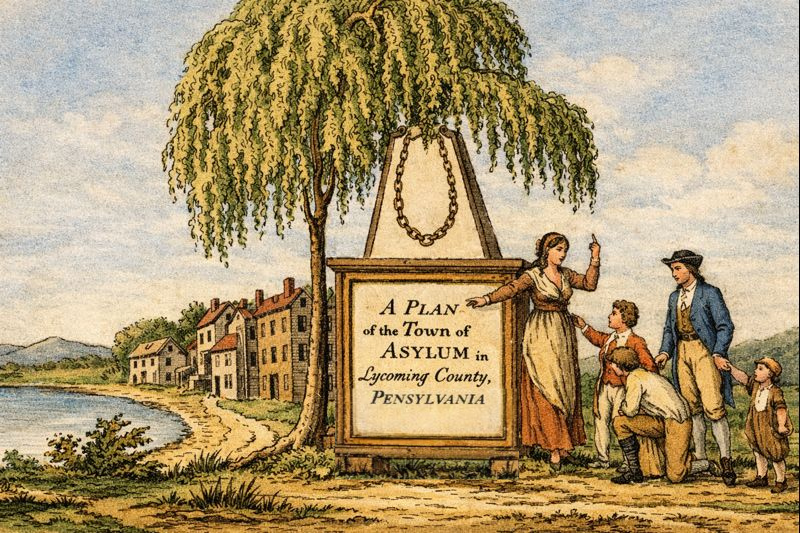
In 1789, aristocrats started scurrying out of revolutionary France like rats off a sinking ship. One group of these posh refugees ended up in a most unlikely place – the wilds of Pennsylvania. Far-off America seemed like the perfect place for those on the wrong side of the Revolution to wait out the troubled times, but little did they suspect the primitive conditions that awaited them.

Asylum in Azilum
As the French refugees started to arrive in the United States, there were several plans to build settlements for them. But only one really took off – it was called Azilum and was located in, of all places, the northern Pennsylvania wilderness. Why the founders of this community thought a group of city-dwelling, French aristocrats accustomed to all of life’s luxuries, would flourish in the backwoods of Pennsylvania, we may never know. Maybe it was because they got a really good deal on the land purchase.
Azilum was the brainchild of two French men, Omer de Talon and Comte Louis de Noailles, to help their displaced countrymen. They joined forces with American financiers, Robert Morris and John Nicholson, who saw it as a good investment. They soon started planning their settlement and called it French Asylum. The name seemed logical since the French were seeking asylum, but the residents would soon ask that it be changed to Azilum. Apparently, they didn’t want anyone confusing their town with a mental asylum for Frenchies.
Selling Real Estate
Azilum’s founders did a great job advertising and promoting their new town. They sent agents to meet incoming ships and look for French aristocrats with money to buy their overpriced land in the middle of nowhere. Land they had bought for fifteen cents per acre, they sold for six francs per acre, earning about a 500% profit. But to those used to French land prices, these plots seemed quite the bargain.

Country Living
Azilum representatives would show the potential buyers the plan for the new French town. It looked perfect. It was near a river, and it was described as being in an idyllic setting. But maybe they forgot to mention that it was 75 miles from the nearest place to buy supplies… and that their homes would be made of logs… and that the severe weather made travel to and from the town next to impossible in winter.
Build It and They Will Come
Construction on Azilum started in the summer of 1793. Land was cleared and a few log cabins sprung up. That autumn, the new residents began to trickle in, but the majority of them arrived the next spring.
The town covered 300 acres. It had a large, two-acre market square, five streets running north and south, and nine streets running east and west. It was a far cry from Paris, but at least they would be safe there.
The Queen’s House
In the center of town was a 3,600 square foot house which was possibly the largest log house ever built in America. It was 84 feet long by 60 feet wide, and had two stories with eight fireplaces on each floor. This grand building was known as the Queen’s House, or La Grande Maison, and was supposedly planned for Marie Antoinette and her children if they had escaped.
Unfortunately, the Queen lost her head before she could sneak-off to America, but the building was used as a community center and to house important guests who visited the town. Louis Philippe, who in 1830 became the king of France, visited Azilum and was entertained at the Queen’s House. (Yes, after the Revolution of 1789, the French reinstated the monarchy for a short time – then they had another revolution… and another… But that’s another story.)

It Wasn’t Versailles
Before the French Revolution, these aristocratic refugees could never have imagined they would be living in such a place. But they did their best to make Azilum feel like home. They built multi-story log houses, with extra windows and fireplaces. They plastered the interior, covered the walls with patterned wallpaper, and hung luxurious draperies at the windows. Some even had large pieces of elegant French furniture they had managed to bring with them across the sea.
Extravagant Necessities
After their homes were built and furnished, they concentrated on other necessities for the genteel lifestyle they planned to continue. They constructed pavilions and summerhouses and hired landscape gardeners. They carried on with their favorite pastimes such as throwing fancy parties, playing music, and dancing. In this sophisticated outpost, a theatre was just as essential as a grocer. The American settlers who passed through this strange French town were amazed. They had never seen such luxury or manners in the wilderness.
No Place Like Home
Even though the French refugees had done their best to create a civilized and cultured life in the wilds of Pennsylvania, they still longed for their homeland, their fellow countrymen, and the luxuries they had left behind.
Then one day in 1802, the postman arrived shouting the news at the top of his voice – Napoleon had declared a general amnesty! All refugees had been invited to return to France! The streets of Azilum were filled with hugging, kissing, and crying French people. They celebrated with a fabulous feast, and then joyfully started packing their bags.
Although they were grateful that America had given them refuge during the Revolution, there was no place like home, and now that it was safe, most of these displaced aristocrats flocked back to France like birds returning from their winter migration.
It seems they had left something very important behind in France – it was their hearts.

*French Azilum, near Towanda, Bradford County, Pennsylvania lasted about 10 years, from 1793-1803. None of the 50 or so original buildings remain because the thrifty American settlers dismantled them to recycle into other structures. In 1836, John LaPorte, son of one of the original Azilum settlers, built a home on the land, and that house acts as a museum today.
What do you think? Let me know in the comments section below. And if you want to read more of my curious histories, subscribe to my blog (at the top or bottom of this page).


Follow Me on Social Media:

- Bath’s Jane Austen Festival: Books, Balls, and Bonnets – 5 September 2026
- Curious History Review: September 2026 – 3 September 2026
- Jane Austen Walking Tour of Bath – 27 August 2026



COMMENT HERE: Can't wait to hear what you think… (email not required)