
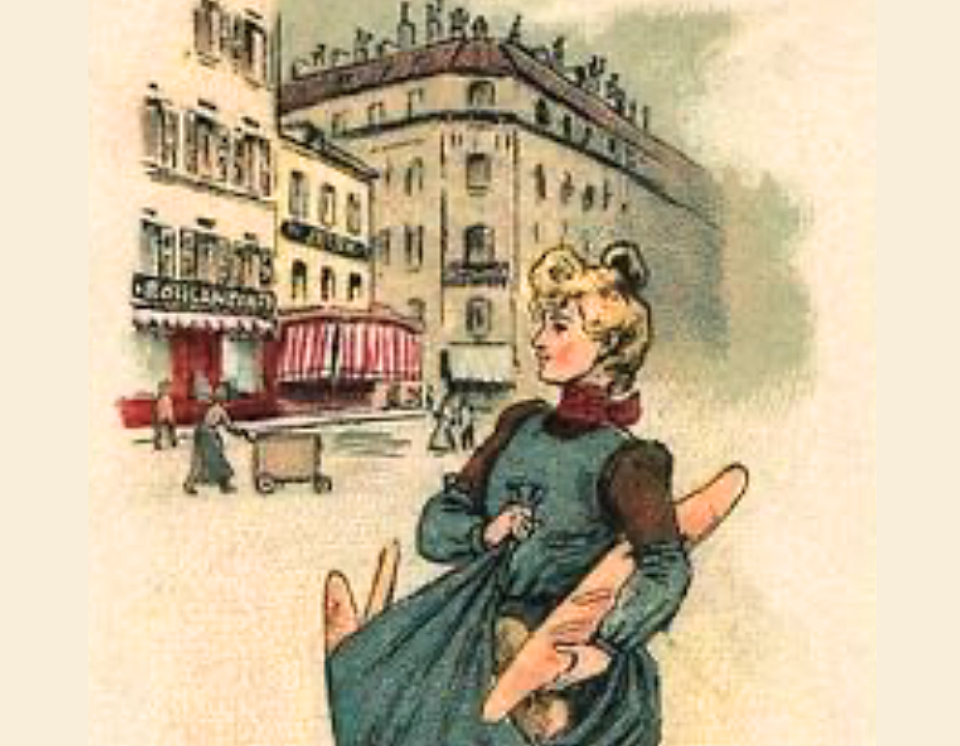

If you like bread, then when you’re in France you probably stop by the boulangerie, or bakery, every day to buy a baguette, croissant, or one of the other tempting treats that you will find inside. But if you were a bourgeois, or wealthy, family in the nineteenth or early twentieth century you wouldn’t need to. Your daily bread would be delivered before you even got out of bed. Oh, wouldn’t it be wonderful to wake up to a nice fresh croissant or pain au chocolat? Yum! …
But let’s get back to our story… The job of bread delivery usually fell to women who were called les porteuses de pain, which means bread delivery women (pain sounds like “pan” without pronouncing the “n” and has nothing to do with hurting). These ladies would start work about 5:00 in the morning – as soon as the bread came out of the oven. Some delivered the bread in baskets or wooden frames carried on their backs, while others carried the bread in their large specially designed aprons. The lucky ones worked for bakeries that provided pushcarts.
These hard-working women could have up to 300 clients and they had to memorize all of their addresses, their likes and dislikes, and the amount of bread they required. When they arrived at the client’s home they often had to climb to the top floors with aprons loaded with bread. Even though some of these buildings would have had elevators, they wouldn’t have been permitted to use them. Elevators were only for residents – servants and service people were required to take the stairs.
Since the French were (and still are) quite fond of their bread, the porteuse de pain performed a very important service. (I wouldn’t complain if one would show up at my door this morning.)


“La Porteuse de Pain” is also the title of a book written by Xavier de Mentépin. It started as a series in a newspaper in 1884 and tells the story of Jeanne Fortier, a young widow with two children who is wrongly accused of murder. She goes to prison for 20 years and later in her life she becomes a porteuse de pain, a bread delivery woman. Of course, she has many adventures along the way, trying to track down her children, searching for the real murderer, etc. This popular story has been adapted for theatre, inspired six films made between 1906 and 1963, and became a television series in 1973.

More about France – You can read more stories like this in my book Berets, Baguettes, and Beyond.
Follow Me on Social Media:


- Curious Birds of London: A Roundup of the City’s Favorite Feathered Locals – 23 July 2026
- Animal Symbols of Great Britain: Lion, Unicorn, and Dragon – 8 July 2026
- Curious History Review: July 2026 – 2 July 2026





COMMENT HERE: Can't wait to hear what you think… (email not required)