
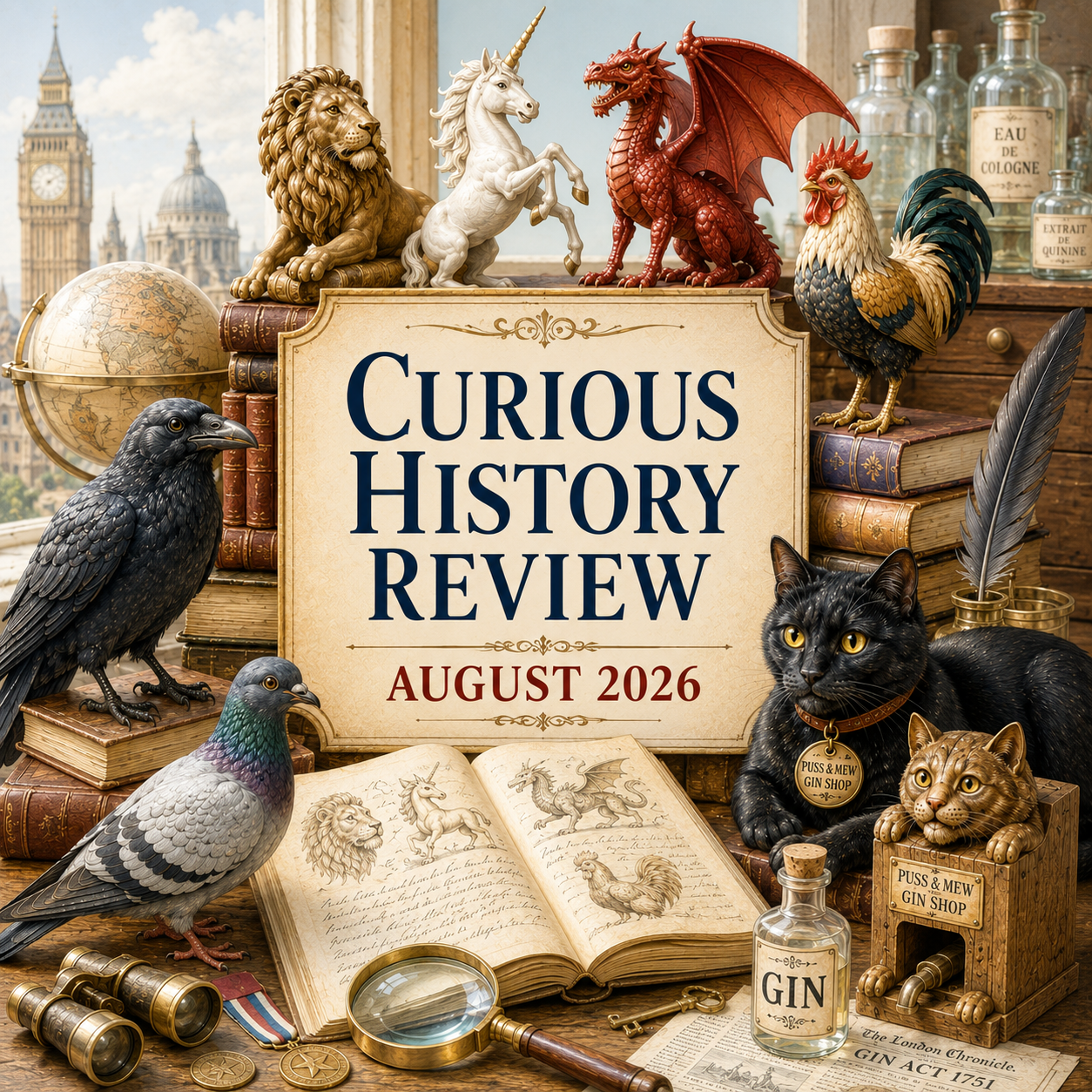
Fur, Feathers, and Fantastical Creatures
To follow the footprints of history is often to find paw prints, hoof prints, and feathers along the way.
History isn’t just about people and events, it’s also about animals – both real and mythical. This month, we’re focusing on our furry and feathered friends and some of their curious histories.
We’ll admire animals that represent countries and behold birds that caused an international incident and others that helped win wars. Then we’ll follow felines that ignored politics altogether and instead served drinks to thirsty folks who knew the password. They all have remarkable tales to tell.
Let’s begin with the animals that represent the countries of Great Britain: A lion, a unicorn, and a red dragon… Some very interesting choices!

Great Britain’s National Animal Symbols: Lion, Unicorn, and Dragon
Many countries choose national animals that actually live within their borders. Great Britain took a rather different approach…
Lions… unicorns… fire-breathing dragons? You won’t find any of these creatures roaming the British countryside!
These animal symbols are a fascinating mix of history, mythology, and royal propaganda. Discover how the English lion became a symbol of kings, why the Scots embraced the unicorn as a creature of purity and independence, and how an ancient Welsh legend gave rise to Wales’ famous red dragon.
👉🏼 Read the full story to discover the surprising rivalry between the lion and the unicorn, and decide which animal legend is your favorite. 👇
While Britain chose majestic and mythological animal symbols, France adopted the humble barnyard rooster. What’s that all about?

FROM THE ARCHIVES
Why is the Rooster the Symbol of France?
Why did France, a nation known for cathedrals, croissants, and couture, choose a familiar farmyard fowl as its symbol?
The answer began with a Roman joke – and ended with one of the country’s most pride-inducing emblems. Find out how a Latin play on words transformed the rooster into a symbol of courage, revolution, and national identity.
Along the way you’ll meet Julius Caesar, Napoleon, the French Revolution, and even Asterix and Obelix. Next time you spot a rooster on a French football jersey or hear a triumphant cry of cocorico! you’ll know the surprising story behind it. It’s a tale that’s far more curious than you might expect.
👉🏼 Learn why the French proudly adopted a symbol that began as an insult. 👇
🗓️ Curious History Calendar 🗓️
For your reading pleasure: Here are a few Curious Rambler articles for the month ahead:
| Aug 8 | International Cat Day – Cat Cafés & Why Cats Purr |
| Aug 9 | Book Lovers Day – Bookish Travel Down Literary Lanes |
| Aug 17 | Black Cat Appreciation Day – Kaspar, the Lucky Black Cat |
| Aug 26 | International Dog Day – A Dog Wedding |
| Aug 28 | Nice, France Liberation Day |
| Aug 30 | Frankenstein Day – Frankenstein in Bath, England |
| Sept 3 | Next issue of Curious History Review – First Thurs. of Sept. |
Leaving the French barnyard behind, let’s fly over to London and have a look at the rich variety of birds who call the city home. Some of them might surprise you.

Meet London’s Most Curious Birds
London’s birds are more than just familiar faces in the park. Some are protected by royal decree, some have saved lives on the battlefield, and others arrived under circumstances that remain a mystery.
Meet the pelicans that sparked an international diplomatic mishap, the noisy green parakeets whose origin is still hotly debated, the ravens said to protect the Crown, and the pigeons that became unlikely war heroes. Along the way, you’ll discover centuries of curious traditions, legends, and larger-than-life characters. After reading these stories, you’ll never look at London’s feathered residents in quite the same way again.
👉🏼 Read about how London’s birds have become some of the city’s most fascinating historical characters. Many have better stories than some famous Londoners. 👇
Now let’s “throw a cat among the pigeons.” But these felines weren’t worried about chasing birds, they had other jobs – in gin joints.

FROM THE ARCHIVES
When Cats Sold Gin in London
Imagine walking down a London street, dropping a coin into the mouth of a wooden cat, and filling your bottle with gin from beneath its paw.
It sounds bizarre, but during the eighteenth-century Gin Craze, this was a very real way to buy illegal alcohol. Discover how a clever entrepreneur exploited a legal loophole to create these feline “vending machines” which became known as Puss and Mew shops.
👉🏼 Read more and discover why people had to whisper a secret phrase to a wooden cat before they could buy a drink. 👇
That’s it for this month’s Curious History Review. I hope you found something here that sparked your curiosity.
Which story was your favorite? Or do you have a favorite historical animal that deserves its own article? I’d love to hear in the comments.
If you enjoy strange and lesser-known stories from history, make sure you’re subscribed – and feel free to share this with a friend who might enjoy it too.
See you next month for more curious histories!

- A Tragic Medieval Bedtime Story: The Chatelaine of Vergy – 18 September 2026
- Bath’s Jane Austen Festival: Books, Balls, and Bonnets – 5 September 2026
- Curious History Review: September 2026 – 3 September 2026




COMMENT HERE: Can't wait to hear what you think… (email not required)