
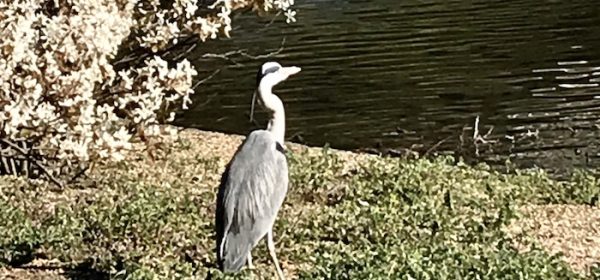

St. James’s Park is the place to go in London if you want to see lots of ducks, geese, swans, and other waterfowl. This oldest of the royal parks has long been home to many species of water-loving birds.
I visited the park the other day and saw so many unusual birds… I let my imagination run wild, and they seemed to be speaking to me. See the photos for what I thought the birds wanted to say. I’ve interspersed the photos in this short history of the park.

St. James’s Park
The area that makes up St. James’s Park has always been a wet place. In the thirteenth century, a tributary of the Tyburn river ran through it. At that time, it was the site of a leper hospital, and its name comes from that hospital’s patron saint, James the Lesser.

Henry VIII and a Marsh
King Henry VIII was the first royal to own the land. In 1532 he purchased it and used it to raise deer – deer hunting being one of his favorite sports. Nearby he built a hunting lodge which is now St James’s Palace.
James I – Birdcages and Zoo
Birds were introduced into the park in the seventeenth century when King James took an interest in the land. He drained a lot of it and created small ponds (called decoys) to lure in wild birds – which would usually end up on his dinner table.
He also he had an aviary built and filled it with exotic birds. The bird cages were lined along the street now known as Bird Cage Walk on the south side of the park. In addition King James kept a little zoo on the land which included a pair of crocodiles, an elephant, and five camels.

Charles II – More Birds and a Canal
Charles II made great changes to the park. During the English Civil War, when his father was dethroned and beheaded, Charles took refuge in France. Then when the monarchy was restored in 1660, he returned as king with images of great, French-style gardens dancing in his head.
Charles soon set about turning St. James’s into a pleasure park in the formal French style. He added a long, straight canal (2,800 feet long and 100 feet wide) with wide avenues of trees on each side. He entertained European royals and other important folks there, and he opened parts of it up to the public.

In the summer, the king would swim in his canal or, when he wanted to relax, he would ride in one of his Venetian gondolas which were gifts from the Doge of Venice. Then in the winter, he would turn his canal into an ice-skating rink.
Like James I before him, Charles II liked exotic birds and he expanded on the aviaries along Bird Cage Walk. In 1664 the Russian ambassador gave him a gift of pelicans, and the park has been home to a few pelicans ever since. Read about the pelicans here.

One of the most interesting St. James’s birds mentioned in historical records is a crane with a wooden leg. Apparently, the crane had run into some misfortune and lost one of his long legs. A soldier made him a new one out of wood. It was jointed and the crane walked around with it “as well as if it had been natural.”

George IV and John Nash
In 1761 the Royal Family, under George III bought the big house at the end of the park which is now Buckingham Palace. His son, who would later become George IV, set out to remodel the park in front of it.
He commissioned the famed architect, John Nash to carry out the changes. Nash gave the park the more naturalistic appearance that we see today. He turned the straight canal into a curving lake and the tree lined avenues became meandering paths. The Ornithological Society of London built the charming little birdkeeper cottage that still stands on Duck Island.

So, as we can see, St. James’s Park has always been filled with water and birds. It’s a wonderful place to enjoy nature in the heart of the city. When you have a chance, take a walk there (or in any park near you) and see what the birds might have to say to you.
What do you think? Let me know in the comments section below. And if you want to read more of my curious histories, subscribe to my blog (at the top or bottom of this page).


Follow Me on Social Media:


- Curious History Review: November 2026 – 5 November 2026
- Michelangelo’s Secret Room in Florence: A Hiding Place Beneath the Tombs – 5 November 2026
- Why Michelangelo Hung Mattresses from a Bell Tower – 26 October 2026



COMMENT HERE: Can’t wait to hear what you think… (email not required)